

About Mougins
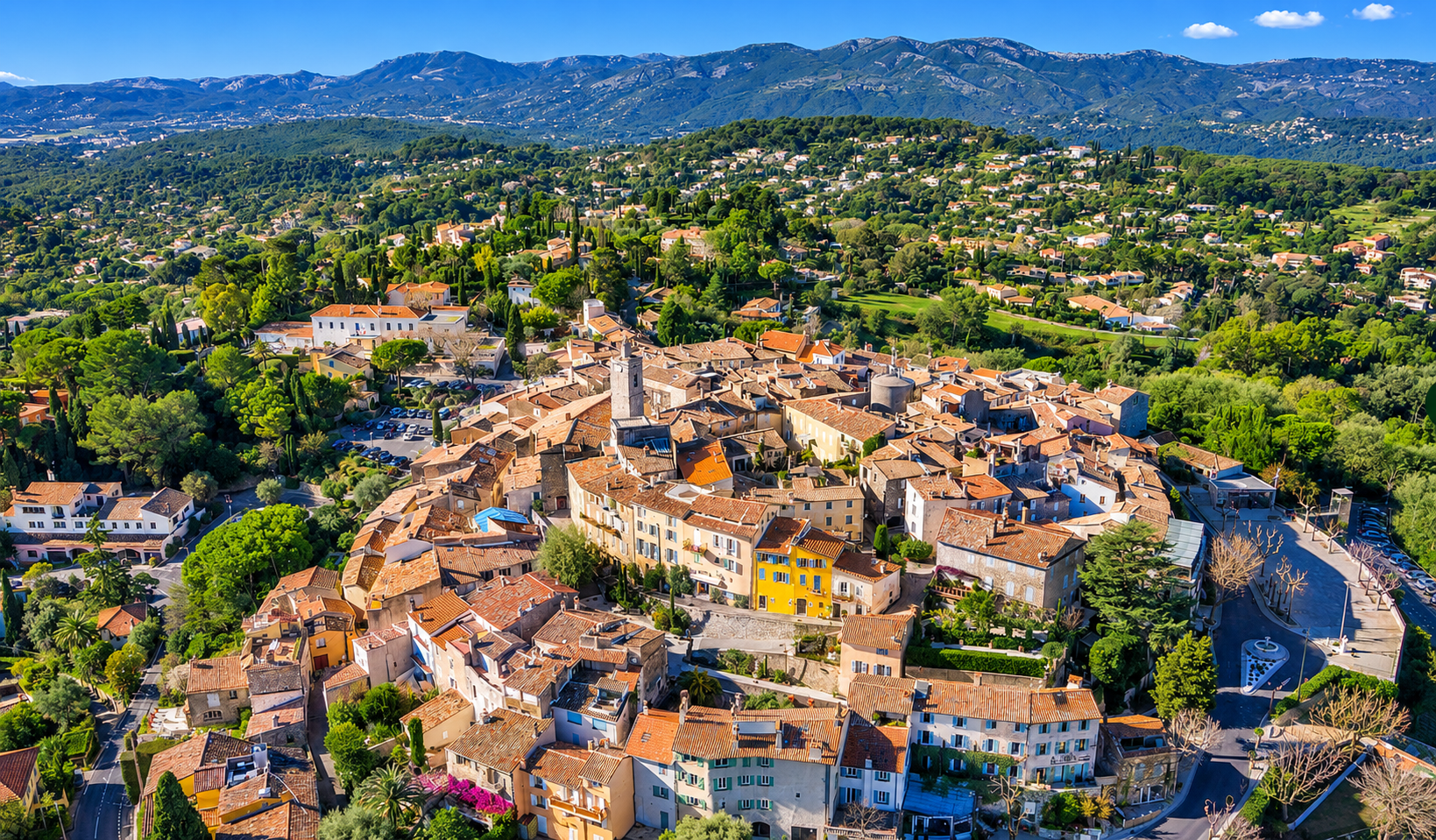
Mougins lies in the hills just north of Cannes, close enough to the coast to be part of everyday life there, but with a character of its own. The historic village occupies a small hilltop, its narrow streets winding between old stone houses, galleries and restaurants. From several points around the village there are views across the surrounding countryside towards Grasse, the Estérel mountains and, in places, the Mediterranean. Yet the old centre represents only a small part of Mougins. Most of the commune consists of residential neighbourhoods, wooded hills and established villa estates, making it one of the most sought-after places to live in the Cannes area.
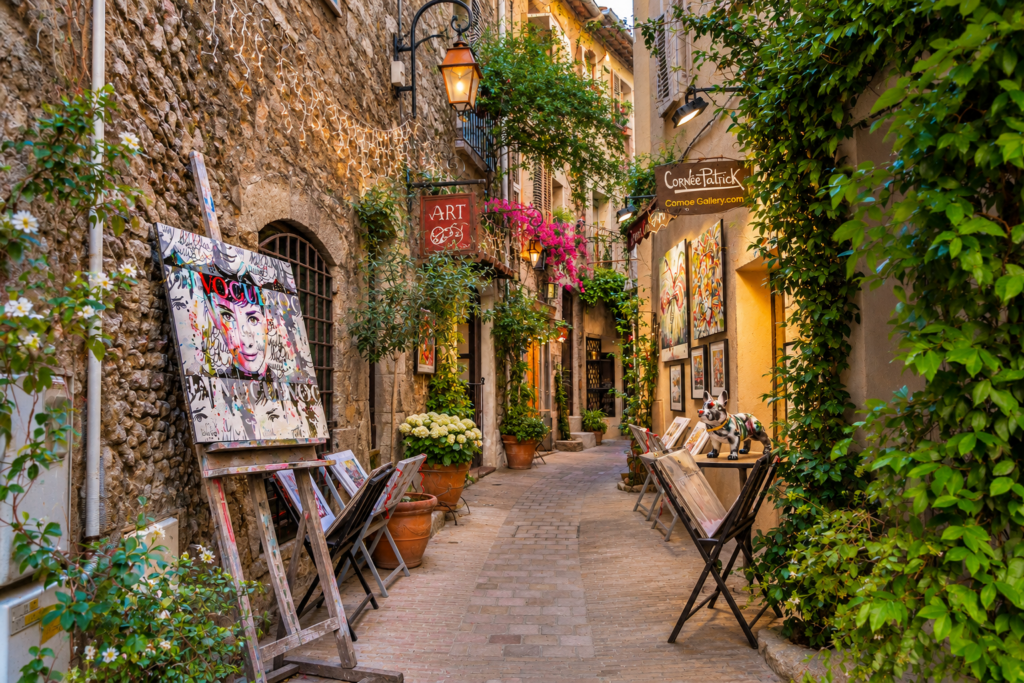
The historic centre is certainly worth visiting. Its streets curve around the hill in a pattern that has changed relatively little over the centuries, with small squares, vaulted passages and carefully restored buildings. Art galleries and restaurants occupy many of the former village houses, reflecting the reputation Mougins developed during the twentieth century. It is an attractive place to wander, particularly in the evening when the restaurants are open and the day visitors have largely gone. Unlike Valbonne, however, the old village is not really the centre of everyday shopping and services. Much of that activity takes place in the residential and commercial areas below.
Mougins has a particularly strong association with art. Pablo Picasso spent the final twelve years of his life here, living at Notre-Dame-de-Vie from 1961 until his death in 1973. His presence reinforced a connection with artists that had begun much earlier, when figures such as Francis Picabia, Fernand Léger and Jean Cocteau were drawn to the village and its surroundings. That artistic history is still visible in the galleries and cultural institutions, although Mougins today is also a substantial residential commune with a population far larger than the old village might suggest.
Food has played an equally important role in its reputation. For many years Mougins was closely associated with the chef Roger Vergé, whose restaurant Le Moulin de Mougins helped establish the village as a gastronomic destination. Other well-known chefs followed, and the village became particularly popular for long lunches and special evenings out. The restaurant scene has changed over time, but gastronomy remains part of the identity of Mougins, alongside its art galleries and historic architecture.
For people considering a home here, however, the main attraction is often found beyond the village itself. Mougins has an extensive villa market, ranging from traditional Provençal houses in established gardens to large contemporary properties with swimming pools and substantial grounds. Some neighbourhoods are particularly private, with mature trees and generous distances between houses, while others offer smaller plots and a more conventional residential setting. Certain elevated locations have views towards the Bay of Cannes or the Estérel, although many buyers are just as interested in privacy, garden space and the quality of the immediate surroundings.
The commune also has a strong international character. Its proximity to Cannes, Sophia Antipolis and the international schools in the area has attracted families and professionals from many countries. The Mougins School, for example, has long been part of the local international education landscape. For families who want to live in France while maintaining access to international education and employment, Mougins can be a particularly practical choice.
Everyday life is generally organised around the car. The historic village is compact and easily explored on foot, but the residential neighbourhoods are spread over a considerable area, and many properties are too far from shops and schools to make walking realistic. There are supermarkets, local shopping areas, sports facilities and medical services throughout the commune, although their convenience depends very much on where you live. The A8 motorway is nearby, and Cannes, Mouans-Sartoux, Valbonne and Sophia Antipolis are all accessible, but traffic on the main roads can be heavy during commuting hours and in summer.
One of the advantages of Mougins is the amount of greenery that has survived despite its proximity to the densely developed coastline. The Valmasque forest lies along the eastern side of the commune, with walking paths and woodland that provide a welcome contrast to the busy roads around Cannes. Many residential areas also have mature gardens, tall pines and substantial vegetation, giving parts of Mougins a remarkably secluded atmosphere. The climate is Mediterranean, with warm summers and generally mild winters, although properties in shaded or elevated locations can feel noticeably cooler than those closer to the sea.
Mougins is particularly appealing to buyers who want the space and privacy of a villa without moving too far inland. Cannes and its beaches are relatively close, Nice Airport is within reach, and the surrounding area offers a wide choice of schools, restaurants and services. The main consideration is the precise location. A house near the old village, a villa in a private estate and a property close to the roads towards Sophia Antipolis can offer very different experiences, even though they all have a Mougins address.
For anyone who enjoys the cultural life of the Côte d’Azur but prefers to return home to a garden rather than a busy seafront, Mougins is an attractive possibility. Its artistic and gastronomic history gives the village a distinctive identity, while the surrounding residential areas offer the space and privacy that are increasingly difficult to find along the coast.

Neigbourhoods
Mougins covers a much larger area than its historic hilltop village might suggest. The commune stretches from the wooded residential hills above Cannes towards Mouans-Sartoux and the outskirts of Sophia Antipolis, with considerable differences in landscape, architecture and everyday life. Some neighbourhoods are dominated by substantial villas in private estates, while others have a mixture of family houses, apartments, shops and local services. Understanding these differences is particularly important in Mougins, where two properties only a few kilometres apart can offer entirely different living environments.
Mougins Village
The historic hilltop
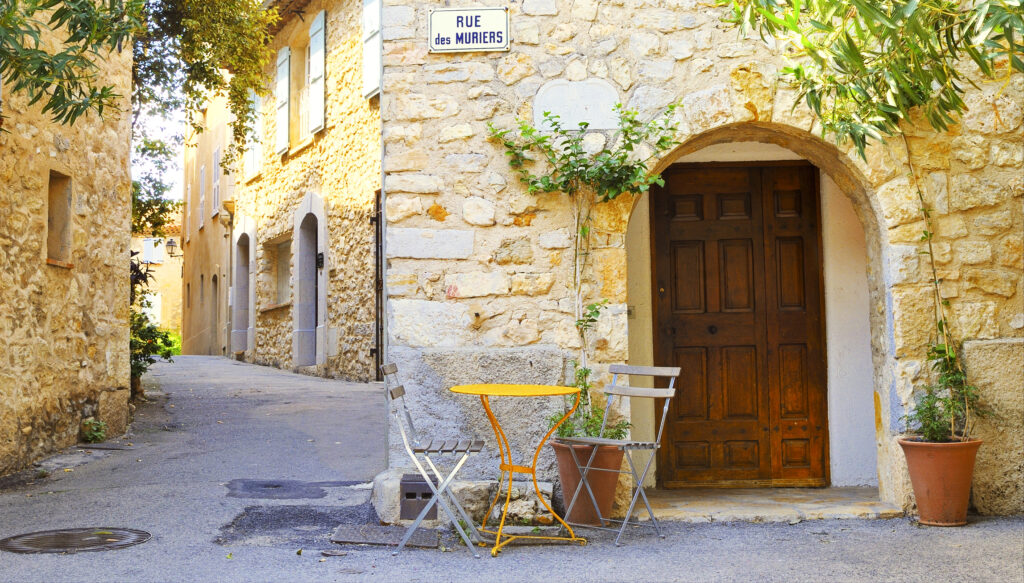
The old village occupies the hilltop at the centre of Mougins, with narrow streets winding around a small historic core. Stone houses, galleries, restaurants and carefully restored façades give it a distinctive atmosphere, and several viewpoints look out across the surrounding countryside towards the coast and the hills around Grasse.
Living in the village itself is quite different from living in the surrounding villa neighbourhoods. Properties are mainly traditional village houses and apartments, often with several floors, original architectural features and irregular layouts. Some have terraces with beautiful views, although private gardens and swimming pools are uncommon within the historic centre.
The village is particularly lively during the tourist season, when visitors come for the galleries, restaurants and atmosphere. Outside those periods it is quieter, but the number of everyday shops and services is limited. Residents generally drive down to the surrounding commercial areas for groceries and other necessities.
Parking and access are important considerations. Much of the historic centre is pedestrianised, and older properties may have steep staircases or limited natural light. For buyers who enjoy historic architecture, restaurants and village atmosphere, these compromises may be perfectly acceptable, but Mougins Village is not necessarily the most practical part of the commune for a family home.
Notre-Dame-de-Vie
Established villas and artistic history
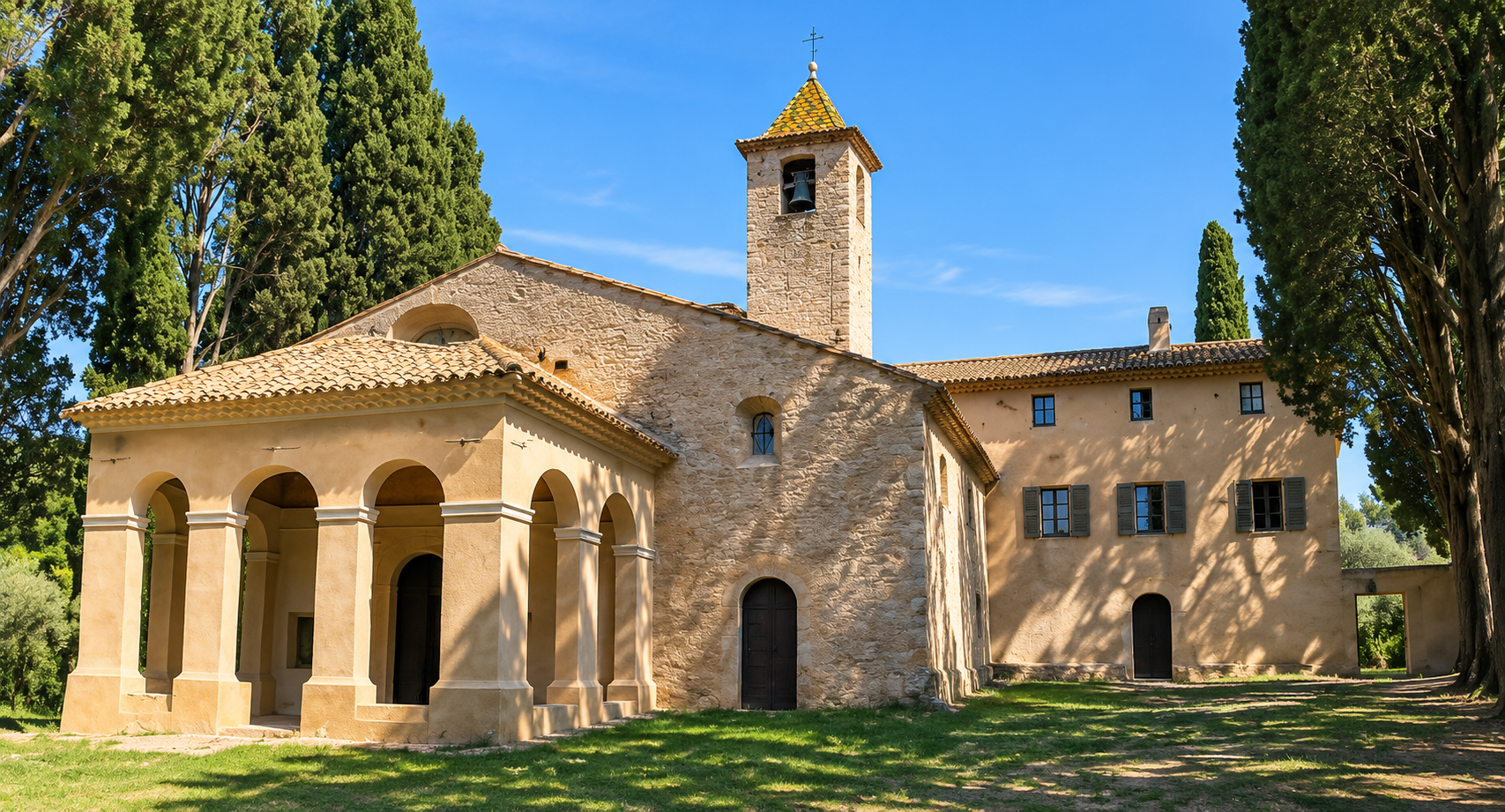
The area around Notre-Dame-de-Vie, south of the historic village, is one of the best-known residential parts of Mougins. It takes its name from the small chapel surrounded by olive trees, close to the property where Pablo Picasso spent the final years of his life.
The neighbourhood has long attracted buyers looking for privacy, mature gardens and substantial villas. Properties are generally set along quiet residential roads, often behind gates and surrounded by established vegetation. Traditional Provençal houses stand alongside more contemporary villas, some of which have been extensively renovated or rebuilt over the years.
The setting is particularly attractive because of its greenery and proximity to the old village. Depending on the precise location, residents can reach the restaurants and galleries of Mougins Village relatively easily, while Cannes and the main roads towards the coast are also accessible.
Not every property has an open view, however. Mature trees and neighbouring gardens provide privacy but can also create shade, and the orientation of a house can make a considerable difference to the amount of sunlight it receives. The neighbourhood’s reputation is reflected in property values, particularly for larger villas on attractive plots.
Les Parcs de Mougins
Privacy and substantial properties
Les Parcs de Mougins is one of the most prestigious residential estates in the commune. This gated domain is known for its large villas, extensive grounds and controlled access, attracting buyers who place a particularly high value on privacy and security.
The properties are generally substantial, with landscaped gardens, swimming pools and generous distances between neighbouring houses. Architecture varies from traditional Provençal villas to contemporary homes, although the overall character is residential rather than resort-like.
The estate is particularly appealing to international buyers looking for a private family residence or second home within reach of Cannes, Nice Airport and Sophia Antipolis. Its wooded setting provides a sense of separation from the surrounding urban areas, even though the main roads and services are not far away.
Buying in a private domain also means understanding its rules and running costs. Security, maintenance of communal areas and any restrictions imposed by the estate’s governing documents should be examined carefully. These arrangements can be part of the attraction, but they also create obligations that differ from owning a villa outside a managed estate.
Saint-Basile
The Saint-Basile area and the surrounding hills offer a mixture of established villa neighbourhoods, with wooded plots and a generally quiet residential atmosphere. The landscape is less formal than in some of the large private estates, and houses vary considerably in age, size and architectural style.
There are traditional villas built during the period when Mougins expanded as a residential commune, as well as more recent houses and extensively renovated properties. Some are set on relatively modest plots, while others have larger gardens with mature trees and swimming pools.
This part of Mougins appeals particularly to families who want a detached house in a green environment without necessarily paying the premium associated with the best-known private estates. Depending on the location, access towards Cannes, the A8 and the international schools can be convenient.
As elsewhere in Mougins, the exact road matters. Some residential streets are exceptionally peaceful, while properties closer to the main routes may experience traffic noise. The amount of sunshine, privacy and usable garden space can also vary significantly between neighbouring plots.
Tournamy
The practical centre of modern Mougins
Tournamy offers a rather different environment from the historic village and the villa estates. It is one of the more practical residential and commercial areas of Mougins, with apartment buildings, shops, supermarkets and services concentrated around the main roads.
For permanent residents, this can be a considerable advantage. Everyday shopping is close at hand, and the location provides relatively straightforward access to Cannes, Mouans-Sartoux and the surrounding communes. Apartments are more common here than in the wooded villa neighbourhoods, often with terraces, parking and more conventional layouts.
The atmosphere is more urban and functional than in the old village, and traffic can be noticeable along the principal roads. Nevertheless, Tournamy is worth considering for buyers who prefer convenience and modern accommodation to a large garden or a secluded setting.
It is also a useful reminder that Mougins is not exclusively a luxury villa market. The commune has a substantial permanent population, and neighbourhoods such as Tournamy provide the housing and services needed for everyday life.
Mougins-le-Haut
Apartments beside the Valmasque forest
Mougins-le-Haut lies on the eastern side of the commune, close to the Valmasque forest and the Sophia Antipolis area. It was developed as a planned residential neighbourhood, with apartment buildings, landscaped grounds and local facilities rather than the individual villas that dominate many other parts of Mougins.
The setting is relatively green, and some residences have views across the surrounding woodland. Apartments often offer terraces or balconies, while communal gardens, parking and, in certain developments, swimming pools provide facilities that can be particularly attractive for families or second-home owners.
The proximity to Sophia Antipolis makes Mougins-le-Haut practical for people working in the technology park, while access to Antibes and the A8 is also relatively convenient. The historic village of Mougins is further away, however, and the neighbourhood has its own identity rather than functioning as an extension of the old centre.
For buyers considering an apartment here, the condition and management of the residence are particularly important. Communal facilities, maintenance charges and planned building works can have a significant influence on the overall cost of ownership.
Pibonson
On the southern side of Mougins, the residential hills descend towards Cannes and Le Cannet. Areas such as Pibonson are particularly interesting for buyers who want a villa while remaining relatively close to the coast.
The landscape consists of established residential roads, individual houses and gardens, with occasional open views towards the Bay of Cannes or the Estérel. Properties vary from older Provençal villas to contemporary homes, and the quality of the setting depends considerably on elevation, orientation and neighbouring development.
The main advantage is the proximity to Cannes. For people who regularly use the beaches, restaurants, shops or cultural facilities of the coastal town, this side of Mougins can be more convenient than the northern or eastern parts of the commune.
The trade-off is that the roads towards Cannes and Le Cannet can become busy, particularly during commuting hours and the summer season. Buyers should also look carefully at the immediate surroundings, as a property may enjoy a quiet garden while being only a short distance from a heavily used road.
The western side
Towards Mouans-Sartoux, Mougins gradually becomes less closely connected to Cannes and more oriented towards the residential countryside between the two communes. The housing is varied, with detached villas, smaller residential developments and properties set among mature gardens.
This part of Mougins can be attractive to families looking for a quieter environment while remaining close to schools, supermarkets and the services of Mouans-Sartoux. The railway station in Mouans-Sartoux is also useful for some journeys, although reaching it generally requires a car.
The landscape is often greener and less densely developed than the southern approaches to Cannes, but there are considerable differences between individual roads. Some properties feel pleasantly rural, while others are close to commercial areas or important traffic routes.
As with Valbonne, it is worth checking the commune boundaries carefully. Houses marketed as being in the Mougins area may actually be in Mouans-Sartoux, Le Cannet or neighbouring communes, where planning regulations, local taxes and school arrangements can differ.
For buyers, the most useful distinction is between the historic village, the established villa neighbourhoods and the more practical residential areas. Mougins offers all three, but the experience of living in each is quite different. A villa in Les Parcs de Mougins, an apartment in Mougins-le-Haut and a village house near the old square may share the same postal address, yet have very little else in common.
Property in Mougins
The property market in Mougins is one of the most established in the hills behind Cannes. Its reputation is closely associated with substantial villas, private estates and beautifully landscaped gardens, although the commune offers a much wider variety of housing than its most expensive properties might suggest. There are traditional village houses, modern apartments, family villas and large private residences, with considerable differences in price and character depending on the neighbourhood.
For many international buyers, Mougins offers an attractive alternative to living directly on the coast. Cannes is close enough for regular visits, while the residential hills provide more space, greenery and privacy than most central coastal locations. A swimming pool, generous terraces and a substantial garden are common features of the villa market, and some elevated properties have views towards the Bay of Cannes or the Estérel mountains.
However, sea views are not necessarily the main reason people buy here. Many of the most desirable properties are valued for their grounds, peaceful surroundings and the privacy they offer.
The historic village has a relatively small property market of its own. Apartments and traditional maisons de village occupy the old buildings around the narrow streets, sometimes with original stonework, exposed beams and terraces overlooking the surrounding countryside. Renovated properties can be particularly attractive, but the limitations of historic buildings should not be underestimated. Parking is often difficult, access may involve stairs and private gardens are rare. The village is also a popular destination for restaurants and visitors, so the atmosphere can be lively during summer evenings.
The largest part of the market consists of detached villas in the surrounding residential neighbourhoods. Many were built during the second half of the twentieth century, when Mougins developed rapidly as a desirable residential area for people working in Cannes and the wider region. These houses often occupy established plots with mature trees and gardens that have developed over several decades. Some have been carefully modernised, while others retain their original layouts, bathrooms, kitchens and technical installations.
Renovation is therefore an important consideration. A villa from the 1970s or 1980s may offer generous rooms, a good plot and an excellent location, but updating it to contemporary standards can involve substantial work. Insulation, heating and cooling systems, windows, electrical installations and the condition of the roof all deserve attention. Buyers planning major alterations should also examine the applicable planning regulations before assuming that an extension, additional building or substantial redesign will be possible.
At the upper end of the market, Mougins has a number of prestigious private estates, including Les Parcs de Mougins. These attract buyers looking for large properties, controlled access and a particularly private residential environment. Villas can occupy extensive landscaped grounds, with swimming pools, guest accommodation and substantial outdoor living areas. The architectural styles vary considerably, from traditional Provençal houses to contemporary designs.
Properties in private domains come with additional considerations. Security arrangements, maintenance of shared facilities, annual charges and the rules governing the estate should all be examined. Depending on the legal structure, restrictions may apply to building works, alterations to the exterior or the use of a property. These arrangements can help preserve the character of a neighbourhood, but buyers should understand them before purchasing.
Mougins also has an important apartment market, particularly in areas such as Tournamy and Mougins-le-Haut. These neighbourhoods offer a more practical alternative to villa ownership, with modern layouts, terraces, parking and, in some residences, communal swimming pools or landscaped gardens. They can be attractive for permanent residents, smaller households and buyers looking for a second home that requires less maintenance. As with any apartment in a French copropriété, the condition of the building, service charges and planned works are important parts of the purchase decision.
The setting of a property deserves particular attention in Mougins. Mature pine trees, oaks and extensive gardens are part of the area’s appeal, but they can also affect the amount of sunlight a house receives, especially in winter. A south-facing terrace may be shaded for much of the day by tall trees, while a neighbouring property on higher ground can influence privacy. It is worth visiting at different times rather than relying entirely on photographs taken in summer.
The terrain also varies considerably. Although Mougins is generally less dramatic than the steep coastal hills around Nice and Monaco, many villas are built on sloping land. A large plot does not always mean a large usable garden, and retaining walls, drainage and access arrangements should be examined carefully. In wooded areas, vegetation maintenance and the applicable wildfire-prevention requirements are additional considerations.
Location within the commune can have a significant influence on everyday convenience. Properties on the southern side of Mougins may offer relatively easy access to Cannes and Le Cannet, while those towards Mougins-le-Haut and the eastern side can be better positioned for Sophia Antipolis. The western neighbourhoods are often convenient for Mouans-Sartoux and the roads towards Grasse. These differences are worth considering before focusing on a particular house, especially for families with school commitments or regular commuting journeys.
Traffic and road noise also vary more than buyers sometimes expect. Mougins is crossed by several important routes connecting Cannes with the inland communes, and the A8 motorway passes close to parts of the residential area. A villa may have a peaceful garden despite being near a busy road, while another property only a short distance away may experience considerably more noise. The immediate surroundings are therefore just as important as the general reputation of the neighbourhood.
For families, access to education is often one of the reasons for choosing Mougins. The presence of international schools in and around the commune has contributed to its popularity with families relocating from abroad. However, school journeys can become time-consuming during the morning rush hour, and a house that appears conveniently located on a map may involve a less straightforward daily drive.
One final point is worth keeping in mind when comparing properties. Mougins is a well-known name in the international property market, and houses in neighbouring Le Cannet, Mouans-Sartoux or Valbonne are sometimes advertised as being in the wider Mougins area. These locations may offer excellent alternatives, but they are not interchangeable. Commune boundaries can affect planning regulations, property taxes and practical matters such as school arrangements.
To Do
Mougins has long been associated with art and gastronomy, and both remain important reasons to visit. The historic village is small enough to explore comfortably on foot, with galleries, restaurants and viewpoints tucked between its winding streets. Beyond the old centre, the commune also has some excellent cultural attractions and extensive woodland, making it possible to combine a morning in the village with an afternoon spent discovering something quite different.
the old village
The historic centre of Mougins occupies a hilltop overlooking the countryside north of Cannes. Its narrow streets follow the contours of the hill, passing between old stone houses, small squares and beautifully restored façades. Unlike Valbonne, with its regular street plan, Mougins developed around a series of curved lanes and passages, making it easy to lose your sense of direction for a few minutes.
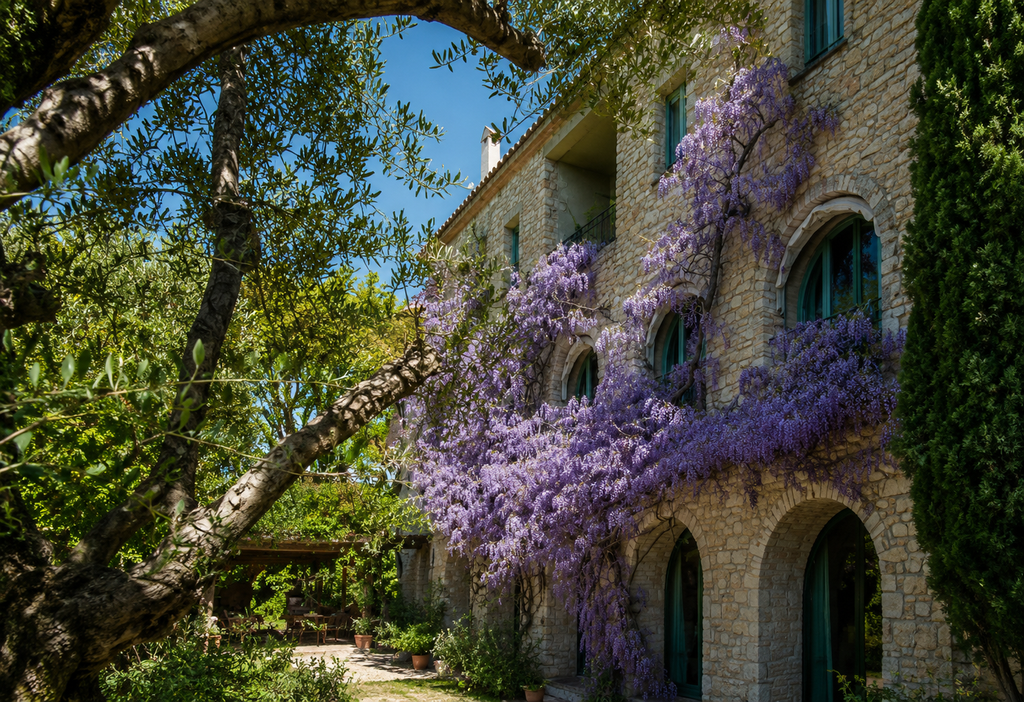
The Place du Commandant Lamy is a good starting point, with its fountain, restaurants and surrounding buildings. From here, the streets lead past galleries, boutiques and old village houses, some with flowering plants climbing across their façades. Several viewpoints offer glimpses of the surrounding hills, while the western side of the village opens towards Grasse and the Estérel.
The village is particularly pleasant in the late afternoon and evening, when the light softens and the restaurants begin preparing for dinner. Although Mougins attracts plenty of visitors, its small scale makes it easy to explore without a particular itinerary.
FAMM
Femmes Artistes du Musée de Mougins
The Musée d’Art Classique de Mougins, commonly known as MACM, opened in 2011 and brought an unusual private collection to the heart of the village. Ancient Egyptian, Greek and Roman works were displayed alongside paintings and sculptures by modern artists, including Picasso, Matisse and Chagall, creating connections between classical antiquity and twentieth-century art.
The museum’s original collection closed to the public in 2023, and the building subsequently took on a new role as FAMM – Femmes Artistes du Musée de Mougins, which opened in 2024 and is dedicated entirely to women artists.
FAMM brings together works by influential female artists, including Frida Kahlo, Berthe Morisot, Joan Mitchell, Lee Krasner and Louise Bourgeois. Spanning different generations and artistic movements, the collection offers a fascinating perspective on women who made important contributions to art history but have not always received the same recognition as their male contemporaries.
Its location in the historic village makes it easy to combine a museum visit with a walk through the surrounding streets, galleries and restaurants.
Picasso’s Mougins
Pablo Picasso spent the final twelve years of his life in Mougins, living at the villa Notre-Dame-de-Vie from 1961 until his death in 1973. The property itself is private, but the nearby chapel of Notre-Dame-de-Vie can be visited from the outside and provides a sense of the landscape that surrounded him during those years.
The small chapel stands among olive trees, with a simple stone façade and a peaceful setting that feels quite removed from the busy coastal towns. Picasso’s presence in Mougins is often associated with his final period of extraordinary artistic productivity, during which he continued painting, drawing and working with remarkable intensity.
His connection with the village is part of a wider artistic history. Francis Picabia, Fernand Léger and Jean Cocteau were among the artists associated with Mougins during the twentieth century, helping establish its reputation as a place where artists could work and socialise away from Paris.
For anyone interested in Picasso, the chapel and its surroundings are worth seeing, although it is important to remember that the villa where he lived is not a public museum.
Read here more about Picasso on the Côte d’Azur.
Centre de la Photographie
The Centre de la Photographie de Mougins is a contemporary photography centre in the historic village, housed in a renovated building that provides an interesting contrast with the surrounding Provençal architecture.
Its exhibitions focus on contemporary photography, often presenting work by international artists and exploring subjects that extend well beyond the Côte d’Azur. The programme changes regularly, making it worth checking what is on during a visit.
The centre adds another dimension to Mougins’ cultural life. While the village’s artistic reputation is often associated with Picasso and the painters of the twentieth century, the photography centre demonstrates that its connection with the arts is not limited to the past.
restaurants of Mougins
Mougins has been a gastronomic destination for decades, largely thanks to the influence of Roger Vergé, who established Le Moulin de Mougins in 1969. His cooking helped popularise the cuisine du soleil, a style inspired by Mediterranean ingredients, olive oil, vegetables and the flavours of Provence.
The restaurant attracted an international clientele and helped turn Mougins into a destination for people who were as interested in food as in the village itself. Other chefs and restaurants followed, strengthening its reputation as one of the gastronomic centres of the Côte d’Azur.
Today, the restaurant scene is more varied, with everything from traditional Provençal cooking to contemporary French cuisine. The old village is particularly enjoyable for lunch or dinner, with terraces overlooking small squares and streets that become especially atmospheric in the evening.
Mougins has also hosted Les Étoiles de Mougins, a gastronomic festival bringing together chefs, demonstrations and culinary events. The festival has contributed to the village’s culinary reputation, although dates and programmes vary from year to year.
Valmasque forest
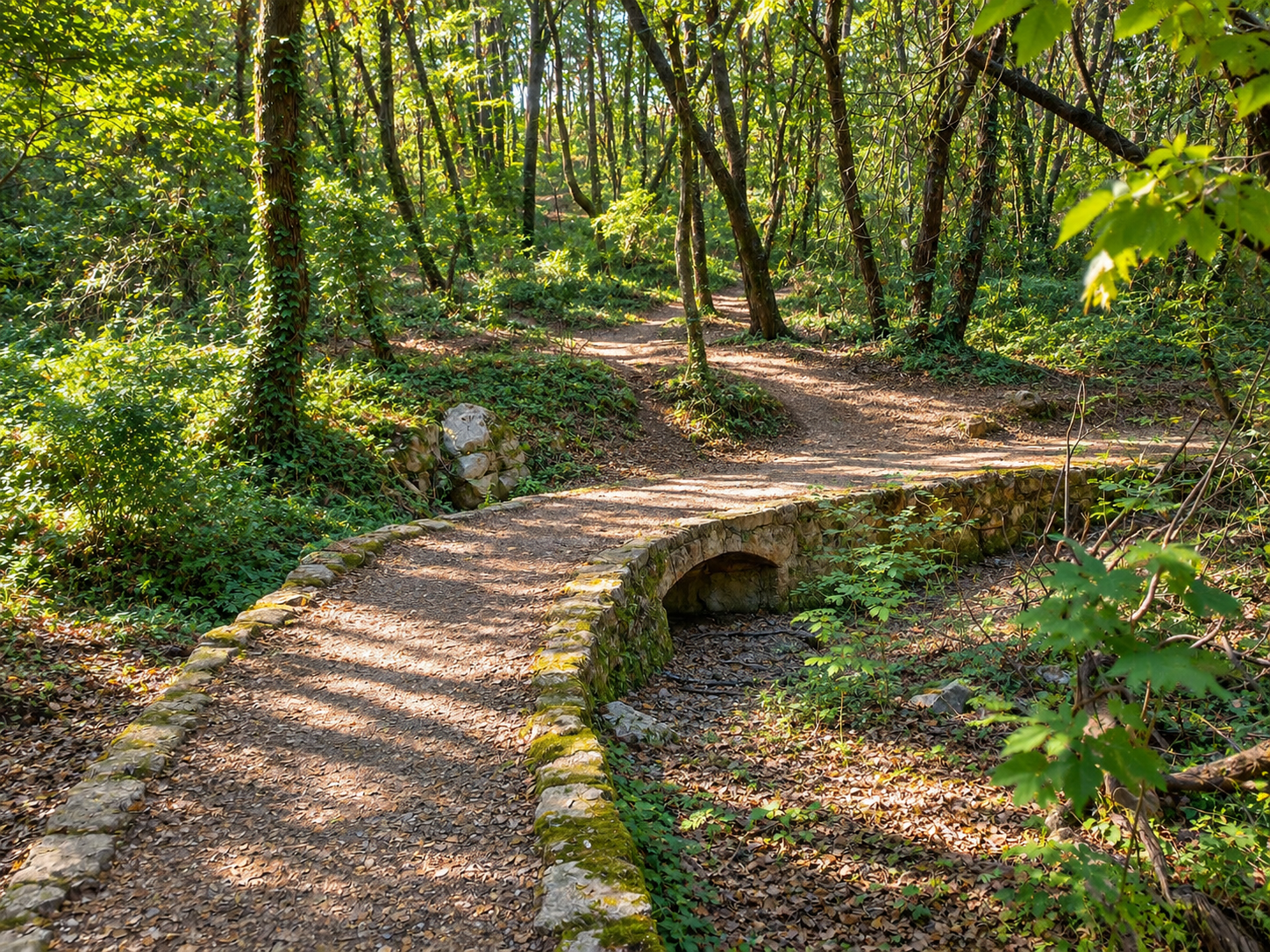
The Parc de la Valmasque is one of the most attractive natural areas between Mougins and Sophia Antipolis. Its extensive woodland includes pine and oak forests, walking paths and open areas that provide a welcome change from the developed coastline.
The park is particularly popular with walkers, runners and families, with routes of varying lengths through the forest. Much of the terrain is relatively gentle, making it accessible without the steep climbs associated with some of the higher villages along the Côte d’Azur.
One of the most interesting places to visit is the Étang de Fontmerle, a pond known for its remarkable collection of lotus plants. During the flowering season, generally in summer, the surface of the water becomes covered with large green leaves and pink flowers. It is an unexpected sight in the south of France and particularly attractive for photography.
The surrounding woodland is pleasant throughout much of the year, although access restrictions may apply during periods of high wildfire risk in summer.
Royal Mougins Golf Resort
Royal Mougins Golf Resort is one of the best-known golf destinations on the Côte d’Azur. Set in a wooded valley southwest of the historic village, the 18-hole championship course was designed by American golf architect Robert von Hagge and opened in 1993. Its fairways follow the natural contours of the landscape, with water hazards, changes in elevation and views across the surrounding hills.
The course is known for its challenging layout and peaceful setting, with much of the playing area surrounded by Mediterranean vegetation. Unlike some coastal golf courses, Royal Mougins has a secluded atmosphere, despite being only a short drive from Cannes.
The resort also has a clubhouse, restaurant, suites and spa facilities, making it a destination for visitors who want to combine golf with a longer stay. Access to the course is subject to the club’s playing and visitor arrangements, so advance reservations are advisable.
For golf enthusiasts, Royal Mougins is an important part of the area’s appeal, alongside other courses in the Cannes and Grasse hinterland.
Musée Bonnard
Just south of Mougins, Le Cannet has an important connection with the painter Pierre Bonnard, who spent many years in the area and found inspiration in the Mediterranean light, gardens and domestic interiors around his home.
The Musée Bonnard, opened in 2011, is dedicated to his work and regularly presents exhibitions exploring his painting and the wider artistic movements of his time. The museum is housed in a restored early twentieth-century building and is an interesting destination for anyone who enjoys the artistic history of the Côte d’Azur.
It also makes a natural addition to a visit to Mougins. The two places are close together, and their artistic histories reflect the attraction this part of the Riviera held for painters during the twentieth century.
Facts
Department: Alpes-Maritimes (06)
Region: Provence-Alpes-Côte d’Azur
Population: Approximately 19,000 inhabitants
Area: 25.64 km²
Altitude: Approximately 30–270 metres above sea level
Location: In the hills north of Cannes, between Le Cannet, Mouans-Sartoux and Valbonne
Distance to Cannes: Approximately 7 km
Distance to Antibes: Approximately 15 km
Distance to Nice Côte d’Azur Airport: Approximately 25 km
Access: Close to the A8 motorway, with road connections to Cannes, Grasse and Sophia Antipolis
Train station: No railway station in Mougins; nearby stations include Cannes and Mouans-Sartoux
Historic centre: Medieval hilltop village with narrow, winding streets, art galleries and restaurants
Museums: FAMM – Femmes Artistes du Musée de Mougins and the Centre de la Photographie de Mougins
Famous resident: Pablo Picasso, who lived at Notre-Dame-de-Vie from 1961 until his death in 1973
Golf: Royal Mougins Golf Resort, an 18-hole championship course designed by Robert von Hagge
Nature: Parc de la Valmasque and Étang de Fontmerle, known for its lotus flowers
Education: International schooling, including Mougins School
Property: Historic village houses, apartments, Provençal villas, contemporary homes and prestigious gated estates
Climate: Mediterranean, with warm, dry summers and generally mild winters
History
The history of Mougins begins long before the village became associated with artists, celebrated chefs and elegant villas. Its position on a hill overlooking the countryside north of Cannes made it a natural place for settlement, with fertile land, woodland and routes connecting the coast to the interior. Archaeological discoveries in the surrounding area point to human activity during antiquity, when this part of Provence was inhabited by Ligurian communities and later came under Roman influence.
The name Mougins is generally associated with the Latin Mons, meaning mountain or hill, although its precise linguistic origins remain uncertain. By the Middle Ages, a fortified settlement had developed on the hilltop, taking advantage of its elevated position and the protection offered by the surrounding walls. The circular arrangement of the old village, still recognisable today, reflects this medieval development.
An important moment came in 1056, when the Counts of Antibes donated Mougins to the Abbey of Lérins, the powerful Benedictine monastery on the islands off Cannes. The monks retained considerable influence over the village for centuries, collecting revenues from the surrounding agricultural land and playing an important role in its administration. Mougins was part of a wider network of villages and estates controlled by religious institutions, whose economic importance extended well beyond their monasteries.
Life in medieval Mougins was not always peaceful. The village suffered during the conflicts that repeatedly affected Provence, particularly in the late Middle Ages and the sixteenth century. Its defensive walls offered some protection, but the surrounding countryside remained vulnerable to military campaigns and raids. Over time, as the region became more stable, the village gradually expanded beyond its original fortifications, although the historic centre retained its compact layout.
For much of its history, Mougins was an agricultural community. Olive trees, vines and cereals were cultivated on the surrounding hills, while flowers and other crops contributed to the rural economy. The village maintained close connections with Grasse, where perfume production became increasingly important, and with Cannes, which remained a relatively modest coastal settlement until the nineteenth century.
The transformation of Cannes into an international resort gradually changed the fortunes of the surrounding villages. From the mid-nineteenth century onwards, the arrival of wealthy European visitors brought new investment to the coastline, while improved roads made the hills behind Cannes more accessible. Mougins remained predominantly agricultural for some time, but its landscape, climate and proximity to the sea increasingly attracted people looking for a quieter place to live.
Its artistic reputation began to develop during the early twentieth century. In the 1920s and 1930s, artists and writers who frequented the Riviera discovered Mougins as an alternative to the increasingly fashionable coastal resorts. Francis Picabia was among the important figures associated with the village, while Fernand Léger, Jean Cocteau and other members of the artistic community also spent time in the area. Their presence helped establish Mougins as a place where creative life could flourish away from the larger cities.
Picasso first became familiar with Mougins during this period. In 1936, he stayed at the Hôtel Vaste Horizon with Dora Maar, accompanied at different times by friends from the artistic and intellectual circles of Paris. The Spanish Civil War was beginning, and political tensions in Europe were becoming increasingly difficult to ignore. The contrast between the peaceful Provençal village and the events unfolding elsewhere formed part of the atmosphere of those years.
Picasso’s most lasting connection with Mougins came much later. In 1961, he moved with Jacqueline Roque to Notre-Dame-de-Vie, a large property near the chapel of the same name. By then he was one of the most famous artists in the world, and the secluded villa offered the privacy he increasingly sought. He continued to work intensely, producing paintings, drawings, prints and other works during a remarkably productive final period. Picasso died at Notre-Dame-de-Vie on 8 April 1973, aged 91. Read here more about Picasso on the Côte d’Azur.
While Picasso brought international attention to Mougins, the village was also undergoing a more practical transformation. During the decades following the Second World War, the population grew as the Cannes area expanded and former agricultural land was gradually developed for housing. Villas appeared among the olive groves and wooded hills, while new roads, schools and commercial areas were created to serve the growing community.
The development of Sophia Antipolis from the late 1960s added another dimension to this growth. The technology park attracted French and international businesses, researchers and professionals, many of whom chose to live in Mougins and the surrounding communes. This helped establish the international residential character that remains an important part of the area today.
Mougins also acquired a reputation for gastronomy. In 1969, the chef Roger Vergé opened Le Moulin de Mougins in a former olive mill, creating a restaurant that would become internationally celebrated. Vergé’s cuisine du soleil, inspired by the ingredients and flavours of Provence, helped define a new approach to Mediterranean cooking. The restaurant attracted distinguished guests and talented young chefs, and Mougins gradually became known as much for its food as for its artistic heritage.
By the end of the twentieth century, Mougins had developed into one of the most desirable residential communes in the hills behind Cannes. Large private estates, contemporary villas and established family neighbourhoods grew around the historic village, while the old centre increasingly focused on restaurants, galleries and cultural activities. The opening of new museums and exhibition spaces in the twenty-first century has continued its artistic tradition.
Trivia
Winston Churchill and his paintings of Mougins
Winston Churchill was not only a politician and writer, but also an enthusiastic amateur painter. During his visits to the French Riviera, he regularly took his painting materials mee naar buiten om het mediterrane landschap vast te leggen. One of the places he painted was Mougins, whose hilltop village and surrounding countryside appealed to his interest in light and colour.
Painting offered Churchill an escape from political life, and the south of France became one of his favourite places to practise it. His landscapes reveal a surprisingly personal side of a man better known for speeches and wartime leadership.
The forgotten celebrity of Le Moulin de Mougins
Long before restaurants became destinations in their own right, Le Moulin de Mougins attracted an extraordinary international clientele. Under Roger Vergé, the former olive mill became a meeting place for film stars, artists, politicians and wealthy visitors to the Riviera.
One of its most famous regular guests was Elizabeth Taylor, who was particularly fond of the restaurant. Vergé’s reputation extended far beyond France, and the restaurant became a symbol of the glamorous social life that developed around Cannes during the second half of the twentieth century.
A village that once belonged to monks on an island
For centuries, Mougins belonged to the monks of the Abbey of Lérins, whose monastery stands on the Île Saint-Honorat off Cannes. Although the island is several kilometres away, the monks controlled agricultural land and collected revenues from the village.
This unusual relationship meant that a small hilltop community was governed by a religious institution situated on an island in the Mediterranean. The connection lasted for centuries and formed an important part of Mougins’ medieval history.
The extraordinary lotus flowers of Fontmerle
One of the most unexpected sights in Mougins is found not in the historic village but in the Valmasque park. The Étang de Fontmerle is famous for its lotus plants, which cover a large part of the pond during summer.
Lotus flowers are more commonly associated with Asia than with the Mediterranean landscape, and their appearance among the pine and oak forests of the Côte d’Azur is particularly striking. The plants were introduced during the twentieth century and have since become one of the area’s most recognisable natural attractions.
When the flowers are in bloom, the pond looks almost like a landscape from another continent, although the surrounding woodland is unmistakably Provençal.
The chef who brought sunshine into French cooking
When Roger Vergé opened Le Moulin de Mougins in 1969, French haute cuisine was still strongly associated with elaborate sauces and formal traditions. Vergé took a different approach, drawing inspiration from the vegetables, herbs, olive oil and fresh ingredients of Provence.
He called his style cuisine du soleil, or cuisine of the sun, and it helped establish Mougins as an international gastronomic destination. Le Moulin de Mougins eventually earned three Michelin stars, attracting guests from around the world.
Vergé also influenced a generation of chefs. Among those who worked with him was Alain Ducasse, who would later become one of the most celebrated figures in international gastronomy.
Who is Mougins for?
Mougins is particularly attractive to people who want to live close to Cannes while enjoying the space, greenery and privacy of a residential setting. Its reputation may be associated with art, gastronomy and prestigious villas, but the appeal of living here is often much more practical. Mougins offers a wide choice of neighbourhoods, good access to schools and services, and the possibility of owning a house with a garden and swimming pool within a relatively short distance of the Mediterranean.
For families, Mougins has several advantages. The presence of international schools, including Mougins School, and the proximity of Sophia Antipolis have helped create an established international community. Children can grow up in a relatively green environment, with gardens, sports facilities and woodland nearby, while parents remain within reach of employment centres in Cannes, Sophia Antipolis and the surrounding region. The residential neighbourhoods offer a range of family homes, from traditional villas on established plots to contemporary properties designed around modern family life.
The choice of neighbourhood is particularly important for families with school-age children. Mougins is a large commune, and a house that appears close to a school on a map may involve a considerable journey during the morning rush hour. Properties on the eastern side can be convenient for Sophia Antipolis, while those closer to Le Cannet and the southern approaches are often better positioned for Cannes. Buyers who need to travel regularly should consider their daily routes before deciding which part of Mougins suits them best.
Mougins is also well suited to people looking for a substantial second home on the Côte d’Azur. The villa neighbourhoods offer privacy and generous outdoor space, while Cannes, its beaches, restaurants and cultural events remain accessible. For owners who spend extended periods in France, a house with a garden, pool and several terraces can provide a comfortable base throughout much of the year. The presence of established property maintenance and management services in the region can also make owning a larger second home more practical, although gardens and swimming pools inevitably require regular attention.
At the upper end of the market, Mougins appeals to buyers who place a high value on discretion and security. Private estates such as Les Parcs de Mougins offer large properties in controlled residential environments, often with mature landscaping and substantial distances between neighbouring houses. These locations attract international buyers who want privacy without being isolated from the facilities of the Riviera. The appeal is generally less about being seen in a fashionable destination and more about having a comfortable, private home in a well-established residential area.
Golf enthusiasts will find Mougins particularly interesting. Royal Mougins Golf Resort is one of the best-known courses in the region, and several other courses can be reached in the wider Cannes and Grasse area. Combined with the generally mild climate, this makes Mougins attractive to people who want to play regularly rather than only during a short holiday. The Valmasque forest also offers opportunities for walking and running, while the surrounding hills are popular with cyclists.
For buyers who enjoy art, restaurants and village life, the historic centre provides a distinctive cultural setting. Mougins has a more pronounced artistic and gastronomic identity than many residential communes in the Cannes hinterland, and its galleries, museums and restaurants are an enjoyable part of local life. However, there is an important distinction between visiting the old village and living in it. The centre has relatively few everyday shops, parking can be difficult, and many of the surrounding villa neighbourhoods are too far away to reach on foot comfortably.
Mougins is therefore less suitable for people who want to organise their daily lives entirely around walking or public transport. Although there are bus services, the commune has no railway station, and a car is generally necessary for shopping, school journeys and visits to the coast. Buyers who prefer to walk to the beach, cafés and shops every day may find Cannes, Antibes or parts of Nice more convenient. Similarly, those looking for a traditional village where most daily necessities are concentrated around a central square might prefer Valbonne or Mouans-Sartoux.
There are also differences worth considering between Mougins and neighbouring residential areas. Valbonne has a more clearly defined village centre and a particularly strong connection with Sophia Antipolis, while Mouans-Sartoux offers a more practical town centre and a railway station. Biot has its own historic character and attractive residential hills, with convenient access towards Antibes and Sophia Antipolis. Le Cannet, immediately south of Mougins, can be interesting for buyers who want to remain closer to Cannes and its urban facilities. Each offers a different balance between accessibility, village atmosphere, privacy and property type.
For people who appreciate gardens and mature trees, Mougins has a particular attraction. Some of its most established neighbourhoods have retained an abundance of vegetation, giving them a sense of space and seclusion that can be difficult to find closer to the coast. Nevertheless, a wooded setting also requires maintenance, and the orientation of a property, the amount of winter sunlight and the usability of the garden deserve careful consideration. A beautiful plot on a hillside is not necessarily as practical as a smaller, level garden.