

About LA TURBIE
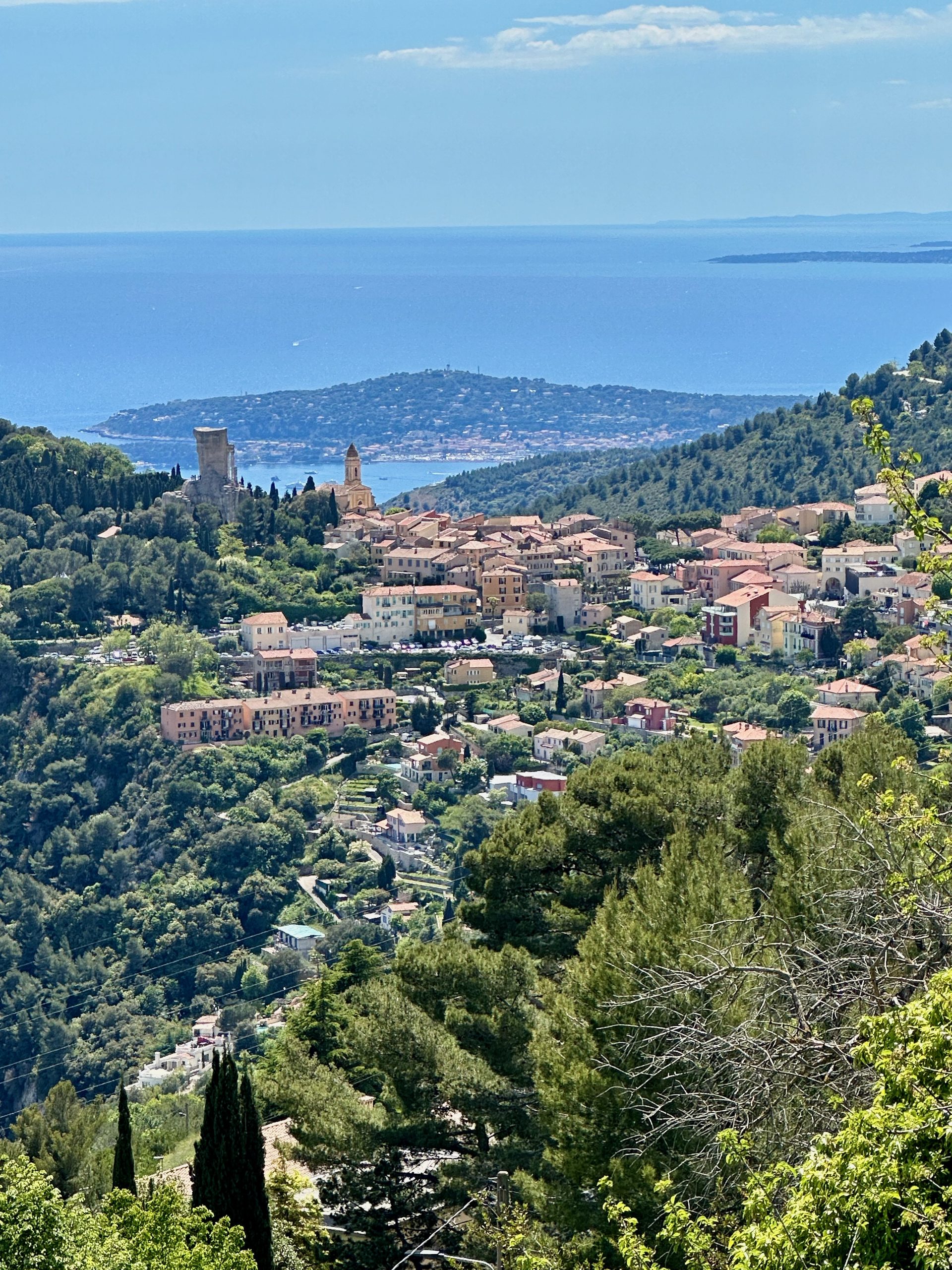
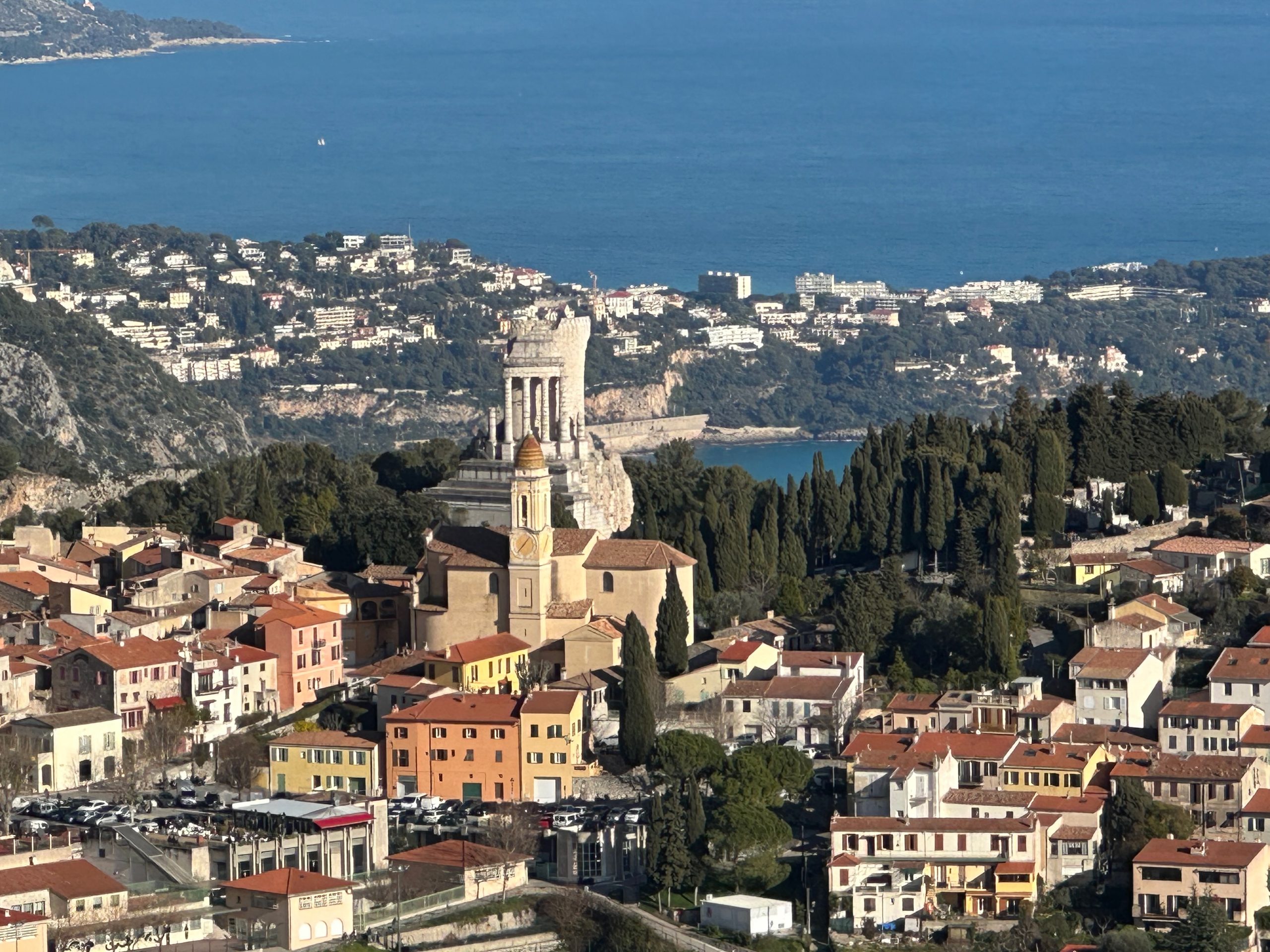
La Turbie lies only a few kilometres from Monaco, yet life up here feels remarkably removed from the Principality below. It is still very much a village, with a butcher, a bakery, a small supermarket, local restaurants and cafés, and people going about their everyday business. Rather unusually, all of this takes place around the remains of one of the most important Roman monuments in the region: the Trophée d’Auguste, which has stood here for more than two thousand years.
The setting is quite exceptional. La Turbie sits at around 450 metres above sea level on the Grande Corniche, with Monaco almost directly below, Nice to the west and Italy not far away in the other direction. From many parts of the village the Mediterranean fills the horizon, while behind La Turbie the landscape quickly becomes mountainous, with Mont Agel and the first foothills of the Alpes-Maritimes surprisingly close.
Living here means having a slightly different relationship with the Mediterranean. The sea dominates many of the views, but everyday life takes place above it, around the village and the mountains behind. Beaches at Cap-d’Ail, Èze-sur-Mer and Monaco are easily reached by car, while walking trails and open countryside begin almost at the edge of the village.
That position gives La Turbie a character quite different from the coastal towns below. There is more space, summer evenings are generally cooler and the village continues to have a life of its own throughout the year. Property also changes with the geography: compared with Monaco and the densely developed coastal strip, gardens, terraces and villas become considerably more attainable.
A village above Monaco
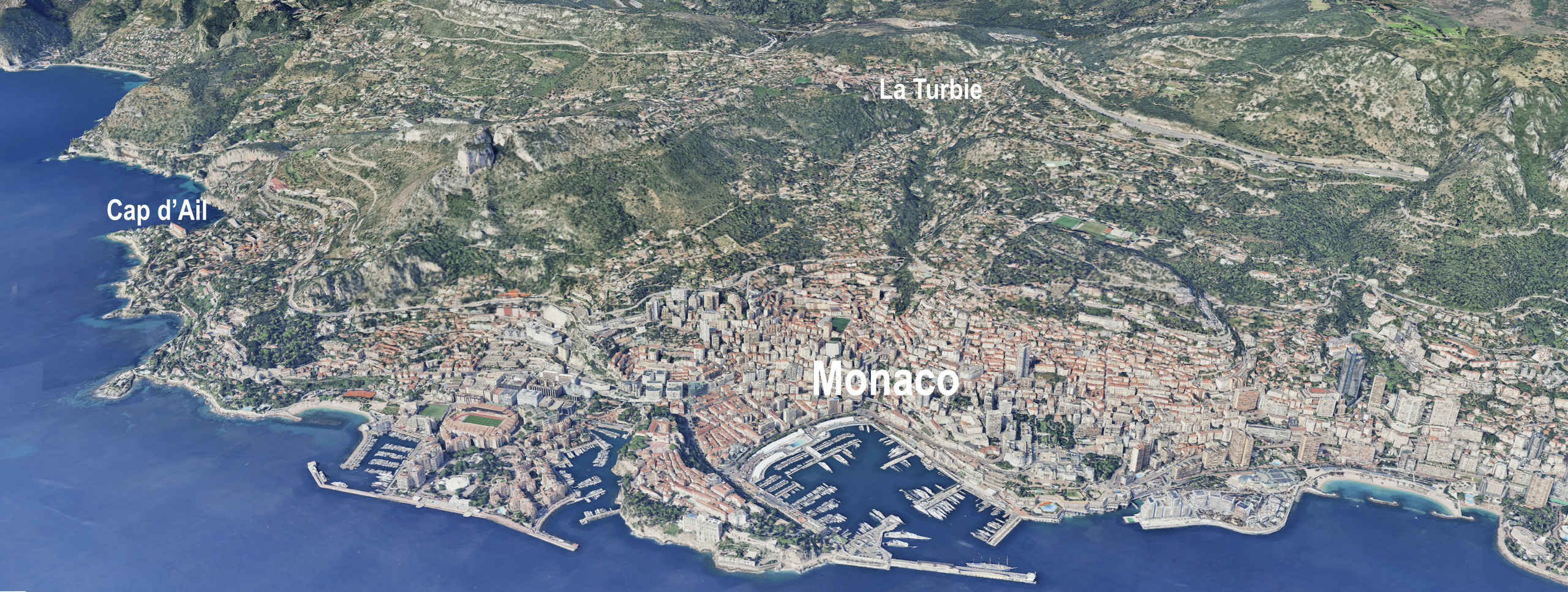
Monaco inevitably plays a part in life in La Turbie. It is one of the main employment centres in this part of the Riviera and an important reason why people choose to live in the village. The attraction is easy to understand: you can work in Monaco and return at the end of the day to surroundings that feel quite separate from the Principality.
The distance on the map is tiny, but that can be deceptive. La Turbie sits some 450 metres above the coast and there are only a limited number of roads down towards Monaco. Early on a Sunday morning the journey can be remarkably quick; during the working week, traffic around the entrances to Monaco can add considerably to the travelling time. For anyone planning to commute regularly, it is worth driving the route during the morning and evening rush hour before deciding where to buy.
Access in the other direction is good. The A8 motorway is close to the village, making Nice and Nice Côte d’Azur Airport relatively easy to reach, as well as Menton and Italy to the east. Public transport is more limited. La Turbie has no railway station and although there are buses, for most residents a car remains part of everyday life.
What is everyday life like?
La Turbie has a permanent village life that is easy to overlook if you only know it from a drive along the Grande Corniche. The centre is small enough to do most everyday errands on foot. There is a bakery, butcher, supermarket, pharmacy and a choice of cafés and restaurants, and after living here for a while you inevitably start recognising people. Children walk to school, the terraces fill around lunchtime and stopping the car somewhere slightly inconvenient while collecting a baguette seems to be tolerated as long as it doesn’t take too long.
For everything beyond the basics, the surrounding towns are close enough to form part of everyday life. A larger supermarket shop, more extensive shopping or an evening out may take you towards Monaco, Beausoleil, Cap-d’Ail or Nice.
The altitude makes more difference than you might expect. At around 450 metres, La Turbie can be several degrees cooler than Monaco below. Winter mornings are noticeably colder, frost occurs and occasionally the village even gets snow while the coast remains clear. Wind can also be a factor, particularly in exposed locations. In summer, the same altitude is often an advantage, with evenings cooling more easily than along the densely built coastline.
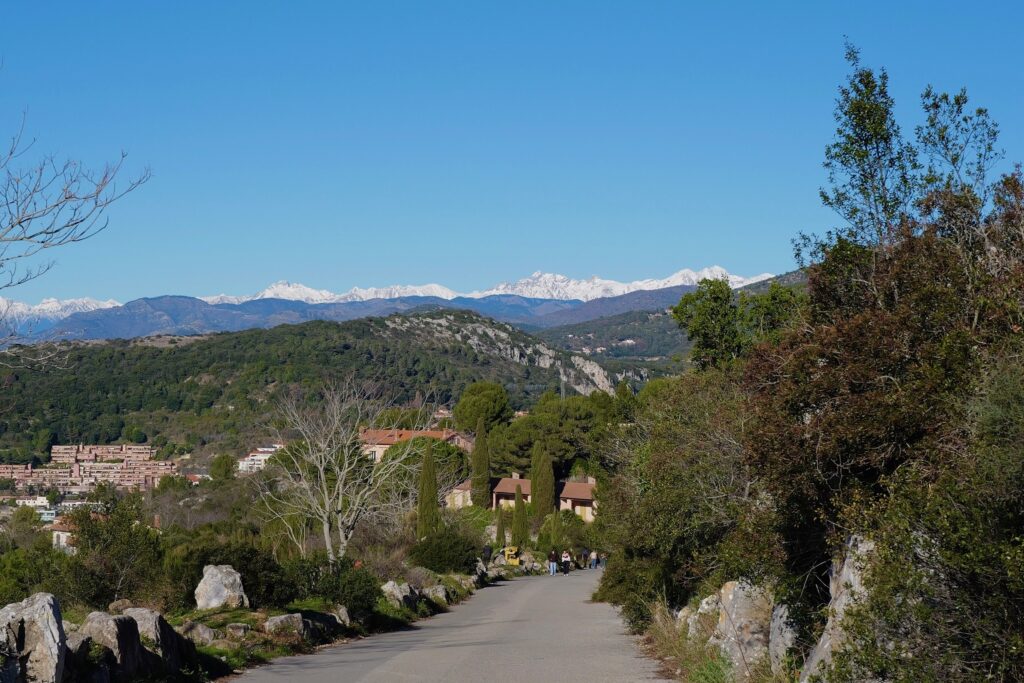
One of the pleasures of living here is how quickly the landscape changes once you leave the centre. Mont Agel rises behind the village, while the Tête de Chien lies just to the south. Walking trails start close by and within a surprisingly short distance you can be away from houses and traffic altogether.
Cycling is particularly important around La Turbie. The village sits in the middle of a network of roads that serious cyclists come here specifically to ride: the Grande Corniche, the climbs from the coast, the Col d’Èze and the roads around Mont Agel. The combination of sustained climbs, relatively quiet mountain roads and a climate that allows cycling for much of the year has also made the area popular with professional riders.
That connection is set to become more formal with the planned Côte d’Azur Cycling Center at the Tête de Chien, conceived as a dedicated training and performance centre. The project is still in development, but its location here is hardly accidental. La Turbie already has the terrain, the climate and an established cycling culture.
For someone who likes walking or cycling, all this changes the experience of living on the Côte quite considerably. Monaco, Nice and the Mediterranean remain close, but daily life can just as easily turn towards the hills and mountains behind the village.
Neigbourhoods
Calling them neighbourhoods is perhaps a little ambitious in a commune this size. But the difference between living in the old village, just outside the centre or on one of the slopes overlooking Monaco is significant.
The old village
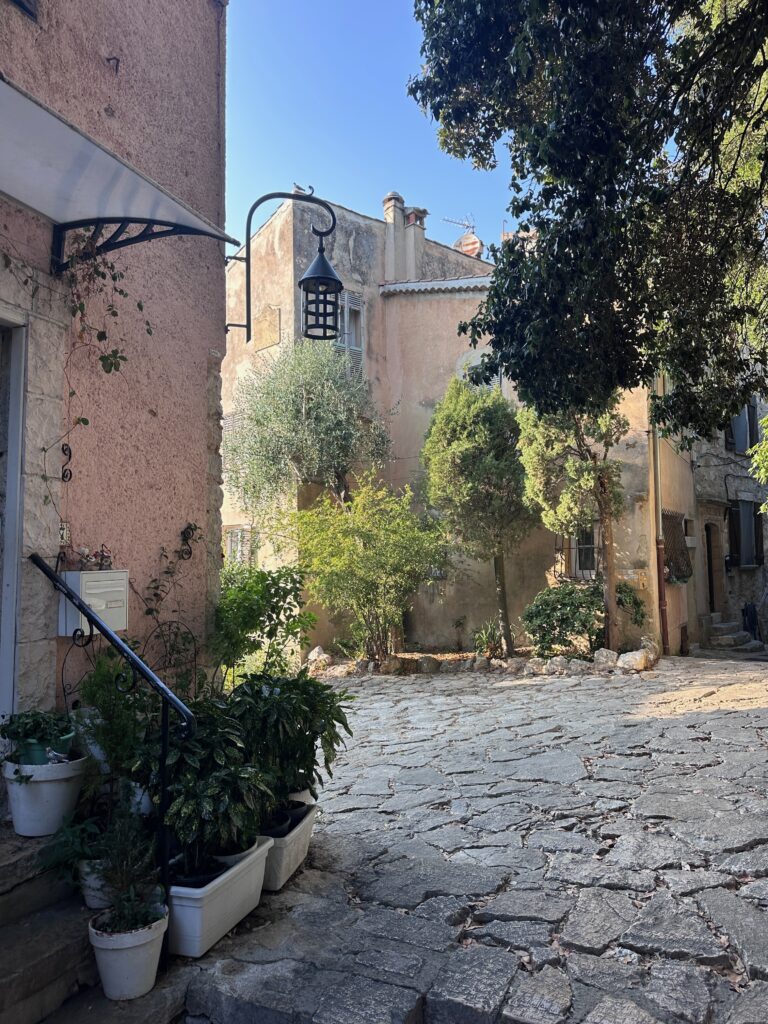
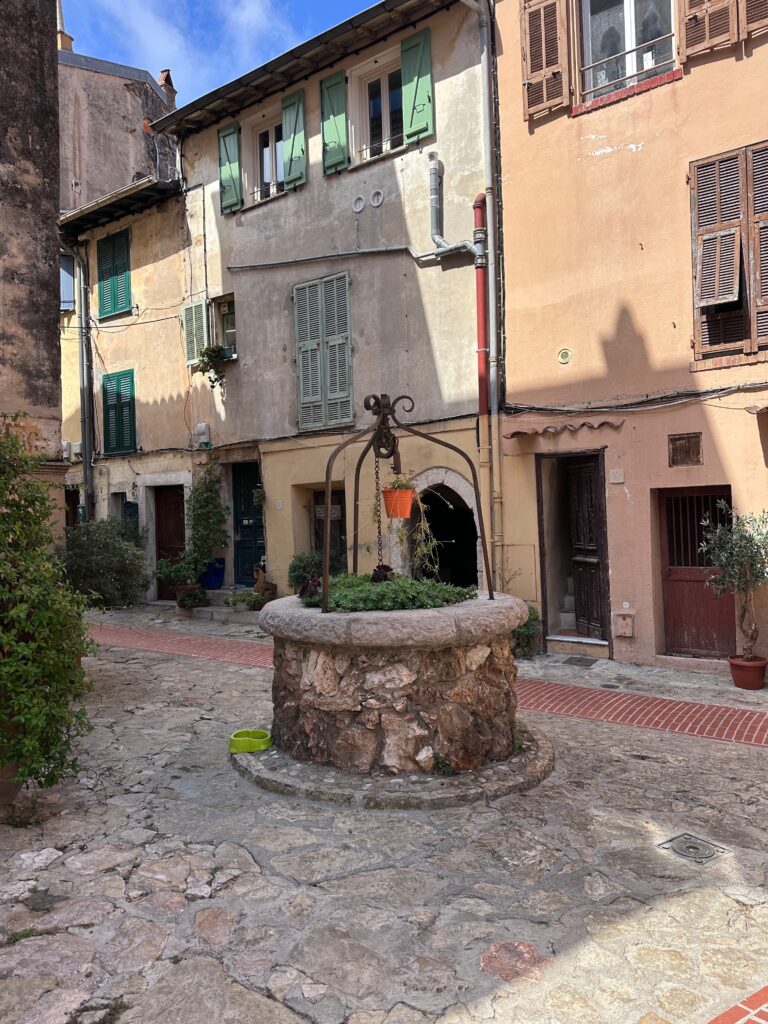
The oldest part of La Turbie is concentrated around the Trophée d’Auguste, with narrow streets, vaulted passages and stone houses that have been adapted and extended over many generations. Despite the importance of the Roman monument and the number of visitors it attracts, the centre has never become an open-air museum. People still live behind these old façades, laundry hangs from windows, scooters are parked wherever there happens to be room and delivery vans somehow find their way through streets that were never designed for them.
Properties here are mainly apartments in older buildings and traditional maisons de village. They can have a great deal of character, particularly when original stonework, beams or terraces have been preserved, but the practical side deserves just as much attention. Some houses extend over several narrow floors, natural light varies enormously from one street to another and parking can be difficult. A garage or private parking space is therefore a considerable advantage.
Outside space is equally unpredictable. One of the most attractive stone houses in the historic centre may have no garden and barely a balcony, while an apartment only a few minutes’ walk away can offer a large terrace and open views towards the sea. The old village works particularly well for people who value atmosphere and want to be able to walk to the shops, bakery and restaurants, but it is worth looking beyond the façade and thinking carefully about how the property would work in everyday life.
Around the village centre
Just beyond the historic centre, the choice of property becomes broader. There are apartments in small residences, townhouses and individual villas, many of them still close enough to walk to the bakery, shops and restaurants in the village.
For permanent living, this part of La Turbie can offer a good balance. Properties tend to be easier to live in than those in the medieval centre, with terraces, garages and private parking more common and lifts available in some of the apartment buildings. Depending on the position, there may also be more light and open views towards the coast.
The architecture is generally less interesting than in the old village, but that is not necessarily a disadvantage. If La Turbie is going to be a home rather than somewhere you visit for a few weeks a year, having somewhere to park the car, carry in the shopping and sit outside comfortably can matter more than having an ancient stone façade. The centre is still only a short walk away, so you don’t have to give up village life to gain those practical comforts.
The slopes towards Monaco and Cap-d’Ail
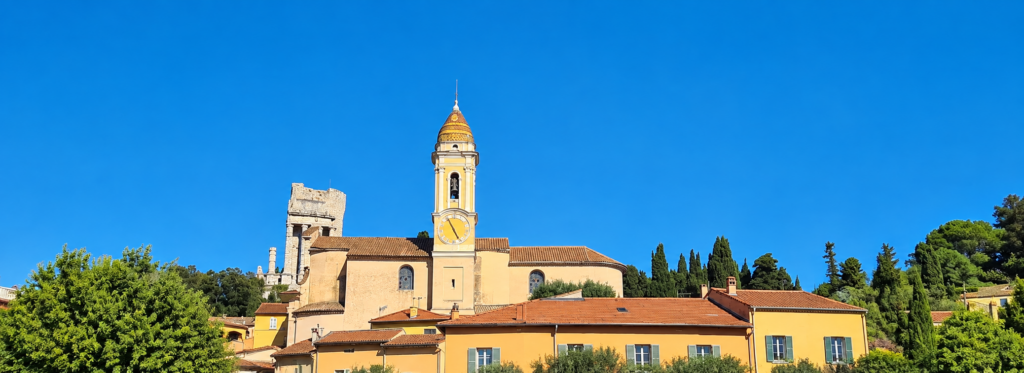
The slopes below and around La Turbie are particularly interesting if you are looking for a villa. Development here is much more scattered than in the village itself, with individual houses, small residences and villas set into the hillside. In the right position, the views can be exceptional. Monaco may lie almost directly below, with the Mediterranean beyond and, from some properties, a long stretch of coastline visible in the distance.
This is where gardens, swimming pools and generous terraces become much easier to find, but also where the precise location of a property matters enormously. The terrain is steep and a house that appears to be only a short distance from the village can be reached by a surprisingly winding road. Some of the smaller access roads are narrow, so private parking and enough room to turn a car comfortably are worth checking rather than taking for granted.
Orientation is just as important. The mountains and steep slopes create considerable differences in light and winter sunshine, sometimes between properties that are geographically very close to one another. A spectacular sea view does not automatically mean a sunny terrace throughout the day. If a property is a serious contender, it is worth returning at a different time of day – and, if possible, seeing it outside the summer months as well.
Towards Mont Agel and the hinterland
Head away from the Mediterranean and the surroundings of La Turbie change quite quickly. The landscape opens towards Mont Agel and the first foothills of the Alpes-Maritimes, with fewer houses, larger plots and considerably more greenery than on the slopes facing Monaco. Properties become more scattered here and the atmosphere is quieter and, in places, almost rural.
This is also the direction of Roc Agel, the country estate used by Monaco’s Grimaldi family since the time of Prince Rainier III and Princess Grace. Hidden in the hills around Mont Agel, only a short distance from the Principality, it was deliberately chosen as a private retreat from life in Monaco. The fact that the princely family has kept a country home here for decades says something about the appeal of this landscape: Monaco is extremely close, yet the surroundings can feel completely removed from it.
For property buyers, this side of La Turbie offers a different proposition from the slopes overlooking the coast. The spectacular Monaco views are less important and may disappear altogether, but plots can be larger and the setting greener and more peaceful. For someone who works in Monaco but would rather come home to countryside than look down on the Principality from the breakfast table, it is an area well worth considering.
PROPERTY IN LA Turbie
The property market in La Turbie is closely connected to Monaco, but the choice of housing is much broader than the short geographical distance might suggest. The historic centre is dominated by apartments and traditional maisons de village, while the areas beyond it offer small residences, townhouses and villas ranging from relatively modest family homes to substantial contemporary properties.
For buyers, the differences between individual locations are often more important than the distance between them on the map. A house facing Monaco may offer an extraordinary panorama but relatively little usable land, while a property towards Mont Agel can exchange the sea view for a larger plot, greater privacy and a much greener setting. Around the village centre, meanwhile, apartments and smaller residences can be an attractive practical option, particularly when they combine walking distance to the shops with a garage, lift or terrace.
With villas in particular, it is worth looking beyond the view. La Turbie is steep, so the size of a plot tells you surprisingly little about how much of it can actually be used as a garden. Access can be narrow or difficult, and orientation has a considerable influence on winter sunshine. Retaining walls, drainage and the condition of the terrain are also worth examining carefully when buying on a hillside.
Noise varies considerably from one location to another. The A8 passes close to parts of the commune, while properties only a relatively short distance away can be exceptionally quiet. This is one of those places where visiting a house once, preferably on a beautiful summer afternoon, doesn’t necessarily tell you enough.
And if Monaco is the main reason for choosing La Turbie, there is one final check we would always make. Don’t take “ten minutes from Monaco” too literally. Drive from the property to Monaco at 8.30 on a weekday and see what those ten minutes look like in real life.
To Do
Walk through the old village
The historic centre of La Turbie is small and no need to explore with a plan. The streets around the Trophée d’Auguste lead through vaulted passages, past old stone façades and small squares, with occasional views opening between the houses towards the mountains or the Mediterranean.
You can walk through the old village fairly quickly, although it is worth leaving the most obvious route around the Trophée and taking some of the smaller streets behind it. This is where La Turbie feels less like a historic attraction and more like the old centre of a village that is still very much lived in.
Visit the Trophée d’Auguste
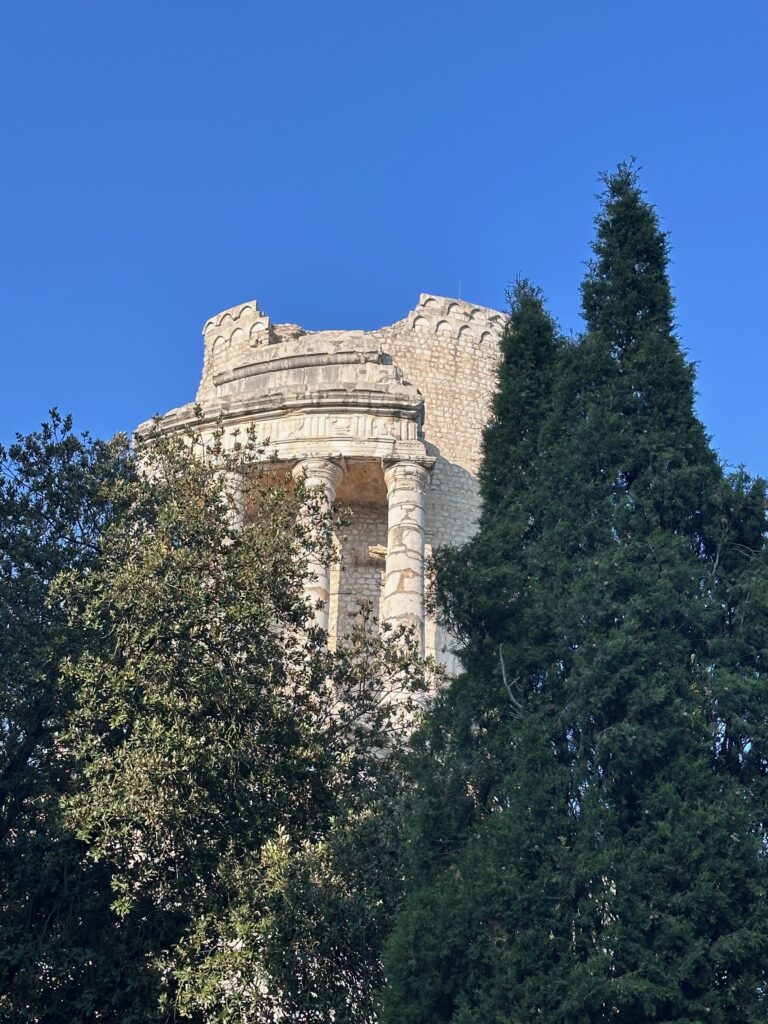
There is no getting around the Trophée d’Auguste in La Turbie. The Roman monument rises above the village and is visible from far along the coast, but its scale is much more impressive when you stand beside it. You can visit the archaeological site and climb to the upper part of the monument, from where the view stretches across Monaco, the Mediterranean and the surrounding mountains.
The history behind the Trophée is one of the most important stories connected with La Turbie – and with the Roman history of this part of the Côte d’Azur – so we have covered it in more detail in the History section below. Once you know why it was built here more than two thousand years ago, its position high above the ancient Roman route connecting Italy with what is now southern France makes considerably more sense.
Walk -or cycle- to the Tête de Chien
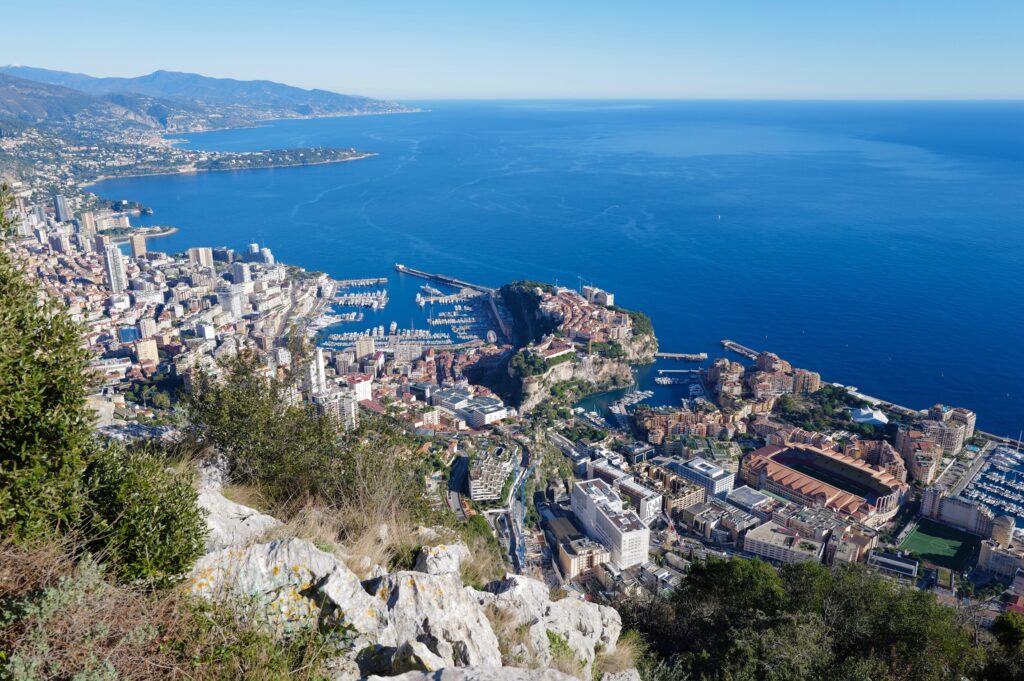
The Tête de Chien rises to around 550 metres just south of La Turbie and offers one of the most remarkable views over Monaco en st Jean Cap Ferrat. From the limestone plateau, the Principality appears almost vertically below, with the coastline stretching away on either side. You can reach the area from La Turbie on foot, although good shoes are advisable once you leave the road and paths.
The Tête de Chien is also part of a much bigger sporting landscape. La Turbie and the surrounding Corniche roads are exceptionally popular with cyclists. The long climbs from the coast, relatively mild winters and choice of routes towards the Col d’Èze, Mont Agel, Nice and Menton make this a natural training area, and seeing serious cyclists climbing through the village is very much part of everyday life here. La Turbie even has its own cycling club and bicycle shop.
Cycling is likely to become still more visible. A Côte d’Azur Cycling Center is planned at the Tête de Chien, conceived as a performance and training centre for cyclists with facilities for physical preparation, seminars and accommodation. The project has been going through the planning and environmental approval process, so for now it should be regarded as a development in progress rather than an existing facility.
Follow the Grande Corniche
Three historic coastal roads connect Nice with Menton: the Basse Corniche close to the sea, the Moyenne Corniche halfway up the slopes and, highest of all, the Grande Corniche. La Turbie lies directly on the latter, which follows parts of the ancient route used by the Roman Via Julia Augusta.
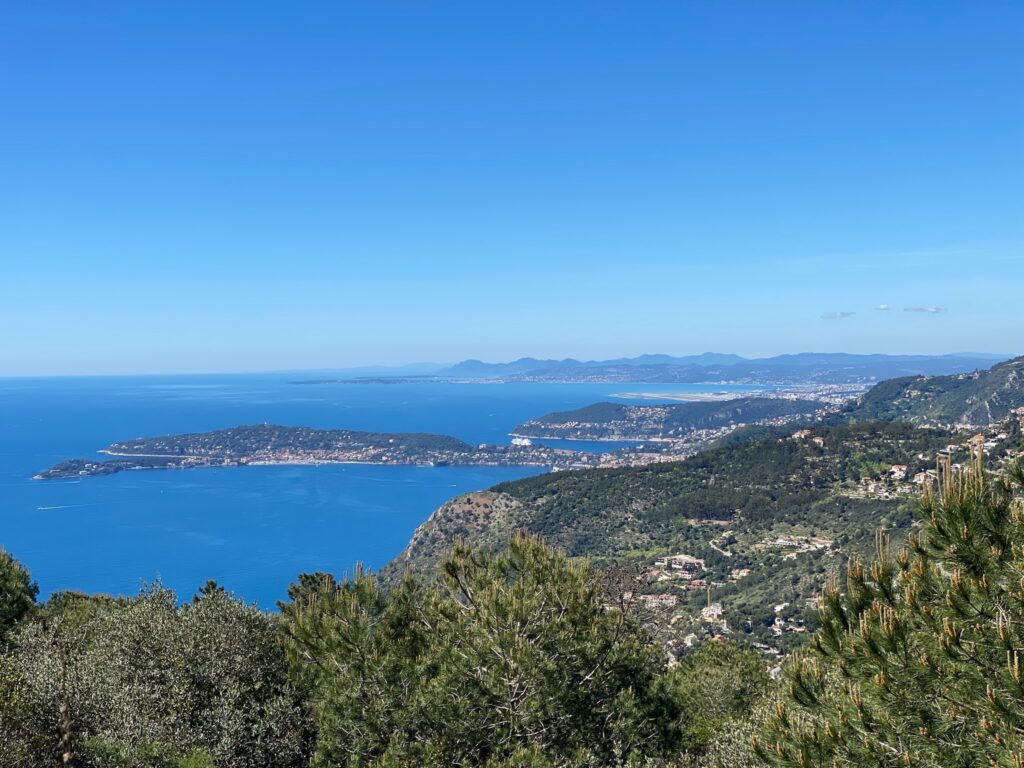
From La Turbie, the Grande Corniche towards Èze and Nice is still a wonderful drive. At several points the road runs high above the Mediterranean, with views across the Cap Ferrat peninsula, Èze and the coastline towards Nice. More than just a scenic route, it gives you a remarkably clear sense of the geography here: the narrow coastal strip below, the steep mountains immediately behind it and the Mediterranean stretching out beyond.
Walk around Mont Agel
Behind La Turbie, the landscape changes remarkably quickly. Roads and paths climb towards Mont Agel and continue into the hills around Peille, where the densely developed coastline soon feels much further away than it actually is. Pine forest, exposed limestone and open mountain terrain replace the villas and apartment buildings of the coast.
There is a good network of walking routes in this area, ranging from relatively easy walks from the village to longer hikes further into the Alpes-Maritimes. It is one of the less obvious attractions of living in La Turbie: Monaco may be only a few kilometres away, yet you can leave home on foot and quite quickly find yourself in a landscape with barely a building in sight.
Visit on an ordinary day
If you are seriously considering La Turbie as a place to live, don’t only visit on a sunny weekend in June. Come back on an ordinary weekday outside the season, preferably when the weather isn’t particularly impressive. Have coffee in the village, buy something at the bakery, walk through the centre and see how much is still going on when there are few visitors around.
It is a simple test, but a useful one. Places along the Côte can feel very different once summer is over, and for a permanent or semi-permanent home that matters. La Turbie remains a functioning village throughout the year, which is one of the reasons it works so well as a place to live rather than simply somewhere to spend a holiday.
FActs
Department: Alpes-Maritimes (06)
Region: Provence-Alpes-Côte d’Azur
Population: approximately 3,000 permanent residents
Altitude of the village: around 450 metres
Location: directly above Monaco, between Nice and Menton
Distance from Monaco: only a few kilometres, although actual journey time depends strongly on traffic
Distance from Nice Côte d’Azur Airport: approximately 25–30 km by road
Railway station: none in the village
Motorway: easy access to the A8
Historic landmark: Trophée d’Auguste / Trophée des Alpes
Main property types: village houses, apartments and villas
Year-round life: strong for a village of its size
Car dependency: moderate to high
Climate: slightly cooler than the coast due to altitude
Landscape: Mediterranean views, limestone hills and mountain terrain
Character: historic, local, residential and closely connected to Monaco without feeling Monegasque
Best suited to: Monaco commuters, villa buyers, walkers and people wanting village life without moving far into the hinterland
History
The Romans and the route through La Turbie
Long before La Turbie became a village, its position high above the Mediterranean was already important. Rome already controlled large parts of what is now southern France (Roman Gaul), but the routes across the Alps connecting these territories with Italy were not yet secure.
During the reign of Augustus, a series of military campaigns between 25 and 14 BC brought the Alpine region under Roman control.
One of the roads connecting Italy with Roman Gaul was the Via Julia Augusta, established under Augustus around 13–12 BC. It followed the coast and crossed the southern end of the Alps at La Turbie before continuing westwards towards present-day southern France and eventually Spain.
It was beside this route that the Romans erected the Tropaeum Alpium, today known as the Trophée d’Auguste or Trophée des Alpes, in 7–6 BC.
The Trophée d’Auguste
The Trophée is much more than an unusually large Roman monument in the middle of a French village. It commemorated Augustus’ conquest of the Alpine region and the establishment of Roman control over the routes between Italy and the western provinces of the Empire.
Its position was deliberately spectacular. Standing high above the Mediterranean and beside the Via Julia Augusta, the monument would have been visible to travellers approaching along the route. The original structure was considerably larger than what we see today and, according to the twentieth-century reconstruction, may have risen to more than 50 metres, crowned by a statue of Augustus.
An enormous inscription recorded Augustus’ victory and named the Alpine peoples who had been brought under Roman authority. Part of the text is also known from Pliny the Elder, who reproduced the inscription in his Natural History. This has helped archaeologists reconstruct sections that were subsequently lost.
The Trophée therefore belongs to a much bigger story than the history of La Turbie itself. It marked the consolidation of Roman power across the Alps and stood on one of the routes that connected Italy with Gaul and Spain. Its location also explains why this particular point above the Mediterranean had strategic importance long before Monaco existed below.
From Roman monument to medieval village
After the decline of the Roman Empire, a settlement developed around the Trophée. The monument was incorporated into medieval fortifications and its stone was gradually reused in houses and walls throughout the village.
This was also a period when living high above the Mediterranean made practical sense. Like Èze and Roquebrune, La Turbie occupied a defensible position overlooking the coast and the routes below.
The Trophée suffered particularly badly in 1705, during the War of the Spanish Succession, when the fortifications built around it were destroyed on the orders of Louis XIV. What remained was essentially a monumental Roman ruin.
Savoy, France and Monaco
For centuries La Turbie stood close to an important political frontier. The County of Nice belonged for long periods to the House of Savoy and later the Kingdom of Sardinia, while Monaco developed separately under the Grimaldi family.
That changed in 1860, when Savoy and the County of Nice were ceded to France during the process of Italian unification. La Turbie became French, while Monaco remained an independent principality below.
At roughly the same time, the entire coastline was beginning to change. The railway arrived, Monte-Carlo developed into an international winter resort and wealthy European visitors discovered the Riviera. Until then La Turbie had been the established settlement and much of the steep land below it was comparatively sparsely developed. During the late nineteenth century, the balance began to reverse.
Between 1894 and 1932 there was even a rack railway connecting the area above Monte-Carlo directly with La Turbie, bringing visitors up to see the Roman monument and the panorama.
When Beausoleil and Cap-d’Ail were still La Turbie
La Turbie was once a much larger commune than it is today. Its territory extended down the slopes towards Monaco and the Mediterranean.
As Monte-Carlo expanded, the French neighbourhood immediately above it grew rapidly. Hotels, villas and apartment buildings appeared and the area became increasingly connected to Monaco rather than to the old village on the hill. In 1904, it separated from La Turbie and became the commune of Beausoleil.
Four years later, in 1908, the coastal district to the west (La Turbie sur Mer) also became independent. Today we know it as Cap-d’Ail.
This is a useful piece of history when looking at the modern map. La Turbie can now seem like a small village that developed above Monaco, with Beausoleil and Cap-d’Ail occupying the land between it and the sea. Historically, the opposite is closer to the truth: La Turbie was the old established commune; much of the development below came later.
Reconstructing Augustus
Interest in the Trophée revived during the nineteenth century and the monument was classified as a French Monument historique in 1865. Major archaeological work followed, particularly under the architects Jean-Camille Formigé and his son Jules Formigé.
The partial reconstruction visible today was largely carried out between 1929 and 1933, with substantial financial support from the American philanthropist Edward Tuck. It deliberately combined surviving Roman remains with reconstructed sections rather than attempting to rebuild the complete monument.
That is why the Trophée today is neither an intact Roman building nor a modern replica. Its stones record several different periods of La Turbie’s history: Roman ambition, medieval fortification, centuries of destruction and reuse, and finally the twentieth-century effort to understand and preserve what remained.
For a village of around 3,000 inhabitants, La Turbie has played a surprisingly substantial role in the history of this part of the Mediterranean. Much of that comes down to its position. For more than two thousand years, the same narrow passage between the Alps and the sea has connected Italy with the coast to the west – and La Turbie has been sitting above it.
Trivia
Grace Kelly and the road below La Turbie
The roads around La Turbie became part of the mythology of the Côte d’Azur long before most people who now drive them were born. The Grande Corniche and the roads between Nice, Èze and Monaco provided the setting for some of the most memorable scenes in Alfred Hitchcock’s To Catch a Thief, released in 1955.
The film starred Cary Grant as retired jewel thief John Robie and Grace Kelly as Frances Stevens, and Hitchcock made full use of the landscape above the Mediterranean. The winding roads, steep mountainsides and views towards Monaco became almost characters in the film themselves.
What gives those scenes an additional significance today is what happened next. During her time on the Côte d’Azur, Grace Kelly met Prince Rainier III of Monaco. They married in 1956 and she became Princess Grace of Monaco.
The roads she had driven for a Hollywood film suddenly became part of her real life.
Her story also has a tragic connection with this landscape. In September 1982, Princess Grace suffered a stroke while driving on the road between La Turbie and Monaco. Her Rover left the road on the descent near La Turbie and plunged down the mountainside. She died the following day at the age of 52.
For anyone who knows these roads well, the combination of Hollywood glamour and that later tragedy gives the landscape a rather different resonance.
La Turbie once had its own railway to Monaco
It is difficult to imagine today, but for almost forty years you didn’t need a car to travel directly between Monaco and La Turbie. In 1894 a rack railway opened between the area above Monte-Carlo and La Turbie. The climb was steep: the village sits roughly 450 metres above the Mediterranean, although only a few kilometres separate the two places as the crow flies.
The railway was partly a product of the Belle Époque tourist boom. Visitors staying in Monaco could travel up to La Turbie to see the Roman Trophée and the panorama over the coast. The journey took around twenty minutes. The line closed in 1932 as road transport became increasingly important. Parts of the former railway infrastructure can still be found around La Turbie if you know where to look. Considering today’s traffic between Monaco and the villages above it, one could argue that closing it was rather unfortunate.
La Turbie once had its own seaside: La Turbie-sur-Mer
It sounds rather unlikely today, but La Turbie was not always confined to the hills above Monaco. Until the early twentieth century, the commune stretched all the way down to the Mediterranean and included what are now Beausoleil and Cap-d’Ail.
For a time, the coastal part was even known as La Turbie-sur-Mer, a wonderfully confusing name for anyone who knows present-day La Turbie, some 450 metres above sea level. As the population along the coast grew, the old commune was gradually divided: Beausoleil became independent in 1904, followed by Cap-d’Ail in 1908. So although La Turbie no longer has a beach, it can legitimately claim that it once had an entire stretch of the Riviera.
The Trophée is hiding throughout the village
When the Roman Trophée lost its original function, the inhabitants of La Turbie were left with an enormous quantity of very useful stone.
Over the centuries, blocks from the monument were removed and incorporated into houses, walls and other structures around the village. Parts of the Roman monument therefore survive not only in the archaeological site but within La Turbie itself.
It is worth remembering when walking through the old streets. Some of the stone around you has had a considerably longer life than the building in which it now sits.
The village and its Roman monument have quite literally become mixed together.
La Turbie can be white while Monaco stays green
La Turbie’s altitude produces one of the stranger contrasts on this part of the Riviera.
The village stands at roughly 450 metres, high enough for its weather occasionally to be quite different from the coast below. Winter nights are colder, frost is possible and every so often snow settles in the village.
At the same time, Monaco can remain completely snow-free beneath it.
It doesn’t happen often enough to define life in La Turbie, but it does underline something prospective residents sometimes underestimate: moving only a few kilometres inland and several hundred metres uphill creates a noticeably different microclimate. In August, when days up here can be pleasantly cooler than on the coast, that difference becomes considerably more attractive.
WHO IS LA TURBIE FOR?
La Turbie suits people who are attracted to the Côte d’Azur but do not necessarily want the classic resort version of it. Its appeal lies less in holiday infrastructure than in the combination of a genuine village, dramatic surroundings and an unusually strategic position between Monaco, Nice, Menton and Italy.
It can work equally well as a permanent home or as a second residence, although the reasons for choosing it tend to be quite specific. Some buyers come because of Monaco, others because they want more space than the coastal towns can offer, and some simply prefer waking up in a village with mountains behind them rather than in a resort beside the Mediterranean. What they generally have in common is that they are prepared to exchange immediate access to the beach for a different kind of Riviera life.
For people who want a villa close to Monaco
This is perhaps the most obvious group. Monaco and the immediate French border areas are extremely densely built, so moving uphill considerably expands the possibilities for buyers looking for a detached house, outside space and privacy.
La Turbie is close enough for Monaco to remain part of daily life without having to feel part of Monaco once you get home. The trade-off is the journey. A property advertisement describing a house as “ten minutes from Monaco” is describing distance under favourable conditions, not necessarily your Monday morning commute. Traffic on the approaches to the Principality can change journey times considerably.
Anyone buying specifically because of Monaco should therefore drive the route at the times they would actually use it.
For people who like village life but don’t want to disappear into the hinterland
There are many beautiful villages further inland, but choosing one often means accepting a much greater distance from the main towns and transport connections. La Turbie occupies an interesting middle ground.
Nice, Menton and Italy are all within relatively easy reach, while the A8 provides quick access in both directions. Yet walk behind the village and the urban Côte disappears remarkably quickly.
For someone who likes hiking, cycling or simply having open landscape nearby, this is a considerable advantage. The mountains are not somewhere you have to make a day trip to find; they form part of the immediate surroundings.
La Turbie or Èze?
These two are frequently mentioned together because both are historic villages high above the Mediterranean and close to Monaco. In reality, they offer quite different experiences.
Èze Village has the more spectacular setting. Its medieval streets rise dramatically above the sea and the combination of architecture, exotic garden and views has made it one of the most visited villages on the Côte d’Azur. But that popularity changes everyday life. During the season, coaches arrive, the narrow streets fill with visitors and much of the old village is geared towards tourism: galleries, hotels, restaurants and souvenir shops.
La Turbie is less theatrical but more obviously a functioning village. Tourism is certainly present, particularly around the Trophée d’Auguste, but it does not dominate daily life to the same extent. For a permanent home, that distinction can matter considerably.
The property markets are different too. Èze extends from the medieval village down towards Èze-sur-Mer, so the commune contains everything from historic village properties to large contemporary villas overlooking the Mediterranean. La Turbie is more closely oriented towards Monaco and the mountains behind it. Which works better depends less on which village is more beautiful than on how you actually intend to live there.
La Turbie or Beausoleil?
Beausoleil is the more obvious choice if Monaco needs to be integrated into daily life as seamlessly as possible. Parts of the town sit immediately above Monte-Carlo and, depending on where you live, walking into Monaco can be perfectly realistic.
The price for that convenience is density. Beausoleil is urban, steep and heavily built, with apartment buildings climbing the hillside above the Principality. Outside space, parking and open surroundings are correspondingly harder to find.
La Turbie asks more of you in terms of transport, but gives considerably more breathing room in return. The choice between the two is therefore not simply about distance from Monaco; it is about whether you want to live as close as possible to the Principality or prefer to leave its urban environment behind at the end of the day.
La Turbie or Cap-d’Ail?
Cap-d’Ail offers something La Turbie cannot: everyday life directly beside the Mediterranean. Its coastal path, coves and beaches are part of the town rather than somewhere you drive to, and Monaco remains extremely close.
That makes the comparison relatively straightforward. Buyers who imagine their life on the Côte around swimming, walking beside the sea and having the coast immediately outside their door are more likely to gravitate towards Cap-d’Ail. Those who place greater value on a village setting, more space and immediate access to the hills may find La Turbie the more natural fit.
Interestingly, the two were once part of the same commune. Their very different characters today show just how much a few kilometres – and several hundred metres of altitude – can change life on this particular stretch of the Riviera.
La Turbie or Roquebrune-Cap-Martin?
This is a more complicated comparison because Roquebrune-Cap-Martin is several places in one.
There is the medieval village high above the sea, the villas and gardens of Cap Martin, the more urban area around Carnolès and properties scattered across the slopes towards Monaco. It therefore offers a much wider range of lifestyles than La Turbie.
Roquebrune also has direct railway access and several beaches, making it easier to combine hillside living with the coast. The trade-off for someone commuting to Monaco is that exact location becomes extremely important; a house that looks close on a map can involve a surprisingly circuitous journey.
La Turbie is simpler. It is a compact village directly above Monaco with the motorway and mountains immediately behind it. For someone whose life is oriented equally towards Menton, Italy and the sea, Roquebrune may offer more.
For someone whose daily axis is Monaco – home – mountains, La Turbie is difficult to beat.