

Matisse’s Côte d’Azur
The light that changed everything
Henri Matisse arrived in Nice in December 1917 and stayed, on and off, for the rest of his life. He painted hotel rooms overlooking the Mediterranean, filled his studios with fabrics, models and plants, moved uphill to the grand Hôtel Régina in Cimiez and, when illness made painting increasingly difficult, began cutting directly into colour instead. His final great work was not a painting at all, but a chapel in Vence. Nearly forty years after discovering the particular light of the Côte d’Azur, Matisse found a way to make that light part of the artwork itself.
Matisse was 48 when he arrived in Nice on Christmas Day 1917. By then he had already shocked Paris as one of the Fauves, travelled extensively and established himself as one of the leading figures of modern art.
He had not come south to reinvent himself. He was looking for somewhere to work.
Nice, 1917: the light after the rain
The story of Matisse’s arrival in Nice has become part of the mythology surrounding him.
He checked into the Hôtel Beau Rivage, on what is now the Quai des États-Unis, and rented a long, rather ordinary room. Its saving grace was a large window overlooking the Mediterranean. [1]
The weather, however, was dreadful.
According to Matisse’s later recollections, rain fell day after day. He became so frustrated that he decided he would leave if the weather did not improve. Then one morning he woke to brilliant sunshine.
The effect was apparently decisive.
Matisse later explained that people assumed he had settled in Nice for its picturesque beauty. What had really captivated this man from northern France were the coloured reflections in winter and the extraordinary brightness of the day. [1]
He stayed. And over the following decades that light would become inseparable from his work.
Painting the Riviera from the inside

Matisse’s Côte d’Azur is surprisingly often an indoor world.
He certainly painted landscapes, but many of the works we associate with his Nice period were made inside hotel rooms and apartments.
After the Beau Rivage came other temporary addresses and, from 1921, an apartment at 1 Place Charles-Félix, overlooking the Cours Saleya and the sea. [1] There he created rooms within rooms.
A woman reclines on a sofa. Patterned fabric covers a screen. There are flowers, a mirror, perhaps a bowl of fruit. Curtains frame a window and somewhere beyond them is a flash of blue Mediterranean.
The sea is present, but it does not necessarily get top billing.
Matisse was less interested in recording the Côte d’Azur than in controlling what happened when its light entered a room. Windows became particularly important: they allowed him to place interior and exterior, pattern and landscape, intimacy and distance within the same painting.
His Nice interiors can look effortless. They weren’t.
Furniture, fabrics, screens, flowers and objects were arranged and rearranged in the studio. The apparent Mediterranean languor was, to a considerable extent, staged.
Which brings us to the women lying on those sofas.
The odalisques: beautiful, exotic — and complicated

During the 1920s, one of Matisse’s recurring subjects was the odalisque: a female model, often partially dressed or nude, surrounded by exotic fabrics and objects. They are among the most immediately recognisable works of his Nice period. They are also more complicated to look at today.
The odalisque belonged to a much older European tradition of Orientalism, in which North Africa, the Middle East and the Ottoman world were presented to Western audiences as exotic, sensual and frequently sexual places. Delacroix and Ingres had famously explored similar territory before him. The Metropolitan Museum of Art Matisse had travelled in Algeria and Morocco and collected textiles and decorative objects. But the interiors in his Nice paintings were not documentary representations of North African life. They were sets.
Photographs of his studio show North African textiles hanging from walls and draped over furniture to create theatrical environments for his models. One of the best known, Henriette Darricarrère, posed for him for years. The Metropolitan Museum of Art notes that Matisse created an “oriental” alcove in his Place Charles-Félix apartment, using patterned hangings to evoke Moorish interiors. [2] The Metropolitan Museum of Art
Matisse himself was quite matter-of-fact about the subject. He said that the odalisque allowed him to paint the nude and pointed to what he had seen during his travels in Morocco. [2]
From a twenty-first-century perspective, it is reasonable to see something else as well: a European artist constructing his own fantasy of the Orient. That doesn’t make the paintings less important, it makes them more interesting.
Meanwhile, there was Picasso
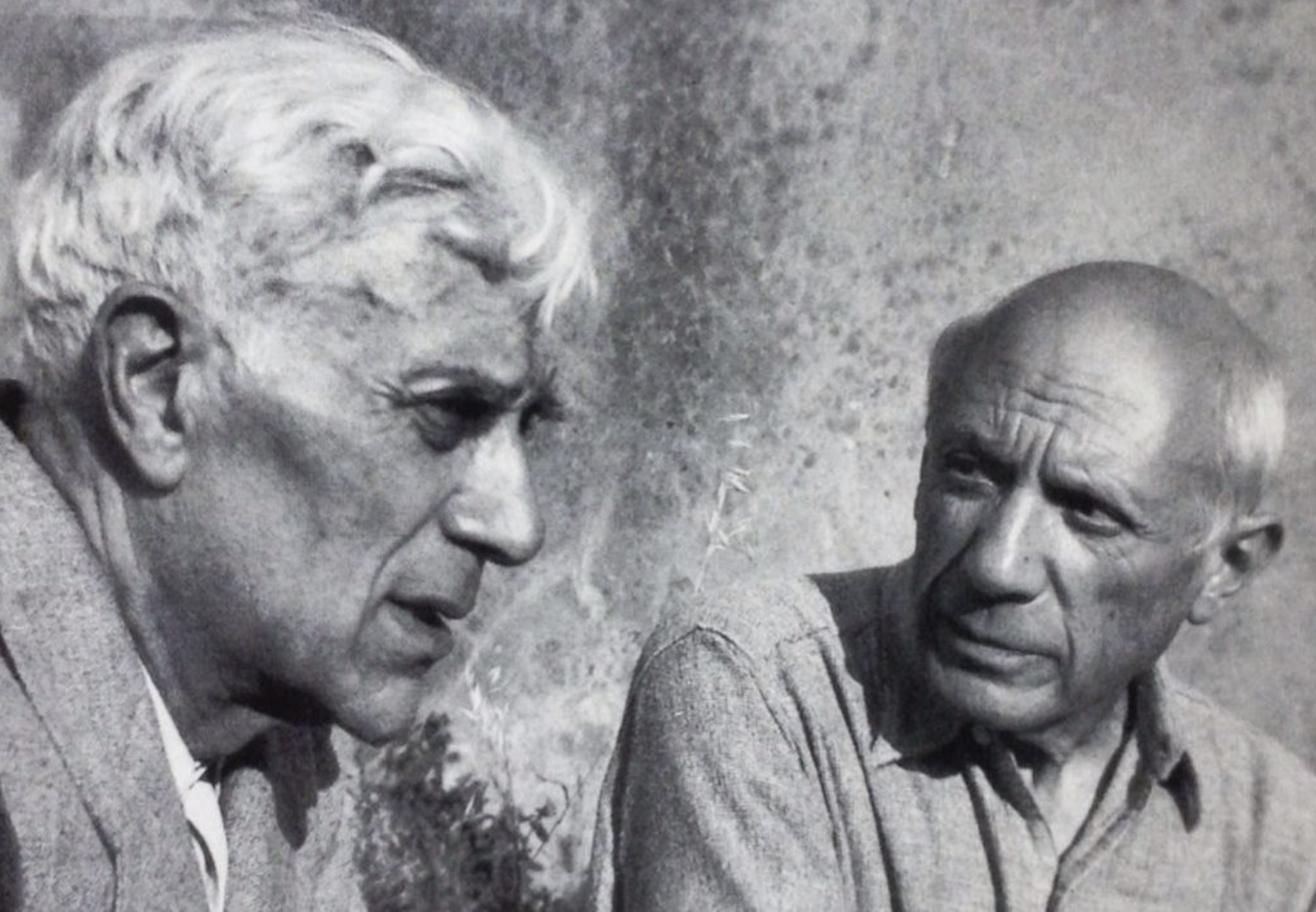
No account of Matisse’s later life is quite complete without Picasso hovering somewhere nearby.
They first met in 1906 and spent almost half a century watching each other’s work with extraordinary attention. MoMA describes them as recognising one another as their only true artistic rival and measure of success. [3] The Museum of Modern Art
They were very different characters. Picasso was twelve years younger, more theatrical and seemingly incapable of entering a room without eventually making the room about Picasso. Matisse was quieter and more deliberate.
Artistically, however, they kept one another alert. Picasso later acknowledged that nobody had looked at Matisse’s work more carefully than he had — and vice versa. The Museum of Modern Art
Their geographical proximity after the war made the relationship even more interesting. Picasso was working in Antibes and later Vallauris; Matisse was in Nice and Vence. Picasso’s partner Françoise Gilot also became friendly with Matisse. The Museum of Modern Art
They were friends, rivals and an audience of one for each other.
And even near the end, Picasso could still tease him. When the non-religious Matisse devoted years to designing a Catholic chapel in Vence, Picasso reportedly wondered why he didn’t build a covered market instead. [4] The Museum of Modern Art
Matisse built the chapel.
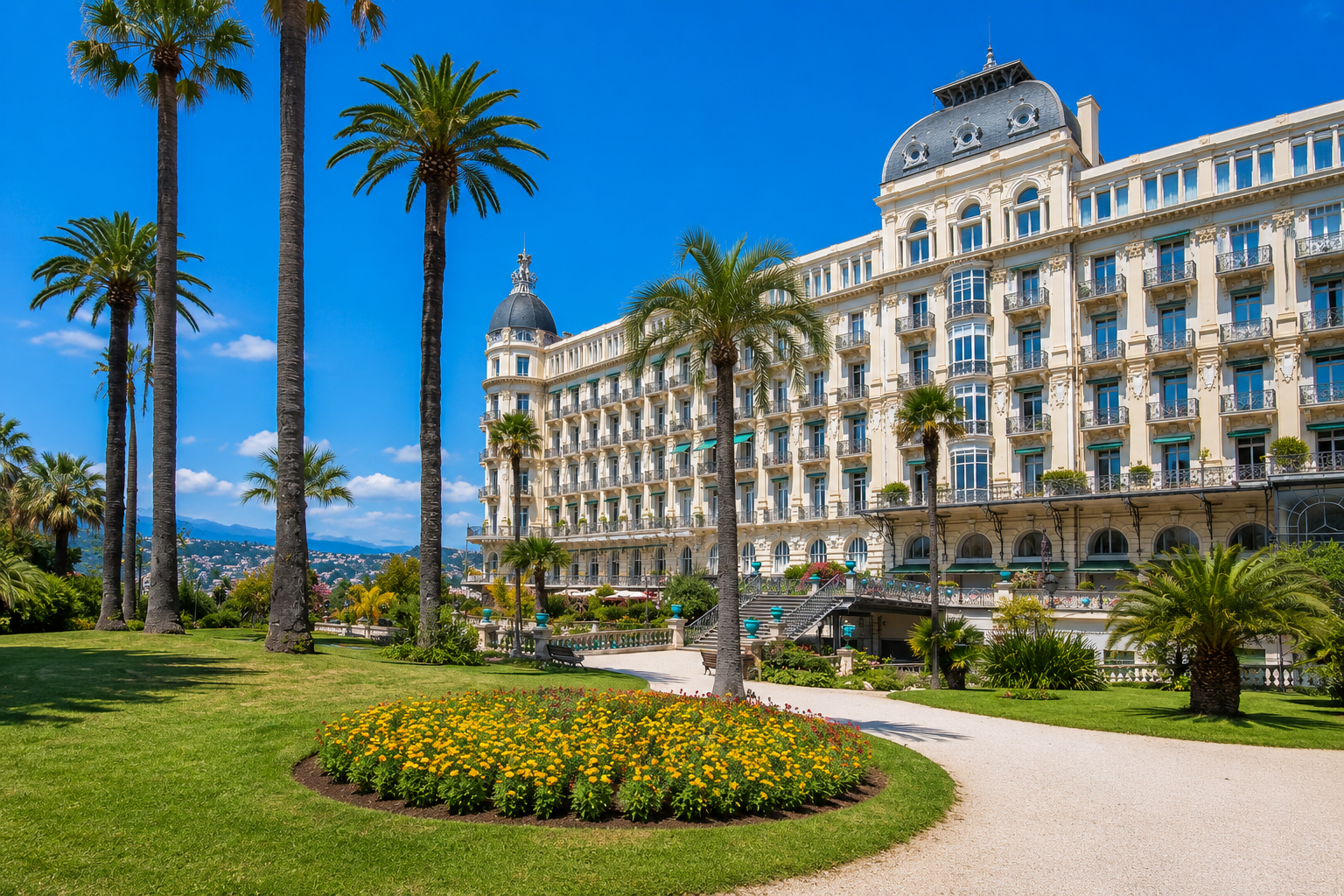
Up the hill to the Régina
In the late 1930s Matisse moved his main Nice studio to the Régina in Cimiez.
The building itself tells another Côte d’Azur story. The enormous former Hôtel Régina had been built during Nice’s great era as a winter resort for Europe’s wealthy northern visitors. Queen Victoria famously stayed there during her visits to Cimiez. By Matisse’s time, that Belle Époque hotel world had faded and the building had been converted into apartments.
For an artist who loved large decorative compositions, the scale was perfect. Matisse occupied spacious rooms with high ceilings and large windows. Plants, textiles, drawings and objects accumulated around him, and the Régina became increasingly important as a working environment.
Later, when his cut-outs grew monumental, he used the walls themselves as working surfaces. Assistants pinned coloured paper forms into position while Matisse adjusted the compositions from his chair or bed.
The studio was no longer simply where the artwork was made. The studio had become part of the artwork. [1][5] The Museum of Modern Art
But between the paintings of the 1930s and those exuberant cut-outs came illness and war.
A remarkably dark background to all that colour
In January 1941, aged 71, Matisse underwent major surgery in Lyon.
He survived, but his physical life changed dramatically. After three months in hospital came a long convalescence. Matisse described what followed as a second life. [6] Chapelle Matisse
At almost exactly the same time, France was living through occupation.
Matisse remained in France, eventually moving from Nice to Villa Le Rêve in Vence in 1943 because he feared the evacuation of Nice. [1][6]
And while his own art from these years can appear serenely removed from politics, his family certainly was not.
His estranged wife Amélie and his daughter Marguerite Matisse-Duthuit became involved in Resistance activities. Marguerite worked as a liaison agent for the FTP. In April 1944 she was arrested by the Gestapo in Rennes, imprisoned and tortured. That August she was put on a deportation convoy towards Germany but was freed at Belfort before the train crossed the border. [7] Musée d’Art Moderne de Paris. She finally saw her father again in Vence in January 1945. Matisse drew her.
The Musée Matisse at Le Cateau records that during their reunion she spent days telling him what she had endured. He produced a new series of portraits of his daughter. [7]
It is difficult to look at the calm, colourful image of Matisse’s late Côte d’Azur years in quite the same way once you know what was happening immediately outside it.
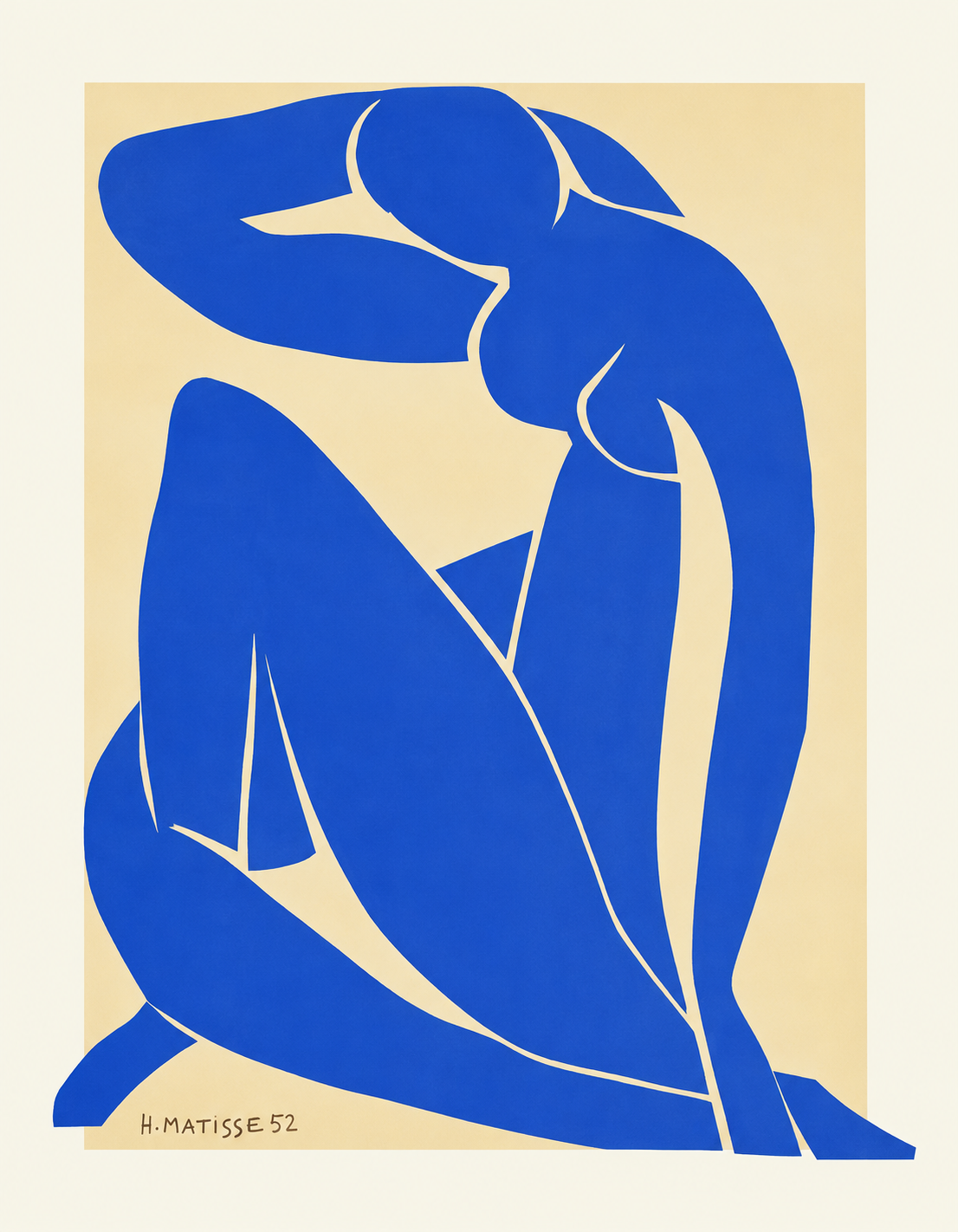
When scissors replaced the brush
Matisse’s illness did not end his career. Instead, physical limitation pushed him towards one of the most radical inventions of his life.
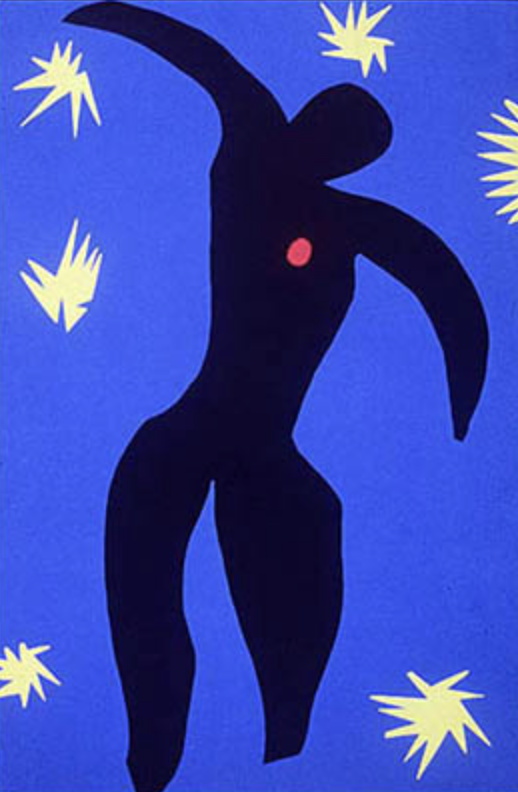
Paper cut-outs.
The method sounds almost ridiculously simple. Studio assistants painted sheets of paper with gouache. Matisse took scissors and cut directly into the coloured paper. The resulting shapes were pinned onto walls or boards, moved around and adjusted until he was satisfied. [5] The Museum of Modern Art
Plants, bodies, stars and abstract forms emerged from the scissors.
Matisse sometimes described this as drawing with scissors, and the phrase is apt. He had effectively removed the distinction between drawing a line and creating a coloured shape.
The results hardly look like the work of an elderly man whose mobility was severely restricted. If anything, they became larger and freer.
At the Régina, works such as The Snail and Memory of Oceania spread across the walls. Assistants helped position the pieces while Matisse directed proceedings. The man had become less mobile. His art did the opposite.
The nurse who became a nun
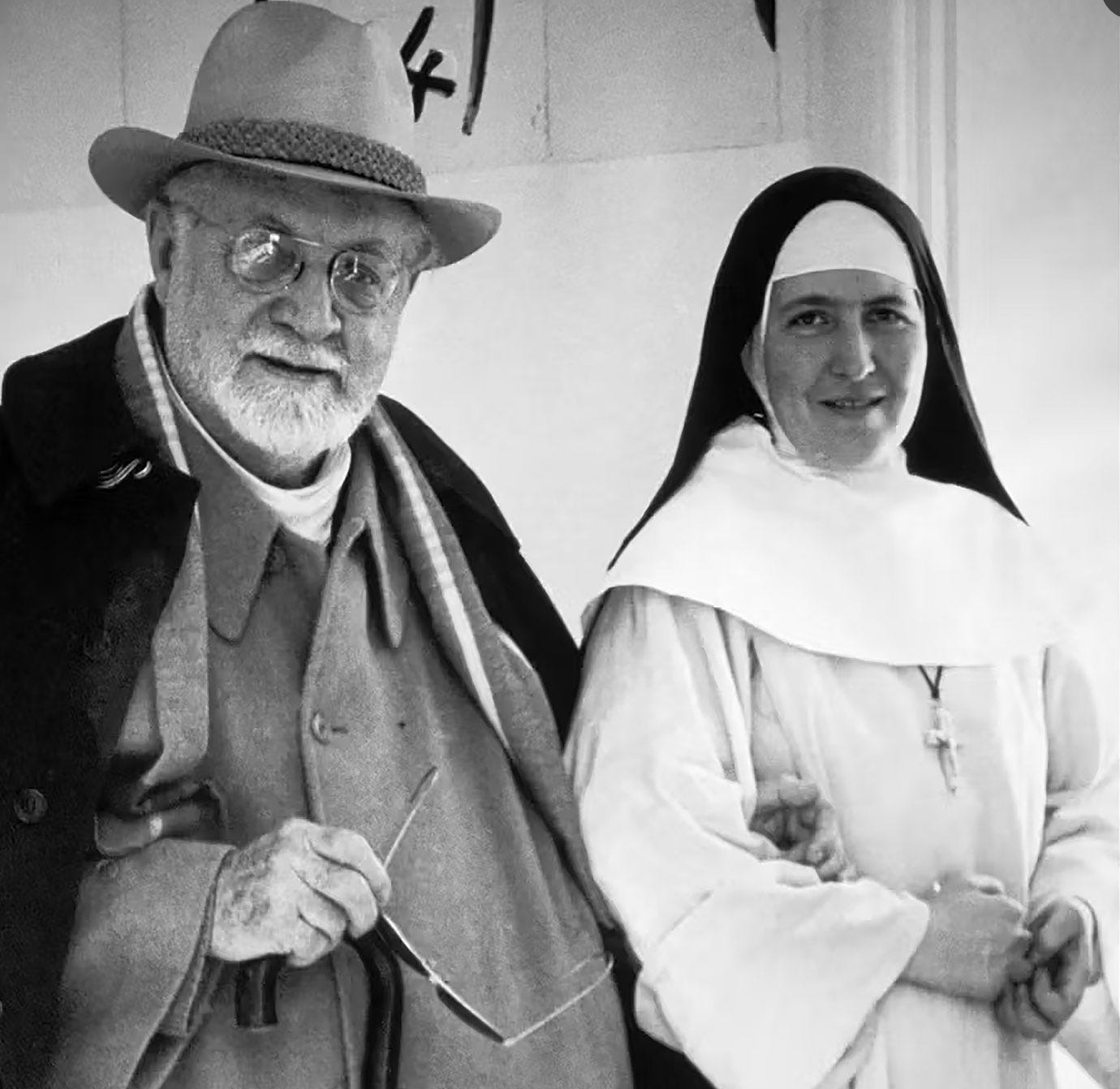
And then there was Monique Bourgeois. She was a young nursing student when she was hired in 1942 to care for Matisse at night. She read to him, talked with him and eventually became one of his models. He painted her several times. [6]
Their friendship might have remained a small episode in Matisse’s biography.
Instead, Monique became a Dominican nun. In 1944 she entered the novitiate and took the name Sœur Jacques-Marie. Matisse was initially dismayed by her decision. Eventually they resumed their friendship. [6]
Then, in 1947, the Dominican sisters in Vence began thinking about replacing the dilapidated garage they were using as a chapel. Sister Jacques-Marie had made a design for a stained-glass window and showed it to Matisse. The project grew. And grew. What began as a possible window became the project that would consume Matisse for approximately four years. He was approaching eighty. Naturally, he decided to design practically everything.
The chapel that brought everything together
The Chapelle du Rosaire in Vence is a remarkably modest building. From the outside, there is little theatricality: white walls, a blue-and-white tiled roof and a slender wrought-iron cross rising above it. [8] Chapelle Matisse
Inside, the simplicity becomes more radical. Matisse worked on virtually every aspect of the chapel: the stained glass, large black line drawings on white ceramic tiles, the altar, liturgical objects and the brightly coloured chasubles worn by the priests. The architectural plans were developed with Dominican brother Louis-Bertrand Rayssiguier; architect Louis Milon de Peillon oversaw construction under Auguste Perret’s authority. [6][9] Chapelle Matisse
Matisse’s palette for the stained glass was strikingly restrained: essentially blue, green and yellow. And then the Côte d’Azur does the rest.
Sunlight passes through the coloured glass and falls across the white interior. As the light changes, the colours move. The architecture is deliberately simple because the architecture is not really the spectacle.
The light is.
The Chapelle du Rosaire was blessed on 25 June 1951. Matisse considered the project the culmination of his life’s work. [6] And suddenly the story that began in a hotel room in Nice in 1917 makes perfect sense.
From a hotel window to a chapel
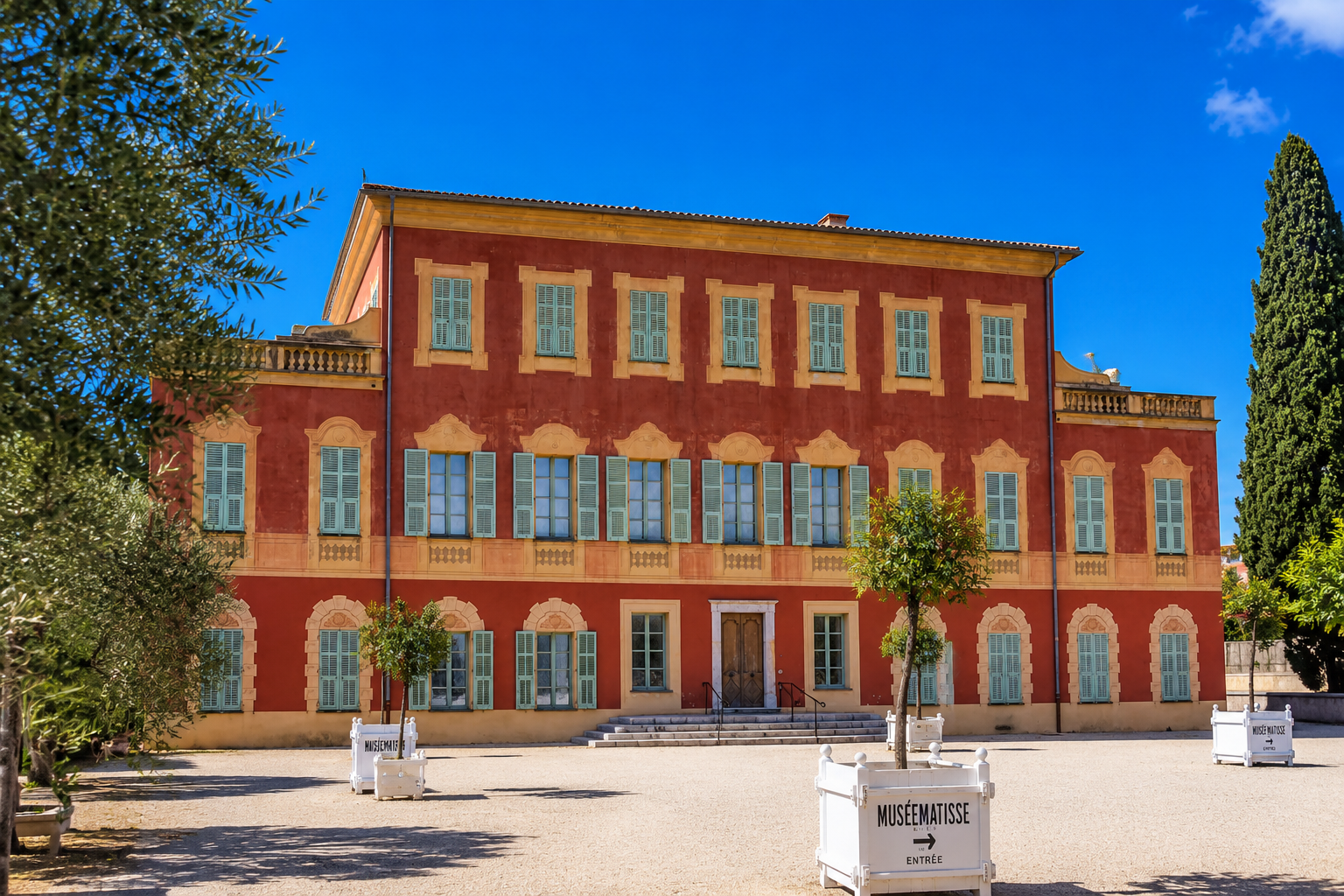
Matisse died in Nice on 3 November 1954, aged 84. He was buried in the cemetery of the Monastère de Cimiez, not far from the Régina and today’s Musée Matisse. [1] Musée Matisse Nice
By then, almost 37 years had passed since he had arrived at the Hôtel Beau Rivage.
He had moved through Nice from the seafront to the old town and eventually uphill to Cimiez. He had painted the Mediterranean through windows, filtered its light through curtains, reflected it in mirrors and bounced it off patterned fabrics. When illness restricted his movement, he covered his walls with colour instead.
And finally, at Vence, he went one step further. Matisse stopped trying to paint the Mediterranean light.He gave it a building to paint for him.
Matisse on the Côte d’Azur in brief
Matisse first arrived in Nice on 25 December 1917. The city’s bright winter light and coloured reflections fascinated him, and Nice subsequently became his principal home and working environment until his death in 1954. [1]
Where did Matisse live in Nice?
Among his important Nice addresses were the Hôtel Beau Rivage, an apartment at 1 Place Charles-Félix near the Cours Saleya and, later, the former Hôtel Régina in Cimiez. These interiors and their views repeatedly influenced his work. [1]
What did Matisse paint in Nice?
Matisse’s Nice period is particularly associated with interiors, female models, odalisques, decorative fabrics and views towards the Mediterranean. During the 1920s he frequently constructed elaborate studio settings using textiles and objects collected during his travels. [2] The Metropolitan Museum of Art
Were Matisse and Picasso friends?
Yes, although they were also important artistic rivals. They met in 1906 and followed one another’s work closely for decades. Both spent important parts of their later careers on the Côte d’Azur. [3]
Why did Matisse start making cut-outs?
Following serious illness and surgery in 1941, Matisse’s mobility became increasingly restricted. During his final decade, cut painted paper became one of his principal media. His assistants prepared gouache-painted paper, which Matisse cut with scissors and arranged into compositions. [5]
Who was Sister Jacques-Marie?
Sœur Jacques-Marie was born Monique Bourgeois. As a young nursing student she cared for Matisse during his recovery and later modelled for him. She subsequently became a Dominican nun and played an important role in the origins and development of Matisse’s Chapelle du Rosaire in Vence. [6]
Did Matisse design the Chapelle du Rosaire in Vence?
Matisse conceived the chapel as a total work of art and designed its stained glass, ceramic imagery, liturgical objects and vestments while working with Dominican advisers and architects on the building itself. The chapel was completed and blessed in 1951. [6][9]
Where is Matisse buried?
Henri Matisse is buried in the cemetery of the Monastère de Cimiez in Nice, close to the Musée Matisse and his former home at the Régina. [1]
Sources & further reading
[1] Musée Matisse Nice — Henri Matisse and Nice
The museum’s detailed chronology of Matisse’s arrival in Nice in December 1917, his different homes and studios, his relationship with the city’s light, the Régina, Vence and his death in 1954. Musée Matisse Nice
Musée Matisse Nice – Matisse and Nice
[2] The Metropolitan Museum of Art — Matisse’s odalisques
Background on Matisse’s Nice interiors, Orientalism, his North African travels and the studio settings he created for his odalisque paintings. The Metropolitan Museum of Art
The Met – Odalisque with Gray Trousers
[3] Museum of Modern Art — Matisse Picasso
MoMA’s major exhibition on the decades-long artistic dialogue, friendship and rivalry between Matisse and Picasso. The Museum of Modern Art
MoMA – Matisse Picasso
[4] Museum of Modern Art — Matisse and the chapel
Background on Picasso’s reaction to the religious project and Matisse’s ambition to create an immersive work at Vence. The Museum of Modern Art
[5] Museum of Modern Art — Henri Matisse: The Cut-Outs
Detailed documentation of Matisse’s working process with gouache-painted paper, scissors, pins and studio assistants. The Museum of Modern Art
MoMA – Henri Matisse: The Cut-Outs
[6] Chapelle du Rosaire, Vence — Historical chronology
The chapel’s own detailed chronology documents Matisse’s 1941 operation, his friendship with Monique Bourgeois/Sœur Jacques-Marie and the conception and construction of the chapel between 1947 and 1951. Chapelle Matisse
Chapelle Matisse – historical chronology
[7] Musée d’Art Moderne de Paris & Musée Matisse Le Cateau-Cambrésis — Marguerite Matisse
Institutional documentation of Marguerite’s work for the Resistance, her arrest and torture by the Gestapo in 1944, the failed deportation and her reunion with her father in 1945. Musée d’Art Moderne de Paris
[8] Chapelle du Rosaire — The building
Official information about the chapel, its exterior and its collection of preparatory drawings, models, photographs and liturgical vestments. Chapelle Matisse
Chapelle du Rosaire, Vence
[9] Chapelle du Rosaire & MoMA — Design and architecture
Sources documenting the collaboration behind the architectural project and Matisse’s design of the chapel’s stained glass, ceramic panels, altar furnishings and vestments.