

Villa Kérylos
A Greek Ideal on the Côte d’Azur
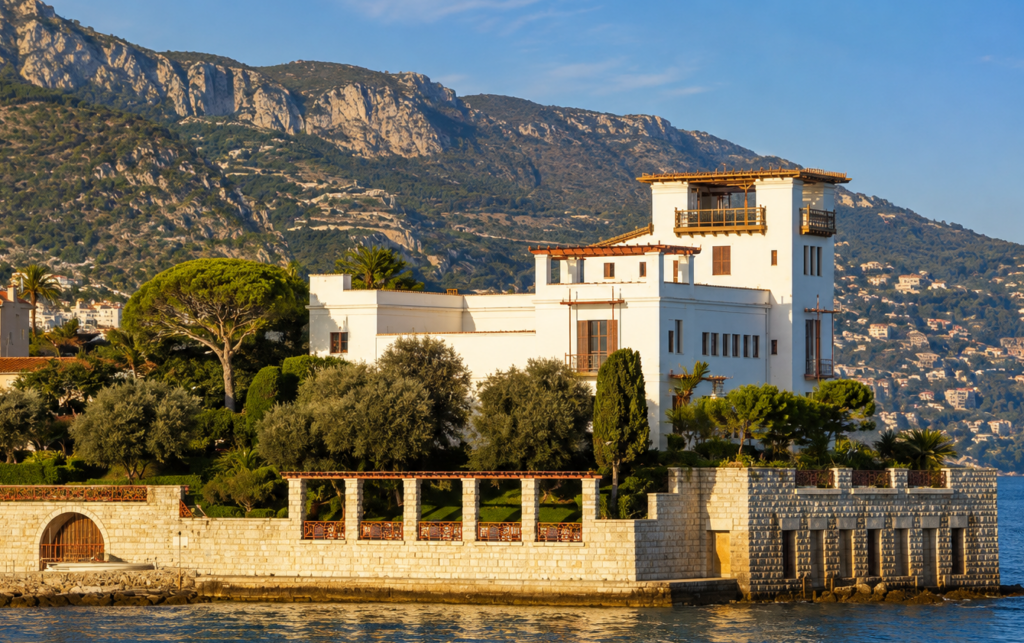
Why did French archaeologist Théodore Reinach build an ancient Greek house in Beaulieu-sur-Mer at the beginning of the twentieth century? Villa Kérylos is far more than an architectural curiosity. It tells a story of archaeology, wealth, idealism and the fascination with the classical world that converged on the Côte d’Azur around 1900.
Walk from the centre of Beaulieu-sur-Mer towards the Baie des Fourmis and, among the palms and Belle Époque villas, you will encounter a house that seems to belong to another place — and another age.
There are none of the turrets, elaborate façades or Renaissance references found in so many of the grand residences built along the Riviera around 1900. Villa Kérylos is strikingly restrained: pale walls, red-painted timber and a sequence of terraces overlooking the Mediterranean.
Step inside and the transition becomes more dramatic.
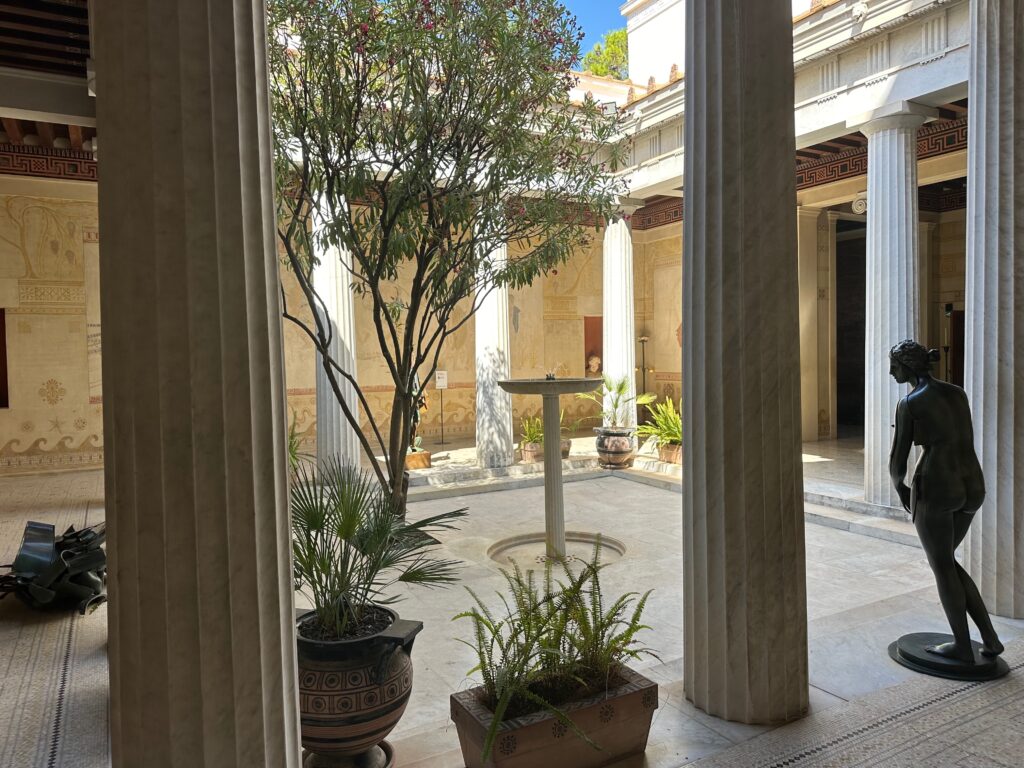
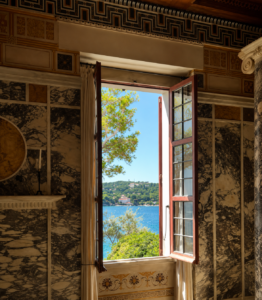
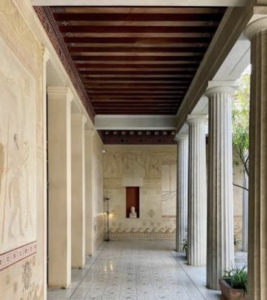
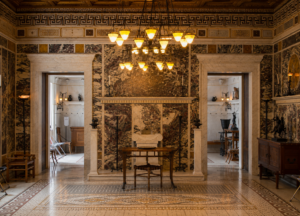
Marble columns surround an internal courtyard. Mosaics cover the floors. Gods and heroes from Greek mythology appear on the walls. Chairs, tables, lamps and decorative objects seem to have arrived from antiquity.
That, of course, was precisely the idea.
Villa Kérylos was built between 1902 and 1908 for Théodore Reinach, a French archaeologist, historian and passionate Hellenist who wanted to do something unusual with his knowledge of ancient Greece.
He wanted to live in it.
The result is one of the most fascinating architectural experiments on the Côte d’Azur.
Beaulieu-sur-Mer around 1900
To understand Villa Kérylos, it helps to first understand Beaulieu-sur-Mer at the turn of the twentieth century.
The French Riviera was undergoing an extraordinary transformation.
The arrival of the railway had made the Mediterranean coast accessible to a wealthy international elite. British aristocrats, Russian families, industrialists, bankers and artists travelled south, initially to spend the winter months in the mild Mediterranean climate.
Nice, Menton and Cannes expanded rapidly. Smaller places such as Beaulieu-sur-Mer became fashionable winter resorts in their own right.
Grand hotels appeared. Exotic gardens were planted. Villas rose among palms, pines and olive trees.
Architecture became part of the spectacle. Italian palazzi, neo-Gothic castles, neoclassical villas and buildings inspired by the Renaissance could stand almost side by side. Wealthy owners had both the land and the means to turn architectural fantasies into reality.
The Riviera became a place where a house could say something about who its owner was — or who its owner wanted to be.
Against this background, Théodore Reinach made an unusual choice.
He did not look to Versailles.
He did not look to Florence.
He looked back more than two thousand years, towards ancient Greece.
Who was Théodore Reinach?
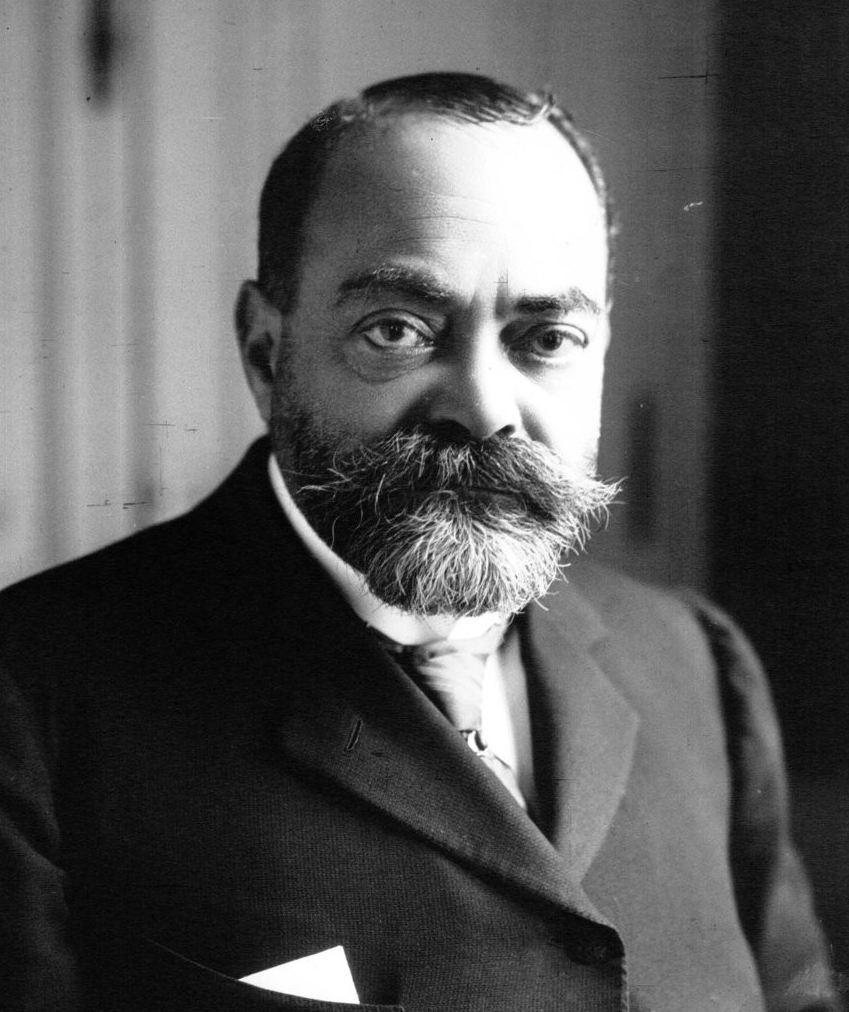
Théodore Reinach, born in 1860, was not simply a wealthy man with a taste for antiquities.
He was a scholar, archaeologist, historian, numismatist, Hellenist and politician, and belonged to an exceptionally intellectual French family. His brothers Joseph and Salomon Reinach were prominent figures in French public and academic life as well.
For Théodore, ancient Greece was not decorative inspiration. It was a serious field of study.
He became a member of the Académie des Inscriptions et Belles-Lettres and devoted much of his academic life to the languages, history, art and culture of the ancient Mediterranean world.
So when Reinach decided to build a family residence at Beaulieu-sur-Mer, a conventional Riviera villa would have been an oddly anonymous choice.
Why merely collect Greek objects?
Why hang classical paintings on the walls?
Why place a few columns in the garden?
Why not attempt something much more ambitious:
to imagine how it might actually feel to live in an ancient Greek house?
Emmanuel Pontremoli: an architect who understood archaeology
For such an experiment, Reinach needed an unusual architect.
He found one in Emmanuel Pontremoli.
Pontremoli had studied at the École des Beaux-Arts in Paris and won the prestigious Grand Prix de Rome in 1890. His architectural education was closely connected to the study of antiquity, and his travels and archaeological work in the eastern Mediterranean gave him first-hand knowledge of classical architecture.
This made the partnership between Reinach and Pontremoli particularly interesting. One was a scholar of ancient Greece. The other was an architect capable of translating archaeological evidence into actual space.
Their objective was not to reproduce one specific ancient house.
Villa Kérylos was something more speculative.
It was an attempt to create an ideal Greek house — a home based on archaeological knowledge but adapted to the life of an affluent French family in the early twentieth century. That distinction is crucial.Kérylos is not a replica.It is an interpretation.
Delos on the Baie des Fourmis
Among the important sources of inspiration were the ancient houses excavated on Delos, the small Greek island in the Cyclades.
Delos had been one of the major religious and commercial centres of the ancient Mediterranean. Archaeological excavations during the nineteenth century revealed not only temples and public monuments, but domestic architecture.
For Reinach and Pontremoli, this was particularly valuable. European architects had been studying Greek temples for centuries. Their columns, proportions and pediments had been reproduced on banks, museums, government buildings and country houses throughout Europe. But temples tell us relatively little about daily domestic life.
A house poses different questions.
Where did people gather?
How did daylight enter?
How were private and public spaces separated?
How did people move through the building?
What did they sit on?
What surrounded them while they ate or talked?
At Kérylos, such questions become architecture. At the centre of the villa is a peristyle surrounded by twelve monolithic columns of white Carrara marble. Rooms are arranged around this central space in a manner inspired by ancient Mediterranean domestic architecture. Yet there is an important problem. The Reinach family was not living in ancient Greece. They were living in 1908.
An ancient house with electricity
This is where Kérylos becomes particularly intriguing. Behind its vision of antiquity lay the technology of the modern age.
The villa had electricity, plumbing, heating and bathrooms. It needed kitchens and practical domestic spaces. It had to function as a comfortable residence for a wealthy twentieth-century family.
Pontremoli therefore faced a question that no archaeological excavation could answer:
How do you build an ancient Greek house for modern people?
A literal reconstruction was impossible. Every modern convenience required interpretation. How do you introduce a bathroom without destroying the illusion? How do you incorporate electricity? How large should windows be?
Where do you conceal modern technology? How do you reconcile twentieth-century expectations of privacy and comfort with a domestic model dating from antiquity?
The solutions are one reason Villa Kérylos is much more interesting than a simple historical reproduction. The house exists simultaneously in two periods. One foot stands in ancient Greece. The other stands firmly in the Belle Époque.
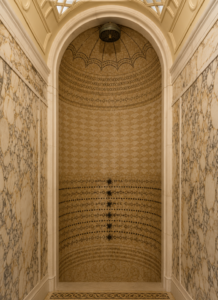
Even the furniture had to be reinvented
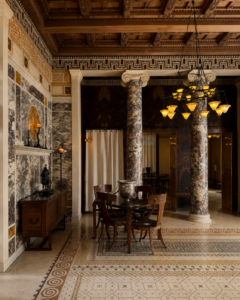
Pontremoli’s involvement did not stop with the architecture. Furniture and interiors were conceived as part of the same intellectual exercise.
Designs drew on ancient representations, archaeological discoveries and objects depicted on Greek pottery. The Parisian cabinetmaker Bettenfeld produced furniture designed specifically for the villa.
One of the most recognisable forms is the klismos — the elegant ancient Greek chair with curved legs and a sweeping back, familiar from representations on classical pottery.
But Kérylos goes considerably further. Lighting, fabrics, tableware and decorative objects all contribute to the same environment. Where an exact ancient precedent was unavailable, Pontremoli and his collaborators had to interpret the evidence.
Architecture, furniture and art therefore become inseparable.
The art of an ancient Greece that never quite existed
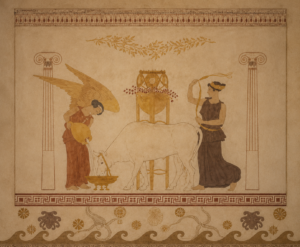
The painted interiors add another layer.Artists including Adrien Karbowsky and Gustave-Louis Jaulmes created decorative schemes inspired by Greek mythology and ancient art, while sculptural and stucco work contributed to the architectural programme.
Gods, heroes and mythological narratives inhabit the rooms. Yet these images reveal something fundamental about Kérylos. They were not painted in antiquity. They were painted by artists working in France at the beginning of the twentieth century, using the archaeological discoveries and visual knowledge available to them at the time.
What was known could be studied. What was missing had to be imagined.
And that is why Villa Kérylos tells us at least as much about Europe around 1900 as it does about Greece two thousand years earlier. This is not ancient Greece itself. It is ancient Greece seen through the eyes of highly educated Europeans at the height of the Belle Époque: harmonious, cultivated, rational and aesthetically refined.
A scholarly reconstruction, certainly. But also an ideal.
When archaeology becomes architecture
This separates Kérylos from much of the historicist architecture built during the same period. A neo-Gothic château evokes the Middle Ages. A neo-Renaissance villa borrows the vocabulary of Renaissance architecture.
Kérylos goes further. Reinach and Pontremoli attempted to transform archaeological knowledge into a three-dimensional living environment.
In that sense, the house can almost be viewed as an early form of experimental archaeology.
What happens when the proportions of rooms are derived from ancient precedents? How does a peristyle affect the way people move through a house? What happens when furniture known primarily from Greek pottery is reconstructed and actually used? How much of the past can architecture recover? Kérylos does not provide a definitive answer. The house itself is the experiment.
Why build it in Beaulieu-sur-Mer?
There remains an obvious question. Why here? The Mediterranean provides part of the answer. The intense light, blue sea, rocky coastline and vegetation make the visual association with Greece almost effortless.
But there is a broader reason. Around 1900, the Côte d’Azur was an extraordinary architectural laboratory. Many of the people building houses here came from elsewhere. They brought money, ideas, collections and cultural references with them. Unlike in an established city neighbourhood, where architecture is constrained by its surroundings, the Riviera offered land and freedom.
A villa could become autobiography. A Russian patron could evoke home.
A British owner could create an English garden. A collector could build around art. And a French Hellenist could construct his own version of ancient Greece.
Kérylos tells us not simply how Reinach wanted to live. It tells us something about how he saw himself.
A remarkable neighbour across the bay
A few years after Kérylos was completed, construction began on another extraordinary Riviera residence nearby: Villa Ephrussi de Rothschild on Saint-Jean-Cap-Ferrat.
Geographically, the two villas are close. Intellectually, they seem worlds apart. Kérylos is disciplined, archaeological and scholarly. Villa Ephrussi is theatrical, eclectic and shaped by the instinct of the collector.
One attempts to create a coherent world. The other brings different worlds together. Seen alongside each other, the villas reveal two different ways in which the wealthy European elite used architecture on the Côte d’Azur around 1900. Neither house is simply somewhere to live. Both are expressions of identity.
Is Villa Kérylos really Greek?
Perhaps this is the most interesting question of all.
However meticulous Reinach and Pontremoli were, nobody in 1902 could know precisely what it felt like to inhabit a luxurious Greek house two thousand years earlier. Archaeology gives us fragments. A floor. A wall. A column. An object. An image on a vase. A sentence in an ancient text.
Between those fragments lie enormous gaps. Villa Kérylos fills them.
Not arbitrarily, but with the archaeological knowledge, artistic preferences and technical possibilities available at the beginning of the twentieth century. That is why calling Kérylos a copy of an ancient Greek villa does it a disservice. It is an interpretation of antiquity.
And perhaps that is precisely why it remains so compelling.
From private experiment to French heritage
A deeply personal architectural experiment had become part of France’s cultural heritage. Today Villa Kérylos is open to visitors. But anyone who sees only its marble, mosaics, frescoes and sea views misses the larger story. Kérylos ultimately asks a much more intriguing question:
Can architecture bring a lost world back to life?
Reinach and Pontremoli believed it was worth trying.For their experiment, they chose a rocky edge of the Mediterranean at Beaulieu-sur-Mer.
More than a century later, the experiment is still there.
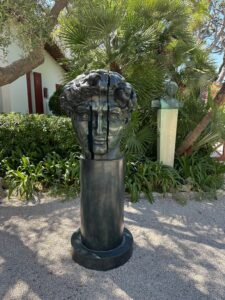
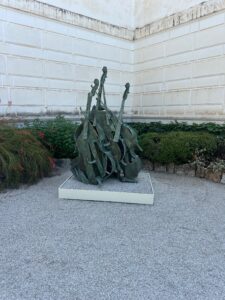
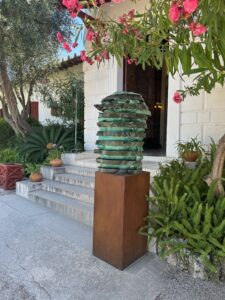
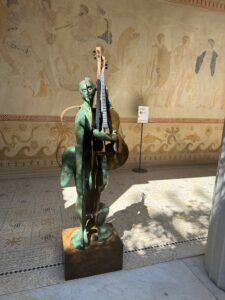
Villa Kérylos now hosts changing art exhibitions. These photographs are from a 2024 exhibition featuring works by the artist Arman.
What is Villa Kérylos?
Villa Kérylos is an early twentieth-century villa in Beaulieu-sur-Mer on the French Riviera, conceived as an interpretation of a luxurious ancient Greek house. It combines archaeological references to classical Greece with the comforts and technology of the Belle Époque.
Where is Villa Kérylos?
Villa Kérylos stands on the Baie des Fourmis in Beaulieu-sur-Mer, in the Alpes-Maritimes department of southern France. It lies between Nice and Monaco and faces the Mediterranean close to Saint-Jean-Cap-Ferrat.
Who built Villa Kérylos?
Villa Kérylos was commissioned by Théodore Reinach, a French archaeologist, historian, Hellenist and politician with a profound scholarly interest in ancient Greece.
Who was the architect of Villa Kérylos?
The villa was designed by French architect Emmanuel Pontremoli, who had studied classical architecture extensively and combined his Beaux-Arts training with archaeological knowledge of the ancient Mediterranean.
When was Villa Kérylos built?
Villa Kérylos was built in Beaulieu-sur-Mer between 1902 and 1908, during the Belle Époque, when the French Riviera was attracting wealthy residents and visitors from across Europe.
What architectural style is Villa Kérylos?
Villa Kérylos is best understood as a modern interpretation of ancient Greek domestic architecture rather than as a conventional Greek Revival building. Its architecture, interiors, furniture, mosaics and painted decoration were conceived as parts of a single classical environment.
Was Villa Kérylos copied from a real Greek house?
No. Villa Kérylos is not an exact reconstruction of one ancient building. Reinach and Pontremoli drew on archaeological research and several ancient sources, including domestic architecture discovered on the Greek island of Delos.
Where evidence was incomplete, they interpreted it.
Did Villa Kérylos have modern facilities?
Yes. Despite its ancient appearance, Villa Kérylos was designed as a comfortable twentieth-century residence. It incorporated electricity, plumbing, heating and modern sanitary facilities.
This combination of archaeological reconstruction and Belle Époque technology is one of the most distinctive aspects of the house.
Why was Villa Kérylos built in Beaulieu-sur-Mer?
The Mediterranean setting suited Reinach’s fascination with Greece, but Beaulieu-sur-Mer was also part of a much wider phenomenon. Around 1900, the Côte d’Azur attracted wealthy international residents who commissioned highly individual villas inspired by their origins, collections, travels and intellectual interests.
Villa Kérylos is one of the clearest surviving examples of this culture.
What is the connection between Villa Kérylos and Villa Ephrussi de Rothschild?
The two famous villas stand close to each other, with Villa Kérylos in Beaulieu-sur-Mer and Villa Ephrussi de Rothschild on neighbouring Saint-Jean-Cap-Ferrat.
Both date from the extraordinary period of villa building on the Côte d’Azur around the beginning of the twentieth century, but their philosophies are very different. Kérylos is inspired by the scholarly reconstruction of ancient Greece; Ephrussi reflects the cosmopolitan world of the collector.
Can you visit Villa Kérylos?
Yes. Villa Kérylos is a historic monument open to the public in Beaulieu-sur-Mer. Because opening days, hours and admission conditions can change, visitors should check the villa’s official website before travelling.
Why is Villa Kérylos important?
Villa Kérylos is significant because it brings together architecture, archaeology, decorative art and the social history of the Belle Époque Côte d’Azur.
Rather than simply imitating Greek architecture, Théodore Reinach and Emmanuel Pontremoli attempted to reconstruct an entire way of living based on the archaeological knowledge available around 1900.
That makes Kérylos not only one of the most unusual villas on the French Riviera, but also a fascinating document of how Europeans at the beginning of the twentieth century imagined the classical past.
Read all about Beaulieu-sur-Mer here!