

The Negresco
The hotel that refused to become ordinary
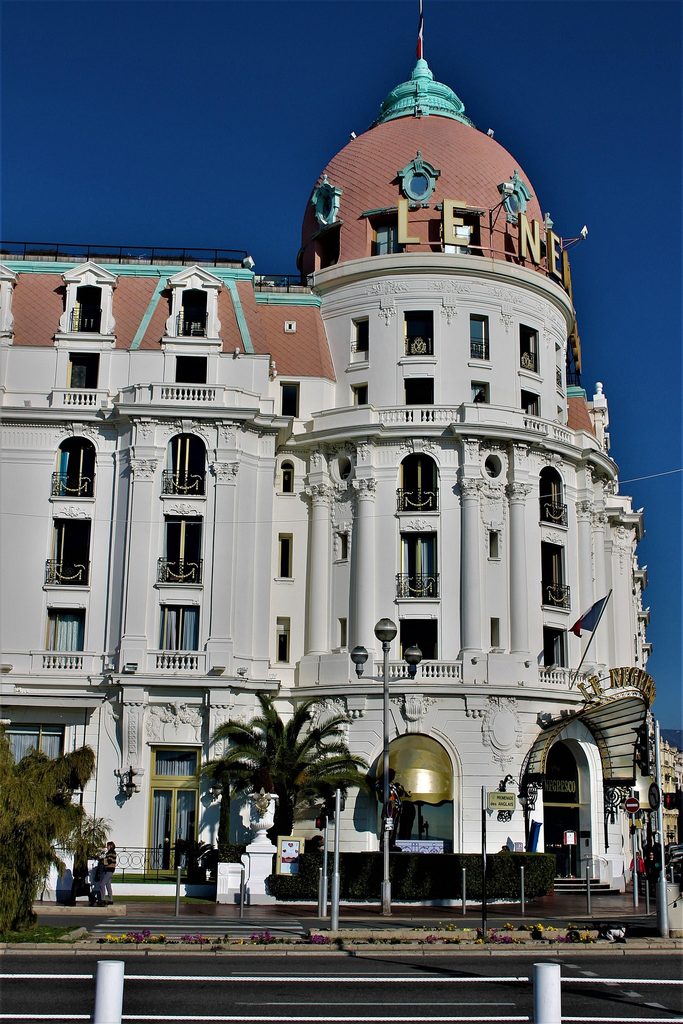
For more than a century, the pink dome of the Negresco has watched over the Promenade des Anglais. It was conceived for Russian grand dukes, American millionaires and the European aristocracy, survived two world wars and financial collapse, became the life’s work of one extraordinarily determined woman and accumulated thousands of works of art along the way. Today it is one of the last great Belle Époque hotels on the Côte d’Azur still serving its original purpose. But the real story of the Negresco is not that it survived. It is that, somehow, it survived without becoming like everywhere else. [1]
There are hotels that belong to a city, and there are hotels that become part of its silhouette. In Nice, the Negresco belongs firmly to the second category. Its white façade and pink dome have become so inseparable from the Promenade des Anglais that it is easy to imagine they have always been there.
The Negresco opened in 1913, at the very end of an extraordinary period in Nice’s history. The city was not yet primarily a summer destination. Wealthy Europeans came south for the winter, escaping the cold of London, St Petersburg, Brussels and Paris. They built villas, promenaded beside the Mediterranean and expected hotels capable of reproducing the standards, and social hierarchy, of the world they had left behind.
Into that world stepped a Romanian innkeeper’s son with an ambitious idea. His name was Henri Negrescu, or, as Nice would come to know him, Henri Negresco.
Henri Negresco’s impossible hotel
Negresco was born in Bucharest, the son of an innkeeper, and made his career in hospitality after leaving Romania. By the beginning of the twentieth century he had become an accomplished maître d’hôtel, working in the rarefied world of wealthy European society.
Eventually he arrived on the Côte d’Azur. His ambition was not modest. He wanted to create one of Europe’s great palace hotels. With financial backing from the industrialist Alexandre Darracq, he commissioned Édouard-Jean Niermans, the Dutch-born Parisian architect who had become a specialist in theatres, cafés and luxury hotels. Niermans was exactly the sort of architect required for the job: someone who understood that a palace hotel was not simply a building containing bedrooms. It was a stage on which wealthy guests expected to perform their social lives. [1]
The site presented a problem. It was an awkward diamond-shaped plot between the Promenade des Anglais and the streets behind it.
Niermans turned the problem into the organising principle of the building. Four wings surround an elliptical central court covered by an enormous glass roof. A diagonal axis connects the opposing rotundas, creating the space that became the Salon Royal. The architecture combines eighteenth-century classical references with what was, in 1912, extremely modern construction and hotel technology.
When the Negresco opened on 8 January 1913, it had around 420 rooms, equipped with an extraordinary degree of comfort for the period, including private bathrooms. [1]
Negresco had built his dream, but his timing could hardly have been worse.
One glorious year
A little over a year later, Europe went to war. The wealthy international clientele on which the Riviera’s palace hotels depended disappeared almost overnight. The Negresco was requisitioned and converted into a military hospital. Its grand rooms, created for aristocrats and millionaires, received wounded soldiers instead.
After the war, the old world did not simply return. Henri Negresco’s finances collapsed and he lost control of the hotel he had created. He died in Paris in 1920, leaving behind the building that still carries his name.
There is something almost cruel about the timing. Negresco had spent years climbing through the European hotel world, found the money and architect to create his palace, opened it at precisely the moment Nice was at the height of its Belle Époque glamour — and then watched the world for which he had built it disappear. The hotel survived him, but for several decades, it was no longer quite sure what it was supposed to be.
The woman who bought a fading palace
The second life of the Negresco began in 1957. Jean-Baptiste Mesnage, a Breton entrepreneur who had made his fortune in property, acquired the hotel and entrusted its management to his daughter Jeanne and her husband, the Nice lawyer Paul Augier. [2]Jeanne Augier was 34.
The Negresco she inherited was not the pristine Belle Époque palace we see today. Its glory had faded and substantial work was needed. Augier did not restore it in the conventional sense, but she began creating something else.
She wanted, as she later explained, to recover the magnificence of the France of Louis XIV and preserve decorative techniques and craftsmanship that were disappearing. Gradually the hotel filled with furniture, paintings, sculptures, tapestries and objects from different periods of French history.
There was no attempt to make everything match.
That may be the most important thing to understand about the Negresco.
A conventional interior designer might have selected a period and followed it through. Augier happily placed historical furniture and old masters in the same hotel as contemporary art. The collection eventually grew to more than 6,000 works and pieces of furniture spanning around five centuries. Louis XIV found himself sharing an address with Niki de Saint Phalle. And somehow it worked!
A museum where you can order breakfast
Walking through the Negresco is consequently a rather peculiar experience. There is a monumental portrait of Louis XIV in coronation robes, associated with Hyacinthe Rigaud’s famous official portrait of 1701. Augier acquired the work from a Belgian collector as part of her determination to bring important French works back to France. [3]
The Versailles Salon goes considerably further. Its coffered ceiling came from the Château de Menjoux in Savoie; its fireplace was moved stone by stone from the Château de Hautefort in Dordogne.
Elsewhere, contemporary works interrupt the historical narrative.
One of the best known is a Nana by Niki de Saint Phalle; exuberant, colourful and not remotely interested in behaving like Louis XIV. This is why calling the Negresco an art hotel doesn’t really capture it.
It isn’t a hotel that acquired some expensive contemporary works because somebody in marketing decided art would be good for the brand.
The collection is the interior. Rooms and corridors move through different periods. Furniture can be as important as paintings. Historical objects are still surrounded by guests going to breakfast, waiters carrying trays and suitcases being wheeled towards lifts.
Like La Colombe d’Or in Saint-Paul-de-Vence, it offers something museums increasingly struggle to provide, art remains surrounded by ordinary life.
Although, admittedly, ordinary life at the Negresco has always been rather relative.
Under the great glass roof
The architectural heart of the hotel is the Salon Royal. The enormous elliptical room occupies Niermans’ original central courtyard and is covered by the great glass roof that is now itself protected as a Monument Historique. The French Ministry of Culture describes it as the central organising space of the building. [1]
Hanging beneath it is an extraordinary Baccarat chandelier, 4.6 metres high and made from 16,800 pieces of crystal. According to the Negresco, it was originally commissioned by Tsar Nicholas II for the Kremlin. [4]
Whether or not every detail of the story has acquired a little extra polish over a century of hotel storytelling, the chandelier belongs perfectly here. The entire room was conceived for spectacle, and that is important.
The Belle Époque palace hotel was not simply somewhere wealthy people slept. The public rooms were designed to see and be seen in. Architecture created the social theatre. More than a century later, the Salon Royal is still performing essentially the same function.
That continuity helped earn the Negresco official recognition. Its façades and roofs had been protected since the 1970s; in 2003, the protection was extended and the façades, roofs, interior courtyard and Salon Royal with its glass roof were classified as Monuments Historiques.
The pink dome — and a story that may be too good
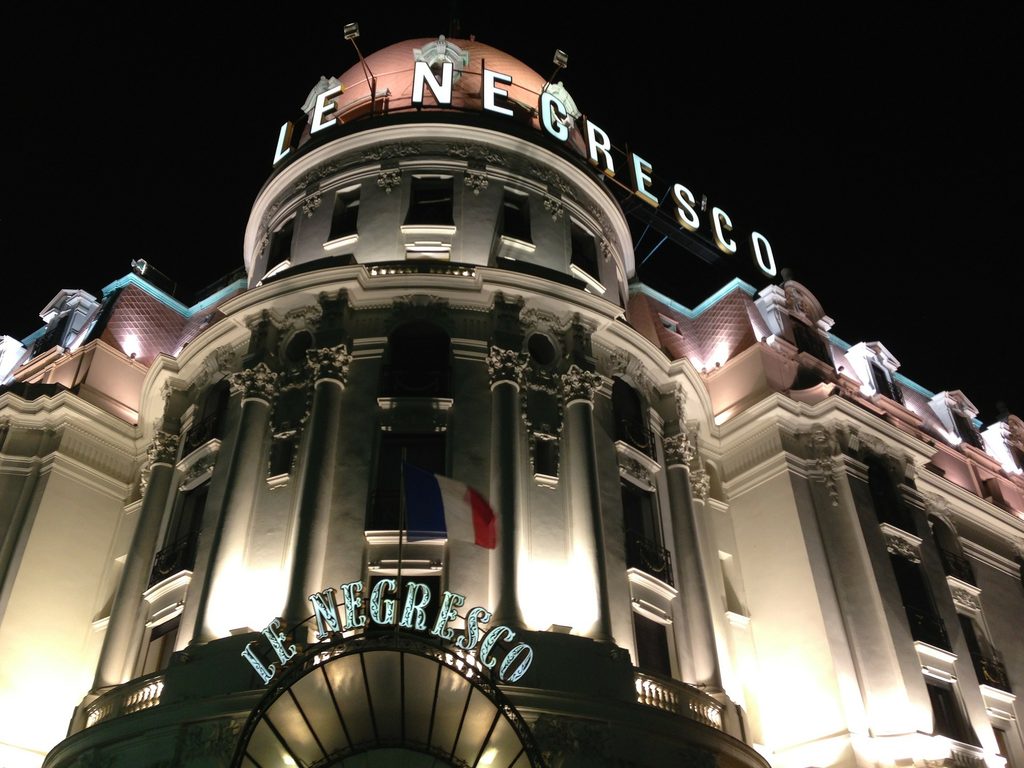
And then there is the dome. It is the part of the Negresco everybody recognises.There is a persistent Riviera story that its voluptuous shape was inspired by the breast of a woman — depending on the version, either a mistress of Henri Negresco or a woman connected to the architect. It’s a wonderful story.
Unfortunately, reliable architectural sources are considerably less enthusiastic about it. The French Ministry of Culture’s detailed description of the building attributes the architecture to Niermans and explains its plan and stylistic influences without mentioning any anatomical inspiration. [1] So we should probably place this particular story where it belongs: somewhere between architectural history and a very good story told after dinner. The Negresco has accumulated quite a few of those.
Dalí, a cheetah and the business of becoming a legend
Once Jeanne Augier had restored the hotel to prominence, its guest list became part of its identity. Grace Kelly came, as well asThe Beatles, Louis Armstrong, Elton John and Salvador Dalí . They were all among the famous guests associated with the hotel.
Dalí, predictably, managed to be more conspicuous than most.The Negresco’s own historical archive records him walking through the hotel with a cheetah on a leash. [5]. This is one of those anecdotes that sounds invented specifically for a Côte d’Azur hotel. In Dalí’s case, however, it is entirely plausible behaviour.
There are other stories. Richard Burton is said to have left behind a diamond necklace intended for Elizabeth Taylor. During the first Nice Jazz Festival in 1948, Louis Armstrong encountered the song C’est si bon, which he would later record in English. But a list of famous guests misses the point because Jeanne Augier understood that a great hotel needs personality more than celebrity. Famous people came partly because the Negresco was not interchangeable with another five-star hotel in another city. And much of that personality was hers.
Madame
For decades Jeanne Augier was simply known around the hotel as Madame. She was not an invisible owner.
She selected art and furniture, oversaw the decoration and received guests. The hotel became an expression of her own rather fearless taste. She loved French history, contemporary art and animals, and apparently saw no compelling reason why those interests should be kept separate. [2]
She was also fiercely protective of the hotel’s independence. International hotel groups showed interest. Augier refused to sell.
One frequently repeated story has Bill Gates offering to buy the Negresco and inviting her effectively to name her price. Her reported response was admirably short: the Negresco was not for sale. Le Monde reported the anecdote in its obituary of Augier, though, as with many stories surrounding famous hotels, it is best understood as a reported recollection rather than a transaction documented in public records.
Her determination mattered. Across the Côte d’Azur, many Belle Époque hotels disappeared, were converted into apartments or became parts of international groups. The Ministry of Culture describes the Negresco as one of the last Belle Époque palace hotels in the region still performing the function for which it was originally built. [1]. But the independence Augier guarded so carefully became much more difficult to protect towards the end of her life.
When Madame could no longer run her hotel
For more than half a century, Jeanne Augier had controlled the Negresco with remarkable determination. Then her health deteriorated.
Augier suffered from Alzheimer’s disease. As her ability to manage her affairs diminished, questions arose about the management of both her personal fortune and the complicated corporate structure surrounding the hotel.
In 2013 she was placed under legal guardianship, while the Negresco companies came under court-appointed provisional administration.
She remained in the place that had consumed most of her adult life, living in her apartment inside the Negresco. What followed was an uncomfortable final chapter.
People around the increasingly vulnerable owner came under scrutiny, and questions were raised about financial decisions and documents signed during the period in which her mental capacity was deteriorating. In 2016, a figure involved in the hotel’s administration was formally placed under investigation on suspicion of abus de faiblesse, exploitation of a vulnerable person. That judicial status represented an investigation, not a finding of guilt.
At the same time, the future of an extraordinarily valuable property on the Promenade des Anglais inevitably attracted attention. Employees worried about a possible sale. Distant family interests emerged. Administrators and courts became involved. Even actions taken by the then public prosecutor of Nice concerning the future administration of the hotel became controversial; the matter was subsequently transferred away from Nice amid concerns about possible conflicts surrounding a prospective purchaser.
There is an irony here because Augier had spent years trying to prevent precisely this uncertainty.
An inheritance designed to outlive its owner
Jeanne and Paul Augier had no children. In 2009, while she was still capable of arranging her succession, Jeanne created the Fonds de Dotation Mesnage-Augier-Negresco.
The idea was unusual but entirely consistent with the woman who had spent decades refusing to sell. Rather than allowing the hotel and her fortune simply to pass into private hands, the fund was intended to protect her legacy. Its objectives included maintaining and developing the Negresco, supporting people with disabilities, animal welfare and promoting French art.
In other words, even her inheritance combined the same things that had occupied her life: the hotel, art, social causes and animals.
Jeanne Augier died at the Negresco on 7 January 2019, aged 95. [6]
She left behind one of the most recognisable hotels in France, thousands of works of art and a succession complicated enough to keep lawyers, administrators and journalists occupied long after her death.
There is something poignant about that ending. For decades Augier had refused to let anyone else decide what the Negresco should become.
Unfortunately at the end of her life, that was the one decision she could no longer make herself.
So who owns the Negresco today?
This is where her plan ultimately matters. Despite the disputes surrounding her final years and succession, the Negresco was not swallowed by an international hotel group.
Today, the hotel states that it belongs to the Fonds de Dotation Mesnage-Augier-Negresco, to which Augier left her estate. The fund is chaired by Nicole Spitz and the hotel is led by director-general Lionel Servant.
So in one important respect, Madame got what she wanted, the Negresco remained independent.
That doesn’t mean it has been frozen in 1957. Rooms have been renovated, new facilities have been added and the building requires continual restoration — not least because more than a century of salt-laden air from the Mediterranean is not particularly kind to a Belle Époque façade.
But the peculiar mixture remains, The Louis XIV portrait is still there. So is Niki de Saint Phalle, The Baccarat chandelier still hangs beneath the glass roof.
And guests still sleep in the building Henri Negresco created for a society that vanished more than a century ago. The Negresco managed to change without becoming like everywhere else.
The Negresco in brief
The Negresco was commissioned by Romanian-born hotelier Henri Negresco and designed by architect Édouard-Jean Niermans. It opened on 8 January 1913 on the Promenade des Anglais. The original hotel contained approximately 420 rooms and represented the latest standards of luxury hospitality.
Who was Henri Negresco?
Henri Negresco was the Romanian-born son of an innkeeper who built a career in European luxury hospitality before creating his own palace hotel in Nice. The First World War devastated the business shortly after it opened, and he lost control of the hotel before his death in 1920.
Who was Jeanne Augier?
Jeanne Augier was the daughter of Jean-Baptiste Mesnage, whose family acquired the Negresco in 1957. Together with her husband Paul Augier, she restored and reinvented the hotel. Over the following decades she assembled its eclectic collection of more than 6,000 artworks and pieces of furniture.
Why is there so much art inside the Negresco?
Jeanne Augier deliberately conceived the hotel as a celebration of several centuries of French art and decorative history. The collection ranges from historical furniture and Old Master paintings to modern and contemporary works, including Niki de Saint Phalle.
What is the Salon Royal?
The Salon Royal is the Negresco’s great elliptical central hall beneath a monumental glass roof. It formed part of architect Niermans’ solution to the hotel’s unusually shaped site and is now protected as part of the building’s Monument Historique classification.
What is special about the Negresco chandelier?
The enormous Baccarat crystal chandelier in the Salon Royal is 4.6 metres high and contains 16,800 crystals. According to the Negresco, it was originally commissioned by Tsar Nicholas II for the Kremlin.
Was the Negresco a hospital during the First World War?
Yes. Soon after opening, the hotel was requisitioned and converted into a military hospital during the First World War. The loss of its wealthy international clientele contributed to Henri Negresco’s financial collapse.
Is the Negresco a protected historic monument?
Yes. Parts of the building had been protected since the 1970s, and in 2003 its façades, roofs, interior courtyard and Salon Royal with its glass roof were classified as Monuments Historiques.
Did Salvador Dalí really bring a cheetah to the Negresco?
The Negresco’s own historical account records Salvador Dalí walking through the hotel with a cheetah on a leash. He was one of numerous artists, musicians and actors associated with the hotel during Jeanne Augier’s years.
What happened to Jeanne Augier at the end of her life?
Augier developed Alzheimer’s disease and was placed under legal guardianship in 2013. The hotel companies came under provisional court administration, and disputes and investigations subsequently arose around the management of her affairs and the future of the Negresco. She died at the hotel in January 2019, aged 95.
Who owns the Negresco today?
As of 2026, the Negresco is owned by the Fonds de Dotation Mesnage-Augier-Negresco, the endowment fund to which Jeanne Augier left her estate. This structure has allowed the hotel to remain independent rather than becoming part of an international hotel chain.
Sources & further reading
[1] French Ministry of Culture — Hôtel Negresco
The strongest source for the architecture and early history: Niermans, Henri Negresco, the original plan, 420 rooms, Salon Royal and the hotel’s Monument Historique status.
French Ministry of Culture – Hôtel Negresco
[2] Le Negresco — History and Jeanne Augier
The hotel’s historical archive covers the 1957 acquisition by Jean-Baptiste Mesnage, Jeanne and Paul Augier’s management and the development of the art collection.
Le Negresco – history
[3] Le Negresco — Louis XIV and the art collection
Background on Jeanne Augier’s acquisition of the monumental Louis XIV portrait and her approach to collecting French art.
Le Negresco – Louis XIV
[4] Le Negresco — Salon Royal
Official documentation of the glass roof and the 4.6-metre Baccarat chandelier containing 16,800 crystals.
Le Negresco – Salon Royal
[5] Le Negresco — Art Through the Ages
The hotel’s historical archive on its celebrity guests, including Dalí and his cheetah, Louis Armstrong and other episodes in its post-war cultural history.
Le Negresco – Art Through the Ages
[6] Le Monde — Jeanne Augier and the Negresco succession
Reporting on Augier’s final years, the 2009 endowment fund, her legal guardianship and the conflicts surrounding the future of the hotel.
https://www.lemonde.fr/disparitions/article/2019/01/10/la-mort-de-jeanne-augier-proprietaire-du-negresco-a-nice_5407364_3382.html?utm_source=chatgpt.com