

La Colombe d’Or
The Inn Where Artists Left More Than Their Names Behind
There are restaurants with art on the walls, and then there is La Colombe d’Or. In Saint-Paul-de-Vence, paintings and sculptures by some of the greatest artists of the twentieth century hang above dining tables, stand beside the swimming pool and appear almost casually in the garden. Picasso came here. So did Matisse, Braque, Chagall and Calder. Later came actors, writers and film stars. The remarkable thing is that La Colombe d’Or never really became a museum. It remained what it had always been: a family-run inn where people came to eat, drink, argue, fall in love and, occasionally, leave a work of art behind.
To understand La Colombe d’Or, you have to forget Saint-Paul-de-Vence as it looks today.
The village is now one of the best-known destinations on the Côte d’Azur, filled with galleries, restaurants and visitors making their way through its medieval streets. In the early twentieth century, it was a much quieter place. Artists were attracted by the landscape, the light and — importantly — the fact that life here was considerably cheaper than in Paris.
At the entrance to the village, a local man named Paul Roux opened a modest café-bar in the 1920s. It was initially called Chez Robinson. Roux was not an art dealer or a collector with a grand plan. He was an innkeeper with an apparently exceptional instinct for hospitality.
That turned out to be enough.
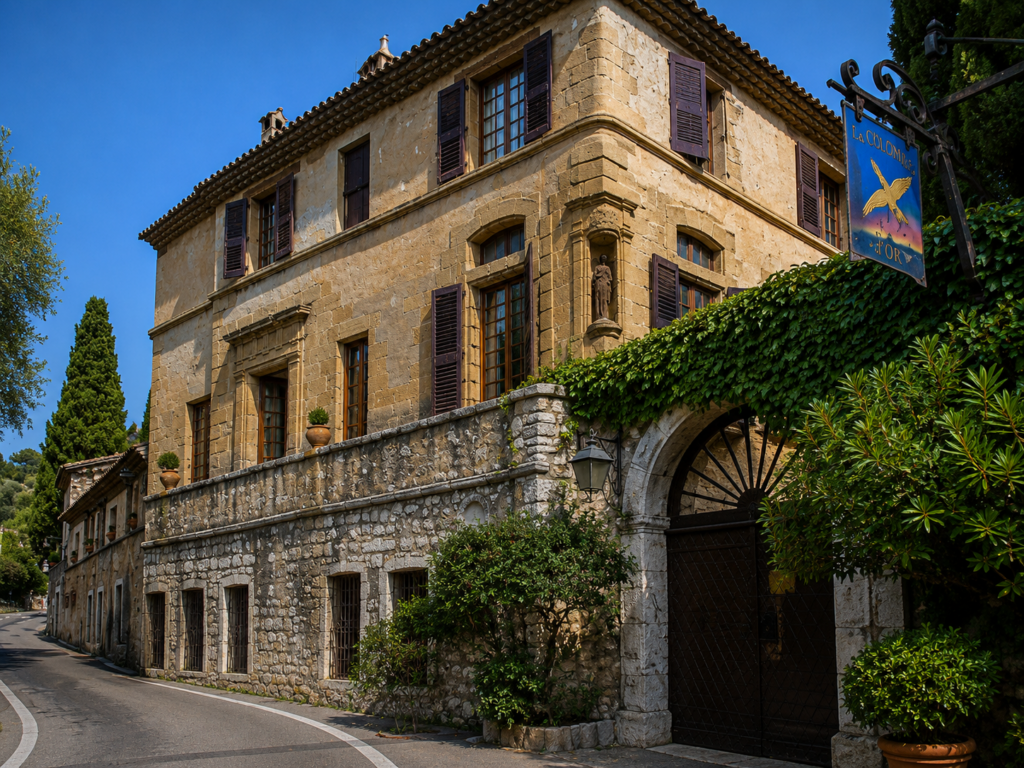
From Chez Robinson to La Colombe d’Or
Paul Roux expanded the café, added rooms and eventually renamed it La Colombe d’Or.
The timing was fortunate. During the interwar years, the Côte d’Azur was becoming a magnet not only for wealthy winter visitors but for artists and writers. The inexpensive villages of the hinterland offered something different from the grand hotels of Cannes or Nice.
Painters came to Saint-Paul. And they came to Roux.
Among those associated with the village and La Colombe d’Or were Georges Braque, Henri Matisse, Pablo Picasso, Fernand Léger and later Marc Chagall. Writers and poets joined them.
Saint-Paul gradually developed the artistic reputation it still has today. France’s official tourism site describes La Colombe d’Or as a celebrated artists’ haunt whose walls contain works by guests including Matisse, Calder, César and Picasso. [1]
Roux himself painted under the name Paul la Colombe, which may help explain why artists felt so comfortable around him. He was not merely serving lunch to painters; he enjoyed their world. More importantly, he made room for it.
Did artists really pay their bills with paintings?
This is the story everybody knows about La Colombe d’Or.
Struggling artists ate and slept there. When they could not pay, Paul Roux accepted a painting instead. Those paintings later became enormously valuable, which explains why a restaurant in Saint-Paul-de-Vence now has an extraordinary private art collection.
It is a wonderful story. It is also a little too neat.
There is truth behind it. Artists did exchange work, give pieces to the Roux family and leave art at La Colombe d’Or. Hospitality and art existed within a much less formal economy than they would today, particularly before some of these artists achieved enormous commercial value.
But the collection did not materialise simply because generations of penniless geniuses forgot their wallets. Paul Roux also collected deliberately. Friendships developed over years, works were exchanged and acquired, and subsequent generations of the Roux family continued adding to the collection.
That distinction makes the story better rather than worse. La Colombe d’Or did not accidentally win an art-world lottery. The Roux family recognised artists, befriended them and created a place to which they wanted to return.
When the art stayed on the walls
The extraordinary thing about the collection is how it is displayed.
There is no hushed gallery. No white cube. No little line on the floor telling you not to come closer.
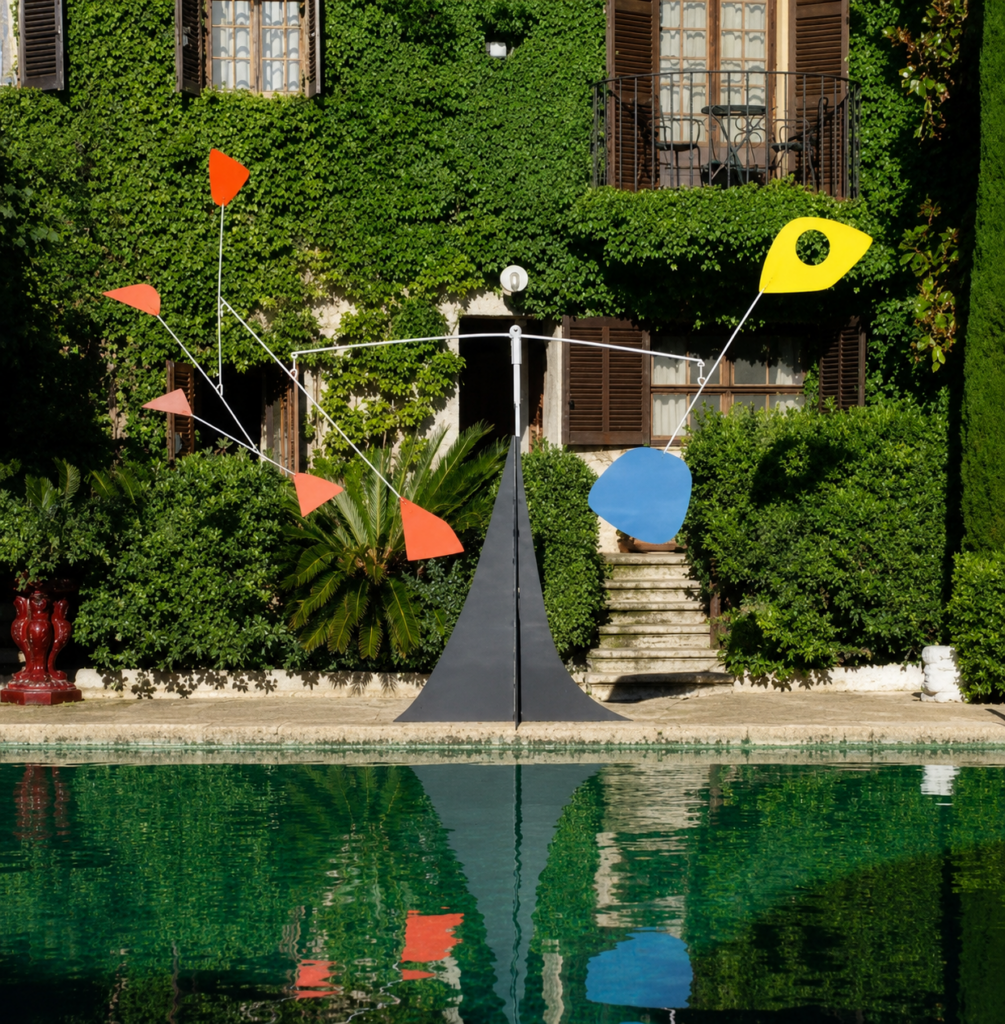
A Léger might be hanging while somebody eats lunch beneath it. A Calder mobile occupies space above diners. Ceramics, paintings and drawings share walls with the ordinary business of a restaurant.
Outside, art continues into the garden.
The swimming pool is particularly famous. A large Calder mobile hangs nearby, while other modern works appear among stone walls, plants and terraces.
The effect is almost the opposite of a museum. These objects were not removed from life in order to become art. That is perhaps the real luxury of La Colombe d’Or. Not that it owns important art, but that it has never felt the need to behave too reverently around it.
Chagall moves into the neighbourhood
Of all the artists associated with Saint-Paul-de-Vence, Marc Chagall developed perhaps the deepest connection with the village.
Chagall settled in Saint-Paul in the 1960s and remained there for the rest of his life. He became a familiar presence at La Colombe d’Or, only a short distance from his home.
By then, the relationship between Saint-Paul and modern art had become firmly established. Georges Braque also spent part of each year in the village, while nearby Aimé and Marguerite Maeght were developing their own extraordinary network of artists.
The Maeghts represented and befriended artists including Braque, Joan Miró, Alberto Giacometti, Chagall and Calder. Their Fondation Maeght opened just outside Saint-Paul in 1964. Fondation Maeght
This created an unusual concentration of artistic life within a very small area. Artists might be represented by the Maeght gallery, work with the family on the future foundation, stay in Saint-Paul and eat at La Colombe d’Or. The village was not merely somewhere artists visited.
For a period, it functioned almost like an informal club. And La Colombe d’Or was its dining room.
Picasso came too
Picasso was another regular visitor, particularly during the years when he lived in nearby Vallauris and Cannes. He knew many of the same people. Braque was there. Chagall was there. Prévert was there. The Maeght circle was nearby.
For Picasso, travelling to Saint-Paul was hardly an expedition. But his presence illustrates something important about the artistic Côte d’Azur of the post-war years. The places we now treat as separate cultural attractions — Picasso in Antibes, ceramics in Vallauris, Chagall in Saint-Paul, the Fondation Maeght — were part of the same social geography. People knew one another. They ate together. They visited one another’s studios. Ideas, gossip and relationships travelled between Antibes, Vallauris, Cannes and Saint-Paul.
Art history tends to put everybody in separate museum rooms. Real life was considerably messier.
From painters to movie stars
After the war, another species began arriving at La Colombe d’Or.
The movie star.
The Côte d’Azur was becoming increasingly associated with cinema. The Cannes Film Festival brought actors, directors and producers south, and Saint-Paul offered an attractive escape from the flashbulbs on the Croisette.
The guest list consequently began to read rather differently. Sophia Loren, Lino Ventura, Romy Schneider, Roger Moore and Tony Curtis are among the film personalities associated with Saint-Paul and its famous inn. France’s official tourism site records the shift from painters and writers towards the international film world. FRANCE.FR
But two names belong particularly to La Colombe d’Or: Yves Montand and Simone Signoret.
A game of pétanque and a love affair
Their story gives La Colombe d’Or exactly the sort of anecdote no marketing department could invent quite as well.
In 1949, actress Simone Signoret was staying at La Colombe d’Or. Yves Montand was there too. They met.
The pétanque terrain outside the hotel became one of the settings for their courtship, and the relationship developed quickly. Signoret was still married to filmmaker Yves Allégret at the time. She left him.
Montand and Signoret subsequently became one of France’s most famous couples and married in Saint-Paul-de-Vence in 1951. The wedding celebrations were held at La Colombe d’Or. Suddenly the inn’s mythology was no longer only about painting. It had romance. Cinema. And just enough scandal.
Montand would later have a highly publicised affair with Marilyn Monroe while filming Let’s Make Love in Hollywood in 1960. His marriage to Signoret nevertheless survived, and they remained together until her death in 1985.
For a place already filled with Picassos and Calders, having one of France’s great twentieth-century love stories begin over pétanque almost feels excessive.
The swimming pool with a Picasso nearby
The swimming pool at La Colombe d’Or has become almost as recognisable as the dining room.
It represents another stage in the evolution of the place. What began as a modest café had gradually become a hotel with gardens, terraces and a pool. But each addition was absorbed into the same informal mixture of Mediterranean architecture and modern art.
The juxtaposition can occasionally feel almost absurd. People swim.
Someone orders lunch. A Calder moves gently in the air. A work that would be roped off in a museum is simply part of the scenery.
It is worth remembering that many of these objects did not have today’s financial status when they arrived. The extraordinary value came later.
That has allowed La Colombe d’Or to preserve something that would be almost impossible to recreate today: great art without museum behaviour.
Why didn’t the Roux family sell?
This may be the most interesting question of all.
As the reputations of Picasso, Matisse, Braque, Léger, Calder and others grew, the works accumulated by La Colombe d’Or became increasingly valuable. Very valuable.
Selling even part of the collection could have produced an enormous financial return. Instead, the family kept it together.
And because La Colombe d’Or remains in the Roux family, the art largely remains where generations of guests encountered it.
That decision transformed the place.
Without the collection, La Colombe d’Or would still be a beautiful and historic Provençal hotel. With it, the building has become something much stranger: a restaurant, hotel, family home, private collection and piece of twentieth-century cultural history all at once.
Has La Colombe d’Or changed?
Of course it has.
It could hardly remain the inexpensive artists’ refuge of the 1930s when the paintings on its walls became worth fortunes and Saint-Paul itself became an international destination.
The struggling painter is unlikely to settle tonight’s bill with a promising canvas. Reservations are difficult. Guests know perfectly well what is hanging around them.The legend has become part of the attraction.
And yet La Colombe d’Or has resisted the most obvious temptation: turning itself into a luxury hotel that merely uses its artistic history as decoration. It remains family-run. It is still relatively small. And the art is not presented as a separate attraction. That continuity matters.
La Colombe d’Or in brief
What is La Colombe d’Or?
La Colombe d’Or is a historic hotel and restaurant at the entrance to Saint-Paul-de-Vence on the Côte d’Azur. Founded by Paul Roux, it became an important meeting place for twentieth-century artists, writers and later film stars.
Why is La Colombe d’Or famous?
It is famous both for its extraordinary artistic clientele and for the private collection displayed throughout the hotel and restaurant. Artists associated with the place include Pablo Picasso, Henri Matisse, Georges Braque, Fernand Léger, Marc Chagall and Alexander Calder. FRANCE.FR
Did artists really pay for rooms and meals with paintings?
Works of art were indeed exchanged, gifted and acquired through the Roux family’s relationships with artists. However, the popular story that the entire collection resulted from impoverished artists routinely paying hotel bills with paintings oversimplifies a much longer history of friendship and collecting.
Which artists visited La Colombe d’Or?
The artists and writers associated with La Colombe d’Or and Saint-Paul include Picasso, Matisse, Braque, Léger, Chagall, Calder, Jacques Prévert and Jean Cocteau, among many others. FRANCE.FR
What is the connection between Yves Montand and Simone Signoret?
Yves Montand and Simone Signoret met in Saint-Paul-de-Vence in 1949 and became a couple. They married in the village in 1951, with La Colombe d’Or closely associated with their courtship and wedding celebrations.
What is the connection between La Colombe d’Or and the Fondation Maeght?
They are separate institutions but belong to the same twentieth-century artistic history of Saint-Paul-de-Vence. Many artists associated with La Colombe d’Or — including Braque, Chagall, Calder and others — were also friends or artists of Aimé and Marguerite Maeght. The Fondation Maeght opened near the village in 1964. Fondation Maeght
Can you visit La Colombe d’Or?
La Colombe d’Or remains a functioning privately owned hotel and restaurant rather than a museum. Its collection forms part of the interiors and grounds used by guests and diners.
Sources & further reading
[1] La Colombe d’Or – historical material and family history
The hotel’s own history is the essential starting point for the Roux family, the development of the auberge and its relationships with artists.
[2] France.fr – La Colombe d’Or and its artistic clientele
France’s official tourism platform documents La Colombe d’Or as a historic artists’ inn and identifies figures including Chagall, Matisse, Calder, César and Picasso among those associated with it. FRANCE.FR
[3] France.fr – The Côte d’Azur Painters Route
Background on Saint-Paul-de-Vence as a gathering place for painters, writers, filmmakers and actors and the role of La Colombe d’Or — formerly Chez Robinson — in that history.
[4] Fondation Maeght – History of the Fondation
Primary institutional source on Aimé and Marguerite Maeght, their relationships with Braque, Miró, Giacometti, Chagall and Calder and the creation of the Fondation in Saint-Paul-de-Vence. Fondation Maeght
[5] Fondation Maeght – Georges Braque and Saint-Paul-de-Vence
The Fondation records that Braque was already spending January and February in Saint-Paul each year before the Fondation existed and later became closely involved in its creation.