

Picasso’s Riviera
Art, Women and the Houses He Left Behind
For almost three decades, Pablo Picasso made the Côte d’Azur his home. From Antibes and Vallauris to Cannes and Mougins, each move marked a new chapter in his work — and often in his private life.
The Riviera gave him studios, clay, space and eventually the privacy that his enormous fame had taken away. In return, Picasso left his mark on the region. Following his houses and studios today reveals not only an extraordinary artist, but also a much more complicated man.
Picasso was already in his sixties when the Côte d’Azur became a permanent part of his life. He was internationally famous, politically outspoken and still producing work at a pace that would have exhausted a much younger artist. What followed was certainly no Mediterranean retirement.
Between the end of the Second World War and his death in Mougins in 1973, Picasso experimented intensively with ceramics, created monumental political works, filled successive houses with paintings and objects and became something close to a local celebrity.
Antibes belongs to the optimism of the immediate post-war years; Vallauris to ceramics and family life with Françoise Gilot; Cannes to Jacqueline Roque, fame and the magnificent creative chaos of La Californie; and Mougins to increasing seclusion and the furious productivity of his final years. [1]
The houses changed, the women changed and the work changed with them. Picasso, on the other hand, remained unmistakably Picasso.
Antibes: Picasso after the war
The Riviera story really begins in Antibes.
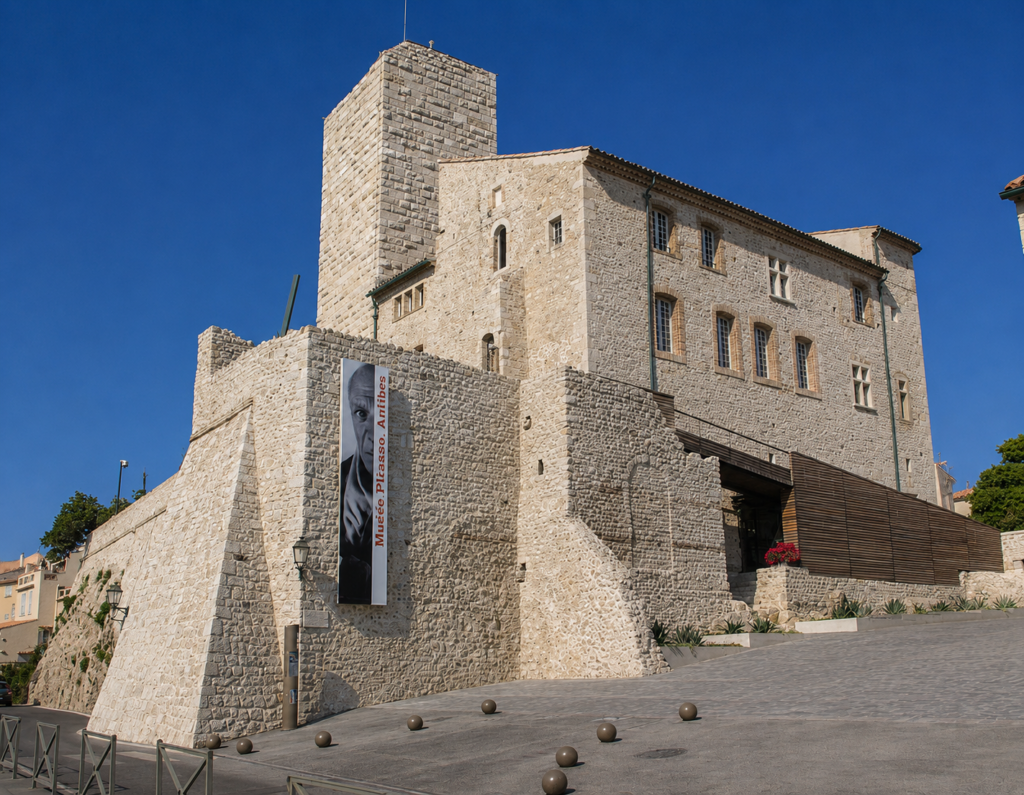
In 1946, Romuald Dor de la Souchère, curator of the Musée Grimaldi, offered Picasso part of the Château Grimaldi as a studio. Picasso accepted enthusiastically and worked there for several months. When he left, he deposited 23 paintings and 44 drawings with the town. They included works such as La Joie de vivre, Satyre, Faune et centaure au trident and Nature morte à la chouette et aux trois oursins. The château would eventually become the Musée Picasso. [2]
The work Picasso produced in Antibes feels strikingly different from much of what had preceded it. After the darkness of war and occupation, the Mediterranean returned to his work in the form of fauns, centaurs, sea creatures, bodies and mythology.
Calling this simply a discovery of the famous Mediterranean light would be too easy. Picasso was born in Málaga; the Mediterranean was hardly exotic territory. What Antibes seems to have offered was something closer to a reconnection with a world he already understood — sun, sea, antiquity, sensuality and the mythology of southern Europe.
Beside him during these years was Françoise Gilot, a French painter forty years his junior. They had met in Paris in 1943, and their relationship became established in 1946. Their children Claude and Paloma were born in 1947 and 1949. [1]
Describing Gilot simply as Picasso’s muse, however, does her a considerable disservice. She was an artist in her own right and, unlike many people in Picasso’s orbit, eventually decided that living with Picasso was not a sufficient reason to remain with him.
She left in 1953.
Picasso was apparently astonished. He was accustomed to being the person who determined when relationships began and ended, and Gilot later described his attempts to convince her that without him she would disappear into obscurity. Instead she continued painting, published the bestselling Life with Picasso, later married Jonas Salk and lived to 101. Picasso, meanwhile, tried unsuccessfully to stop her memoir from being published.
It is one of the more satisfying reversals in his biography: a man who spent his life turning other people into subjects suddenly discovered what it was like to become somebody else’s subject.
Vallauris: when clay changed everything
Picasso first encountered the Madoura pottery workshop in Vallauris in 1946. Two years later he settled in the town with Gilot and their young family, living at Villa La Galloise. He would remain closely associated with Vallauris until his move to Cannes in 1955. [3]
The encounter with ceramics opened an entirely new field for him.
Vallauris had a centuries-old pottery tradition and Picasso suddenly had access to both material and highly skilled craftspeople. He did not simply decorate plates and bowls. He treated traditional ceramic forms as things waiting to become something else: vessels turned into women, plates acquired faces and owls appeared from pieces of pottery.
It suited the way Picasso looked at objects. A thing never necessarily had to remain the thing it had originally been made to be.
The Vallauris years were also unusually domestic. Gilot and their two children were around him, while artists and writers including Jean Cocteau, Jacques Prévert and Paul Éluard were part of the wider circle. Official museum accounts describe the period after the war as a time of considerable family happiness. [3]
There was politics too. Picasso had officially joined the French Communist Party in 1944 and remained a member for the rest of his life. Vallauris, with its working-class and communist traditions, suited this political identity rather well. [4]
By then, however, Picasso was also one of the world’s most valuable artists. His work was collected internationally and his fame was enormous.
The communist millionaire is an obvious contradiction, although Picasso himself seems to have had relatively little difficulty living with it.
His great political legacy in Vallauris is La Guerre et la Paix. Created in the early 1950s for the chapel of the former priory, the monumental work sets war and peace against one another on opposing walls. It belongs to the same politically engaged strand of Picasso’s work as Guernica. [5]
Unlike a Picasso removed from its context and hung in a museum in Paris or New York, War and Peace is still experienced in the place for which it was conceived. That alone makes Vallauris essential to understanding his years on the Riviera.
La Californie: Picasso moves into the picture
Françoise Gilot left Picasso in 1953. By then another woman had entered his life.
Jacqueline Roque had met him while working at Madoura. She was in her twenties; Picasso was more than forty years older. She would become his second wife in 1961 and one of the women he portrayed most frequently during his entire career. [1]
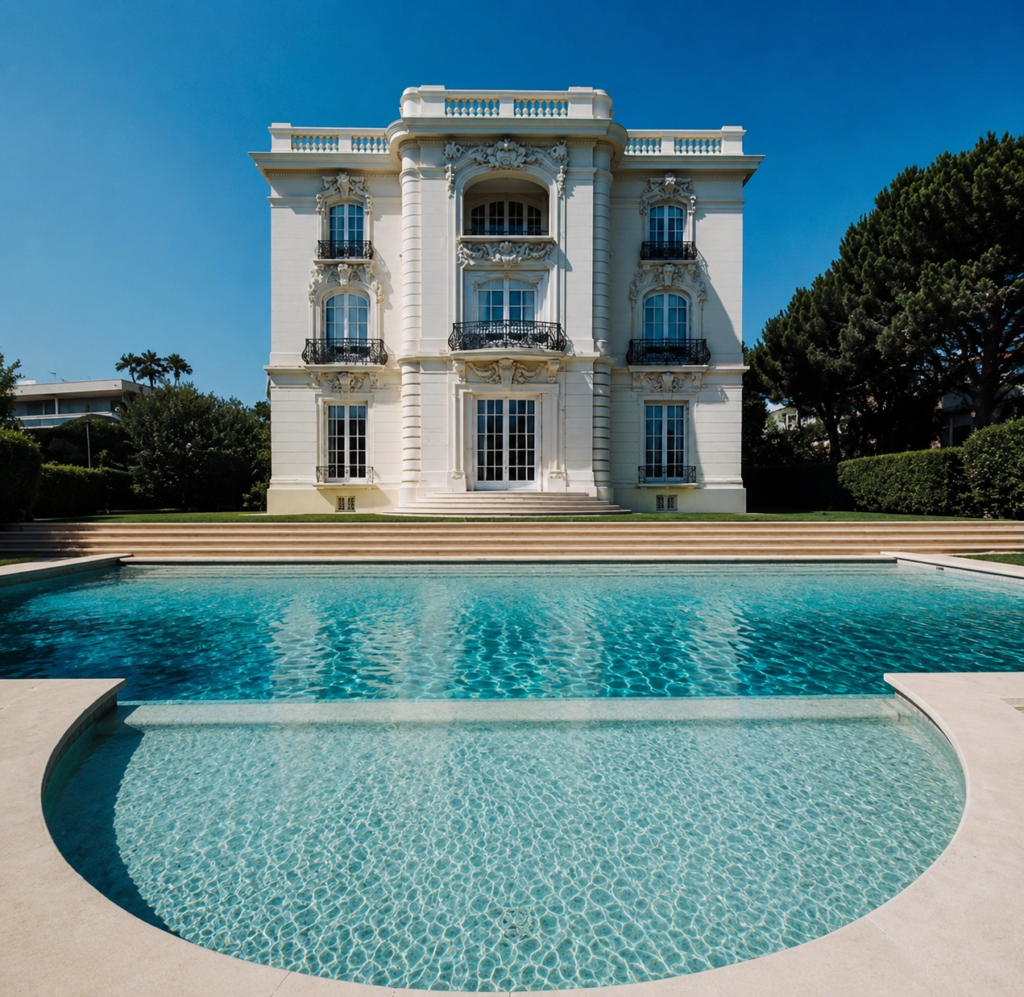
In 1955 Picasso moved with Jacqueline to Villa La Californie, a grand Belle Époque house in the hills above Cannes. It was quite a change from Vallauris. Behind gates and an exotic garden stood an elaborate villa with huge reception rooms, Art Nouveau windows and views across Cannes towards the bay and the Îles de Lérins. Picasso promptly turned the salon into his studio. Before long, paintings, sculptures, ceramics, found objects and pieces from his own collection had spread through the rooms. [6]
Photographs by David Douglas Duncan, Edward Quinn and André Villers reveal what appears to be glorious disorder. This was not the immaculate white studio of architectural magazines. Picasso liked things around him, and the distinction between house, collection and workplace became increasingly difficult to make.
Eventually La Californie itself entered the paintings. The windows, rooms and objects surrounding him became what Picasso called his “interior landscapes.” [1][6]
And among all those artworks and objects wandered a rather small dog.
Lump arrives at La Californie
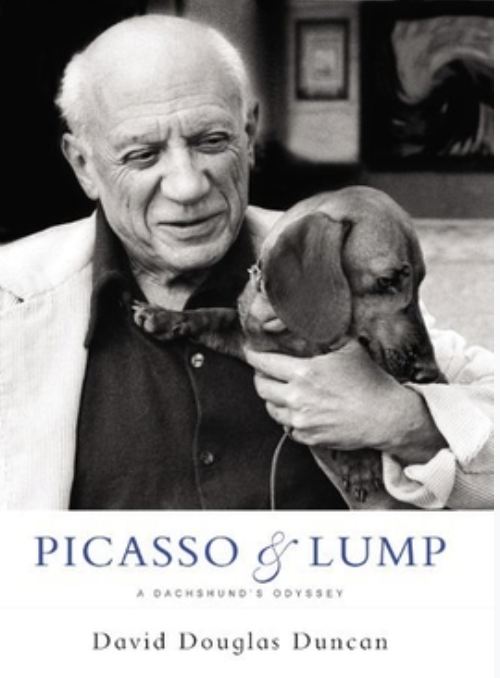
Lump was a dachshund, and he originally belonged to the American photographer David Douglas Duncan.
Duncan was photographing Picasso at La Californie in 1957 when Lump became part of the household. The friendship between Picasso and the little dog has since acquired its own mythology, but in this case there is wonderful photographic evidence.
The archive of the Musée national Picasso-Paris contains photographs of Lump at La Californie with Jacqueline, with Picasso’s son Claude and with the household’s other dogs, Jan the boxer and Perro the Dalmatian.
Duncan also photographed Picasso playing with Lump. [7] One photograph is particularly delightful. On 19 April 1957, Duncan photographed Picasso drawing Lump onto a ceramic plate intended specifically for the dachshund. [8]
It is a small detail, but a revealing one. Picasso’s creative world did not stop when he left the studio because, at La Californie, he never really left the studio. Paintings, furniture, food, animals and family life all occupied the same space.
Apparently even the dog’s dinner could become a Picasso.
Fame comes to the gate
La Californie offered Picasso privacy, but only up to a point.
By the late 1950s, he was no longer simply famous within the art world. He had become a public character, photographed almost like a film star. The Musée Picasso Paris records that curious tourists gathered outside the gates of La Californie during the summer, while photographers, writers, artists and friends moved through the house. [1]
Picasso also knew perfectly well how to play Picasso. The striped shirts, the bare torso, the mischievous expressions, the artist surrounded by ceramics and animals — photographers created an enduring image of the Mediterranean genius, but Picasso was hardly an unwilling participant.
That celebrity generated stories of its own. One of the most repeated has Picasso paying restaurant bills with a drawing on a napkin and refusing to sign it because, in one version, he was paying for dinner rather than buying the restaurant. It’s an excellent Picasso story.
Unfortunately, it exists in so many forms and with so little reliable documentation that it belongs more safely to Picasso mythology than Picasso biography.
The fact that people believed it is perhaps more interesting. By then, a few lines and a Picasso signature really could be worth considerably more than dinner.
The difficult business of Picasso and women
Any contemporary account of Picasso runs into a problem that older biographies often preferred to avoid. What do we do with the women?
For decades, art history conveniently called them muses. One woman followed another and a new stylistic period began. It made Picasso’s private life sound almost like a particularly efficient system for organising a catalogue raisonné. Reality was considerably messier.
Fernande Olivier, Olga Khokhlova, Marie-Thérèse Walter, Dora Maar, Françoise Gilot and Jacqueline Roque were not simply faces appearing in Picasso’s work. They were women with careers, families and lives of their own, and Picasso’s relationships with them could be intensely unequal.
He could be charismatic, playful and generous. He could also be possessive, manipulative and cruel. Gilot’s later account was particularly damaging to the comfortable mythology surrounding him because she described the man behind the celebrated artist — and because she was one of the few women who chose to leave.
There is a danger in correcting the old mythology by creating a new, equally simple one in which every Picasso painting becomes evidence against Picasso the man. His work is more complicated than that, and so were the people around him.
But there is equally little reason to polish away the unpleasant parts.
Picasso’s artistic intelligence was extraordinary. His emotional intelligence could be considerably less impressive.
Mougins: privacy at last
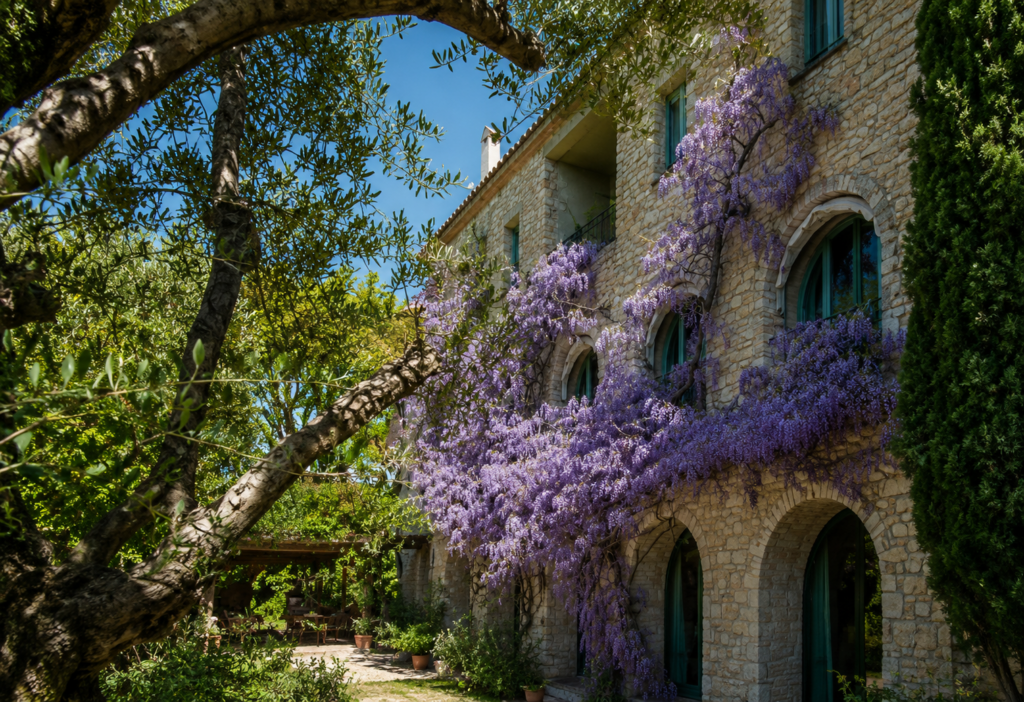
By the early 1960s, the Picasso household was moving away from Cannes. Picasso and Jacqueline used the mas Notre-Dame-de-Vie near Mougins, where he would spend his final years; the Musée Picasso Paris records that he left La Californie permanently for Mougins in 1965. [1][9]
Mougins offered what Cannes increasingly could not: space and distance from the public. Picasso was now in his eighties, but his productivity remained astonishing. After surgery in 1965 and a period of convalescence, he returned to work.
The paintings of his final years became increasingly free, urgent and sometimes deliberately crude. Painters and models, musketeers, sex and references to old masters appear again and again.
There is something almost defiant about this late work. Picasso had become an institution, but he showed remarkably little interest in painting like one.
At Notre-Dame-de-Vie, however, the social world around him became more restricted. Jacqueline increasingly controlled access to the ageing artist and relationships with some members of his family became difficult.
Picasso died there on 8 April 1973, aged 91. He was buried not on the Côte d’Azur but in the grounds of Château de Vauvenargues, near Aix-en-Provence. [1]
What did the Côte d’Azur give Picasso?
It is tempting to answer: the light. Artists are always supposed to have come to the south of France for the light.
For Picasso, that is much too simple. The Côte d’Azur gave him possibilities. Antibes offered a château in which to work immediately after the war. Vallauris gave him clay, traditional knowledge and craftsmen who allowed him to explore an entirely new medium. La Californie gave him large rooms that could become both home and studio. Mougins eventually gave him the privacy that fame had made increasingly difficult.
The Mediterranean mattered culturally too. Pottery, bulls, mythology, bodies and the sea connected naturally with imagery Picasso had known since his childhood in Spain. The Musée Picasso Paris describes the Mediterranean of southern France not simply as a place where he lived, but as a place of extraordinary artistic production. [1]
Picasso did not come to the Riviera to retire. He came here and found more things to do.
Four places, four Picassos
Following Picasso along the Côte d’Azur today tells a story that a conventional museum retrospective cannot quite reproduce.
In Antibes, we find the artist emerging from war and rediscovering the Mediterranean. In Vallauris, he discovers ceramics, raises a young family and becomes both political figure and local celebrity. At La Californie, house and studio merge while Picasso himself becomes almost impossibly famous. And at Notre-Dame-de-Vie in Mougins, the gates begin to close while the work continues inside.
The geography matters because Picasso did not simply make art on the Côte d’Azur. He lived differently here, and as his life changed, his work changed with it.
Perhaps that is what makes the Riviera years so revealing. They contain the Picasso we admire and the Picasso we may find considerably harder to like — often in exactly the same room.
Picasso on the Côte d’Azur in brief
Where did Picasso live on the Côte d’Azur?
Picasso’s principal Côte d’Azur locations were Antibes, Vallauris, Cannes and Mougins. He worked in the Château Grimaldi in Antibes in 1946, lived in Vallauris during his ceramic period, moved to Villa La Californie in Cannes in 1955 and spent his final years at Notre-Dame-de-Vie near Mougins. [1][2][3]
Why is Picasso associated with Antibes?
Picasso used part of the Château Grimaldi as his studio in 1946. He left dozens of works there, and the château later became the Musée Picasso, the first museum devoted to Picasso during his lifetime. [2]
Why did Picasso live in Vallauris?
Vallauris had a long pottery tradition. Picasso’s contact with the Madoura workshop led to an intense period of experimentation with ceramics. He settled there with Françoise Gilot and their family and also created the monumental War and Peace for the town. [3][5]
Where was Picasso’s house in Cannes?
Picasso lived at Villa La Californie, a Belle Époque villa in the hills above Cannes. He turned its large reception rooms into studios, and the house itself repeatedly appeared in his work. [1][6]
Did Picasso have a dachshund?
Yes. Lump, a dachshund associated originally with photographer David Douglas Duncan, lived with Picasso at La Californie. Photographs preserved by the Musée national Picasso-Paris document Picasso and Lump together in Cannes in 1957. [7][8]
Who were Françoise Gilot and Jacqueline Roque?
Françoise Gilot was a French painter and Picasso’s partner during much of his early post-war Riviera period. They had two children, Claude and Paloma, and separated in 1953. Jacqueline Roque met Picasso through Madoura in Vallauris, later became his second wife and shared the final decades of his life. [1]
Was Picasso a communist?
Yes. Picasso officially joined the French Communist Party in 1944 and remained a member until his death. His political engagement is reflected in works including War and Peace in Vallauris. [4][5]
Where did Picasso die?
Pablo Picasso died at Notre-Dame-de-Vie in Mougins on 8 April 1973, aged 91. He was buried at Château de Vauvenargues near Aix-en-Provence. [1][9]
Sources & further reading
[1] Musée national Picasso-Paris — The Mediterranean Years
Picasso’s relationships with Françoise Gilot and Jacqueline Roque, La Californie, Vauvenargues and his Mediterranean artistic production. Musée Picasso Paris
Musée Picasso Paris – The Mediterranean Years
[2] Ville d’Antibes — Musée Picasso
Official history of Picasso’s 1946 studio at the Château Grimaldi and the works he left to Antibes. Antibes Juan-les-Pins : Site Internet
Musée Picasso Antibes – history of the museum
[3] Musée national Pablo Picasso – La Guerre et la Paix — Picasso, les années Vallauris
Picasso’s life at La Galloise with Françoise Gilot, Claude and Paloma and the artistic circle around him in Vallauris. Musées Nationaux Alpes-Maritimes
Picasso – the Vallauris years
[4] Musée national Picasso-Paris — Picasso and the French Communist Party
The museum records Picasso’s official adherence to the French Communist Party in 1944; later museum documentation confirms that he remained a member until his death. Musée Picasso Paris
[5] Musée national Pablo Picasso – La Guerre et la Paix
Museum documentation on Picasso’s monumental War and Peace cycle in Vallauris. Musées Nationaux Alpes-Maritimes
[6] Musée national Picasso-Paris — L’Atelier de La Californie
Documentation of the Belle Époque villa, Picasso’s studio and the extraordinary accumulation of paintings and objects photographed there. Centre d’Études Picasso
Musée Picasso Paris – La Californie
[7] Musée national Picasso-Paris — David Douglas Duncan photographic archive
Photographic evidence of Picasso playing with Lump at La Californie in Cannes in 1957, alongside further archive photographs documenting Lump as part of the household. Centre d’Études Picasso
[8] Musée national Picasso-Paris — Pablo Picasso dessinant Lump dans une assiette
David Douglas Duncan’s photograph of Picasso decorating a plate for Lump at La Californie on 19 April 1957. Centre d’Études Picasso
See the Musée Picasso archive record of Picasso and Lump
[9] Musée national Picasso-Paris — Picasso. Obstinément méditerranéen
Museum documentation on Picasso’s move to Notre-Dame-de-Vie in Mougins and his death there on 8 April 1973.