

E 1027: The modernist masterpiece by Eileen Gray
E-1027 – Eileen Gray’s House for Modern Living
On a steep hillside above the Mediterranean in Roquebrune-Cap-Martin stands one of the most remarkable modernist houses on the Côte d’Azur. Built between 1926 and 1929, E-1027 was conceived by Eileen Gray with Jean Badovici as a house in which architecture, furniture and everyday life formed a single whole. Its later history — involving Le Corbusier, a series of controversial murals and the long underestimation of Gray’s role in modern architecture — has made the story of E-1027 almost as extraordinary as the house itself. [1][2]
From the coastal path at Roquebrune-Cap-Martin, E-1027 can seem surprisingly modest. There is no monumental entrance. No imposing driveway. No ornamental garden announcing the status of its owner.
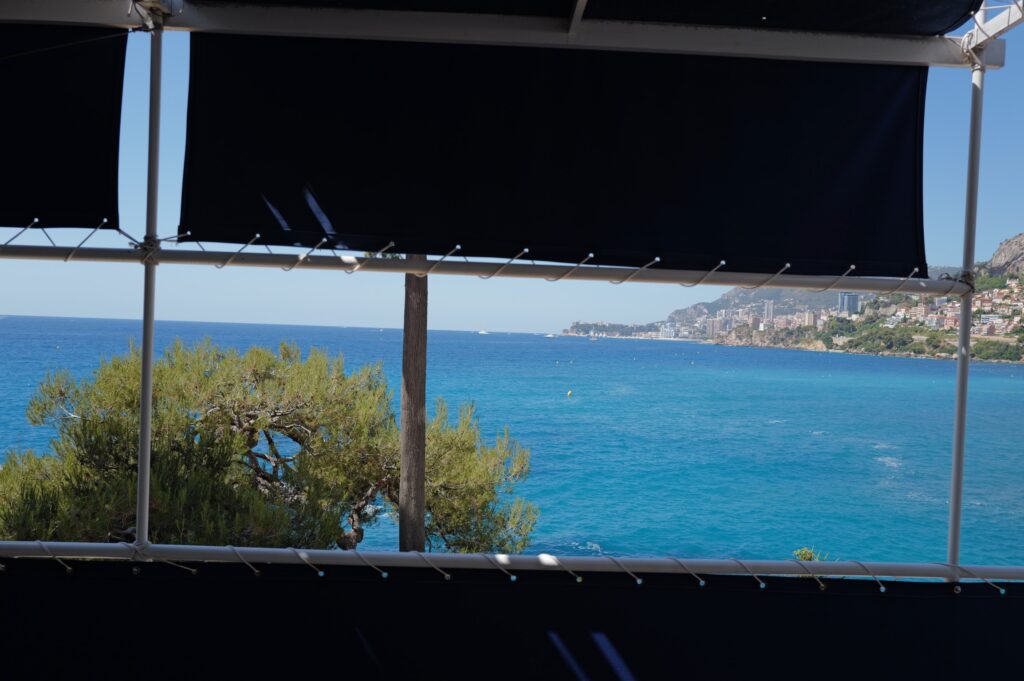
Instead, a white geometric building occupies the steep slope above the Mediterranean. Part of it is raised from the ground; long horizontal windows and terraces look towards the sea.
At first glance, E-1027 appears to possess many of the characteristics we now associate with early modernism. But look more closely and the house becomes something rather different. Because Eileen Gray was interested not simply in what a modern house should look like.
She wanted to know how a modern house should be lived in. That distinction is at the heart of E-1027. And it helps explain why this relatively small house on the Côte d’Azur has become one of the most intriguing buildings in twentieth-century architecture.
A Radical House on the Riviera
E-1027 appeared at a decisive moment in European architecture. During the 1920s, architects and designers were trying to leave the nineteenth century behind. Historic ornament was disappearing. New materials, new construction techniques and a fascination with machines offered the possibility of creating an entirely different architecture.
Cars, aeroplanes and ocean liners became symbols of modernity.
Houses became lighter and more rational. Flat roofs, pilotis, horizontal windows and open plans entered the architectural vocabulary.
E-1027 belongs unmistakably to that movement. The French Ministry of Culture notes its relationship to the principles of modern architecture associated with Le Corbusier.
Yet it also points to something that makes the house different: Gray placed unusual emphasis on the interior, comfort and the wellbeing of its inhabitants. [1] That difference would prove fundamental. For Gray, architecture did not begin with a façade. It began with the person inside it.
Eileen Gray: An Unlikely Architect
Eileen Gray was born in Ireland in 1878 and moved to Paris in the early twentieth century. She did not begin her career as an architect. Nor did she receive the conventional architectural education that many of the men who would become leading figures of modernism had received.
Gray trained as an artist and became particularly accomplished in lacquer work. In Paris she developed a reputation for sophisticated interiors and furniture, combining craftsmanship with increasingly experimental ideas about modern design.
By the 1920s she was an established figure in the decorative arts.
And that background would profoundly influence the way she approached architecture.
Gray understood a room from close range. She understood materials.
She understood furniture. She understood how the height of a table changes the way somebody uses it, how a screen can create privacy without requiring a wall and how the position of a window changes the experience of a room.
When she began working on E-1027, she therefore approached architecture almost from the inside out. The furniture would not be added once the building was finished.
The furniture was part of the building.
Who actually designed E-1027: Eileen Gray or Jean Badovici?
It sounds like a simple question. It isn’t.
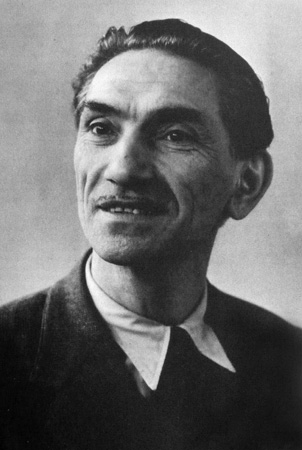
Jean Badovici was a Romanian-born architect and influential architectural critic living in Paris. He was editor of L’Architecture Vivante, an important publication for the emerging modern movement, and was well connected within Europe’s architectural avant-garde.
Gray and Badovici had a close personal and professional relationship. In 1926 they began developing the house at Roquebrune-Cap-Martin.
French heritage records name both Badovici and Gray in connection with E-1027, but describe the house as having been built by Gray with a more occasional contribution from Badovici. The Centre Pompidou, meanwhile, points explicitly to the complicated shared authorship of the project: Badovici was the architect in whose name the land was acquired, while Gray financed the project and played the central creative role in its conception, interiors and furnishings. [1][3]
That complexity matters.
Badovici brought architectural knowledge, connections and a sophisticated understanding of the modernist debate. Gray brought a highly developed design language and an obsessive interest in the relationship between architecture and everyday life.
Rather than trying to remove Badovici from the story, it is more interesting to recognise what E-1027 reveals about authorship itself.
Architecture is rarely produced by one person in complete isolation.
But history has not always been equally good at remembering everyone involved.
What does the name E-1027 mean?
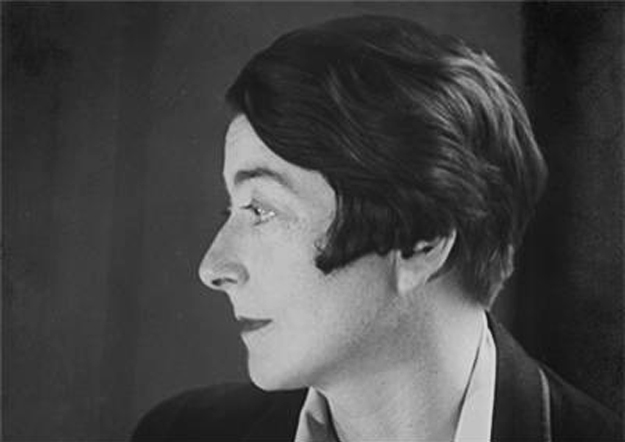
Even the name records their relationship.
E stands for Eileen.
10 represents J, the tenth letter of the alphabet, for Jean.
2 represents B, for Badovici.
7 represents G, for Gray.
The two names are literally woven together. The Centre Pompidou describes the code as a symbol of the close but difficult-to-decipher partnership between Gray and Badovici during the creation of the house. [2]
In hindsight, the name seems almost prophetic. Because the question of who should receive credit for E-1027 would follow the house for much of the twentieth century.
A Difficult Plot Above the Mediterranean
The site was spectacular, but difficult. Gray and Badovici chose a steep piece of land facing the Mediterranean at Roquebrune-Cap-Martin, between Monaco and Menton.
The house was conceived as a holiday home for Badovici. The original brief described a house for a man who enjoyed working, sport and receiving friends. [2]
That sentence sounds simple. Gray treated it as an architectural programme. If somebody works at home, where does he sit? If friends stay, how can they have privacy? Where are their clothes stored? How do people move between sleeping, eating, bathing and outdoor spaces? How does the house respond when the Mediterranean sun becomes too strong? Where can someone read? Where can a guest put down a glass? E-1027 grew out of questions like these.
Modernism on Human Terms
The modernist movement was full of grand ideas. The house could be rationalised. Domestic life could be reorganised. New materials could liberate architecture from the past.
Gray shared much of that enthusiasm. But she distrusted architecture when theory became more important than the person who had to live inside it. At E-1027, modernism is therefore constantly moderated by human needs. Privacy matters. Comfort matters. Shade matters. Storage matters. A place to put a book matters. The ability to alter a room matters.
This produces an architecture that is modern without being doctrinaire. Gray was not designing an abstract manifesto. She was designing behaviour.
A House Designed from the Inside Out
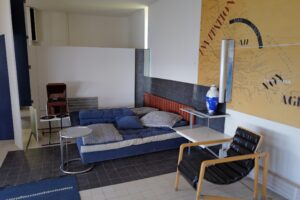
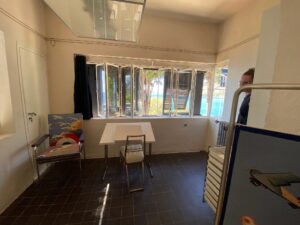
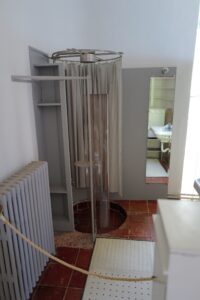
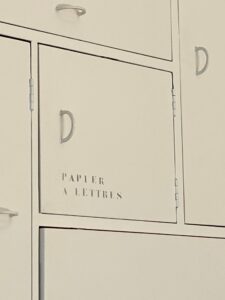
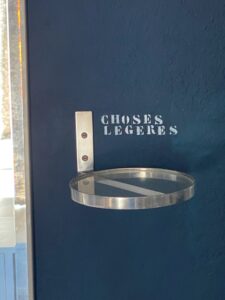
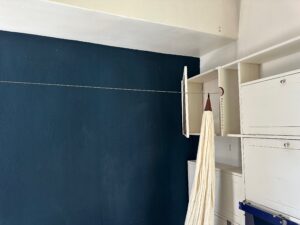
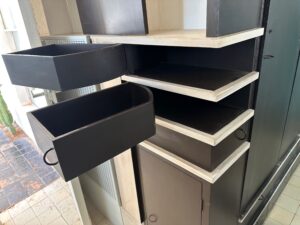
Look closely and the house becomes a catalogue of small solutions. Screens and curtains can change the degree of privacy. Cupboards are integrated into walls. Furniture performs several functions. Rooms can adapt to different uses. Storage appears exactly where it is required.
Gray paid attention to circulation: not merely how someone enters a room, but what they encounter when they do. She considered sightlines and privacy. A guest should not automatically see everything. A person in bed should be able to reach what they need. Sunlight should enter where desirable but be controlled where it becomes uncomfortable.
It is architecture at the scale of the human hand. And that is one reason E-1027 can feel remarkably contemporary almost a century after it was built.
Which furniture did Eileen Gray design for E-1027?
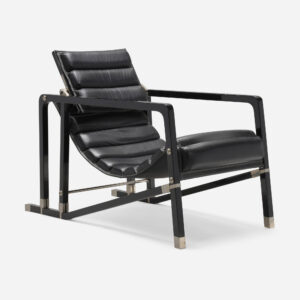
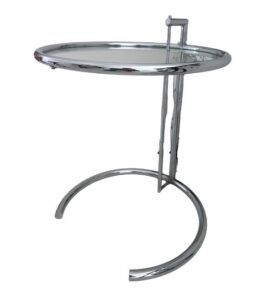
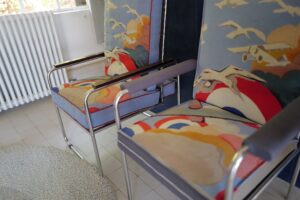
Some pieces created for the villa eventually became icons of twentieth-century furniture design. The Centre Pompidou collection contains several original objects from E-1027, including chairs, tables and a remarkable combined dressing table and screen. [3][4]
The best-known design associated with the house is the E-1027 adjustable table. Its circular glass top can be raised or lowered. The object is light, movable and adaptable — exactly the qualities Gray valued throughout the house.
Another famous design is the Transat chair, whose name refers to the reclining chairs of transatlantic ocean liners. The maritime reference is appropriate. Ships fascinated modernist architects and designers because every square metre aboard had to work efficiently. Furniture could not simply occupy space; it had to justify it. Gray translated that economy into domestic design. Yet her furniture never feels merely mechanical. That is an important distinction. For Gray, function and comfort were not enemies.
No Detail Too Small
Because Gray designed them as one system. At E-1027, asking where architecture stops and furniture begins is surprisingly difficult.
A cupboard can become a wall. A screen can create a room. A table changes the way a bed is used.
A piece of furniture controls movement through a space. This was not interior decoration in the conventional sense. Gray was effectively designing an environment.
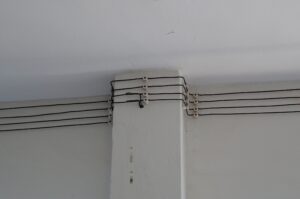
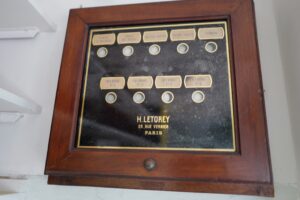
The French Ministry of Culture specifically notes the modern materials used in the interior and furniture: aluminium, steel cable, fibre cement, sheet metal and other industrial materials appear alongside more familiar domestic finishes. [1]
A House in Conversation with the Sea
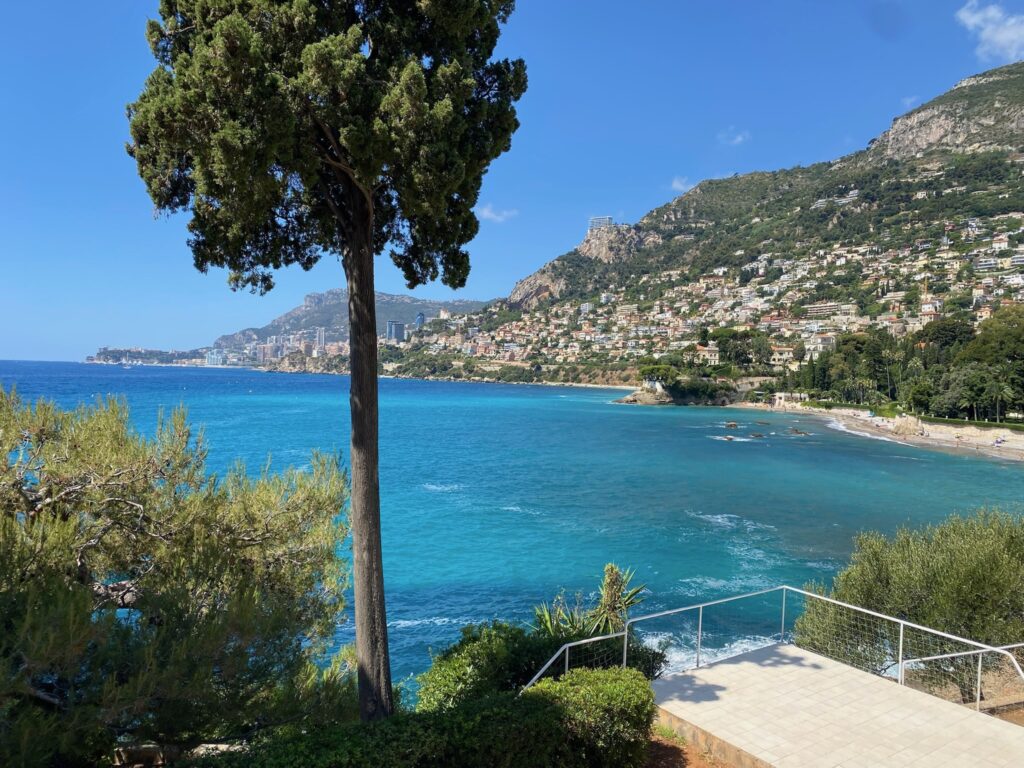
E-1027 could not simply be moved to another site. The Mediterranean is part of the architecture.
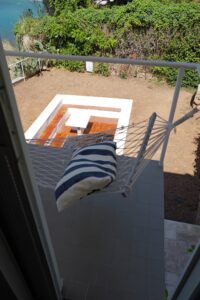
Gray studied the steep terrain, sunlight, views and relationship between interior and exterior. Terraces extend living spaces outside.
Windows frame particular views. Openings allow light and air into the house.
But Gray did something more subtle than simply pointing every room towards the sea. Sometimes the Mediterranean is revealed. Sometimes it is framed. Sometimes the architecture deliberately protects the inhabitant from it. That restraint is important.
Anyone who builds on the Côte d’Azur faces the temptation to make the view the entire architecture.
Gray understood that a beautiful view can also overwhelm a house.
E-1027 is therefore not simply open to the Mediterranean. It negotiates with it.
Then Le Corbusier Arrived
This is where the story changes.
Jean Badovici knew Le Corbusier, who by the late 1920s was becoming one of the dominant figures of European modern architecture. Badovici had published his work and moved within the same architectural circles.
Le Corbusier became a visitor to E-1027. But he did not design it.
This distinction is important because his later connection to the site became so strong that E-1027 has sometimes been incorrectly associated with him as its architect.
The official French heritage record identifies Gray and Badovici as the designers. [1] Le Corbusier’s most controversial contribution came later. He painted on the walls.
The Murals Gray Never Wanted
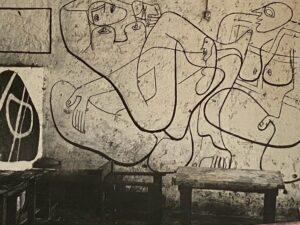
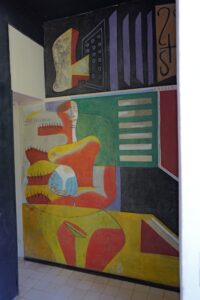
In 1938, several years after Gray had left the villa, Le Corbusier stayed at E-1027 and began painting murals on its white walls. He returned in 1939 and added more.
According to Cap Moderne, Badovici encouraged the work. In total Le Corbusier created a series of murals in and around the house, although not all survive today. [5]
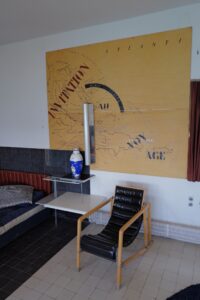
From Le Corbusier’s perspective, they were artworks. From the perspective of Eileen Gray’s carefully controlled interior, the situation is more complicated. The walls were not neutral surfaces waiting for decoration.Their whiteness formed part of Gray’s architectural composition. Le Corbusier’s large, colourful and figurative murals therefore fundamentally changed the character of the spaces.
Did Eileen Gray approve Le Corbusier’s murals?
No. Everything we know suggests quite the opposite.Cap Moderne notes, with some understatement, that according to her biographers she “didn’t think much of these paintings”. [5]
Other accounts of Gray’s reaction are considerably stronger. Drawing on the work of her biographers, architectural historians have described her as furious at the intervention and report that she regarded what Le Corbusier had done as an act of vandalism — a violation of a house in which the white walls were an integral part of the architecture.
That distinction matters.
Le Corbusier had not simply hung paintings in E-1027. He had painted directly onto surfaces that Gray had deliberately designed as part of a carefully controlled interior. His large, colourful, figurative compositions fundamentally altered spaces conceived around restraint, light and precisely calibrated relationships between furniture, walls and views.
There is another detail that has made the episode almost legendary: Le Corbusier painted the murals while naked, something documented in surviving photographs. Why he did it remains open to interpretation.
Was it an artistic tribute to a house he greatly admired? Was it an attempt to leave his own mark on another designer’s architecture? Or, as some later historians have argued, did the intervention reflect something more competitive — an inability to leave untouched an important modernist house created principally by a woman?
We cannot know Le Corbusier’s motives with certainty. What we can say is that Gray did not regard the murals as an improvement to her work.
And that makes the episode much more than an anecdote in the history of E-1027. It raises a question that remains surprisingly modern:
Where does artistic intervention end — and appropriation begin?
The Persistent Le Corbusier Myth
No. Le Corbusier did not design Villa E-1027.
Eileen Gray and Jean Badovici created the house between 1926 and 1929. Le Corbusier’s murals date from almost a decade later. [1][5]
His architectural presence at Cap Martin came later still.
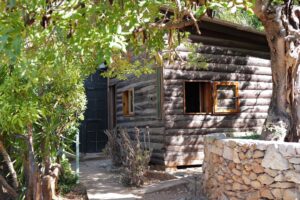
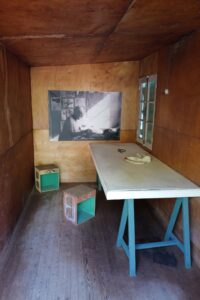
In 1952 he built his tiny Cabanon nearby, adjoining L’Étoile de Mer, the restaurant of his friend Thomas Rebutato.
The Cabanon measures only around sixteen square metres, yet contains an extraordinarily considered interior based on Le Corbusier’s ideas about proportion and minimum living space. [6]
Le Corbusier spent many summers there. He died in 1965 while swimming off Roquebrune-Cap-Martin. His connection with the site became so powerful that the architectural history of this small stretch of coast increasingly revolved around him. And Eileen Gray’s house risked becoming part of the Le Corbusier story.
War, Neglect, MURDER and Near Destruction
For a house designed with such extraordinary precision, E-1027 had a remarkably turbulent afterlife.
By the time the villa finally received full protection as a historic monument in 2000, it had survived war, occupation, gunfire, neglect, the dispersal of its furniture and even a murder.
What happened to E-1027 during the Second World War?
The first serious damage came during the Second World War. The Côte d’Azur did not escape occupation. After the Italian occupation of south-eastern France in 1942, Roquebrune-Cap-Martin came under Italian control. Following Italy’s armistice with the Allies in September 1943, German forces took over the area. E-1027 was occupied by soldiers during this period.
The contrast could hardly have been greater. A house conceived by Eileen Gray around privacy, comfort and the precise rituals of everyday life had become a military billet. And the occupation left physical traces.
German soldiers reportedly used parts of the villa for target practice. Bullet holes were left in the building and one of Le Corbusier’s murals was damaged by gunfire.
There is a strange irony here.
Gray had strongly objected to Le Corbusier painting directly onto the white walls of E-1027 only a few years earlier. During the war, those same walls — including his controversial artwork — became targets.
The war affected Gray’s work elsewhere as well. Her own house, Tempe à Pailla, in nearby Castellar, was looted and damaged, and she lost furniture, drawings and other possessions during the conflict. The Second World War therefore left more than a passing mark on E-1027. It damaged the house physically while also contributing to the loss of part of the wider body of work surrounding its creator.
What happened to E-1027 after the war?
The end of the war did not mean the beginning of a secure future for the villa.
Jean Badovici remained the owner of E-1027 until his death in 1956. By then, however, something else was happening. Eileen Gray was gradually disappearing from the story of her own house.
Le Corbusier’s international reputation was growing enormously, and his presence at Cap Martin — his murals at E-1027, his nearby Cabanon and his regular summers on the coast — increasingly dominated the architectural narrative of the site.
Gray, who built relatively little and had never cultivated the public persona of Le Corbusier, became far less visible. The house itself passed through different hands. Its contents were dispersed. Furniture that Gray had designed specifically for individual rooms was removed and sold. Some pieces eventually entered museum collections or resurfaced on the international design market.
This mattered because E-1027 had never been conceived as an empty architectural shell filled with furniture afterwards. Gray had designed the building, its interiors, its storage and its furniture as a single environment.
As those elements were separated, part of the original idea of E-1027 disappeared with them.
How badly did E-1027 deteriorate?
During the second half of the twentieth century, the condition of the villa declined. Its seaside location did not help. Concrete, metalwork and finishes suffered, while years of insufficient maintenance gradually affected the building.
By the end of the century, a house that is now regarded as one of the important works of European modernism was in a precarious state.
And its history took an even darker turn.
In 1996, the villa’s owner, Swiss physician Peter Kägi, was murdered inside E-1027.
In the period that followed, the already vulnerable house suffered further neglect, vandalism and occupation by squatters.
The contrast with E-1027’s present status is extraordinary.
Today, Gray’s furniture commands enormous attention, the house is studied by architects and historians around the world and E-1027 is recognised as a landmark of modern architecture. Yet only a few decades ago, the building itself was at genuine risk of being lost.
How was E-1027 finally saved?
By the end of the 1990s, the cultural importance of E-1027 was becoming impossible to ignore. French public authorities and conservation organisations became involved in securing its future. The Conservatoire du Littoral acquired the property in 1999, an important step towards protecting the villa and its exceptional coastal setting.
On 27 March 2000, E-1027, together with its garden and grounds, was classified as a French Monument Historique. [1] But saving the building was only the beginning. Restorers now faced an unusually complicated task.
E-1027 contained several histories at once: Gray’s original architecture and interiors from 1929, Le Corbusier’s later murals, physical traces of wartime occupation and decades of alteration and neglect. Even the controversial murals posed a problem. They had never been part of Gray’s original design and she had strongly objected to them. Yet by the time restoration began, they had themselves become historically important works by one of the twentieth century’s most influential architects. The restoration therefore had to do more than repair a damaged modernist villa.
It had to decide how to preserve Eileen Gray’s E-1027 while acknowledging everything that had happened to the house after she left it.
That difficult balance would shape the long restoration that followed.
When was E-1027 restored?
The restoration developed over many years and formed part of the wider conservation of the Cap Moderne site.
The completed restoration of E-1027 was announced in 2021. The wider ensemble includes Gray’s villa, Le Corbusier’s Cabanon and Unités de Camping, and L’Étoile de Mer. [7]
The restoration was not intended simply to make an old building look new. Its purpose was to recover the architectural logic of Gray’s house and, as far as possible, its 1929 character.
That means understanding details that might otherwise appear insignificant. A colour. A piece of built-in furniture. The position of a screen. The way light falls across a wall. At E-1027, those details are the architecture.
What is Cap Moderne?
Today, E-1027 forms part of a remarkable architectural ensemble at Roquebrune-Cap-Martin.
Known as Cap Moderne, the site brings together several layers of twentieth-century architectural history within a remarkably small area.
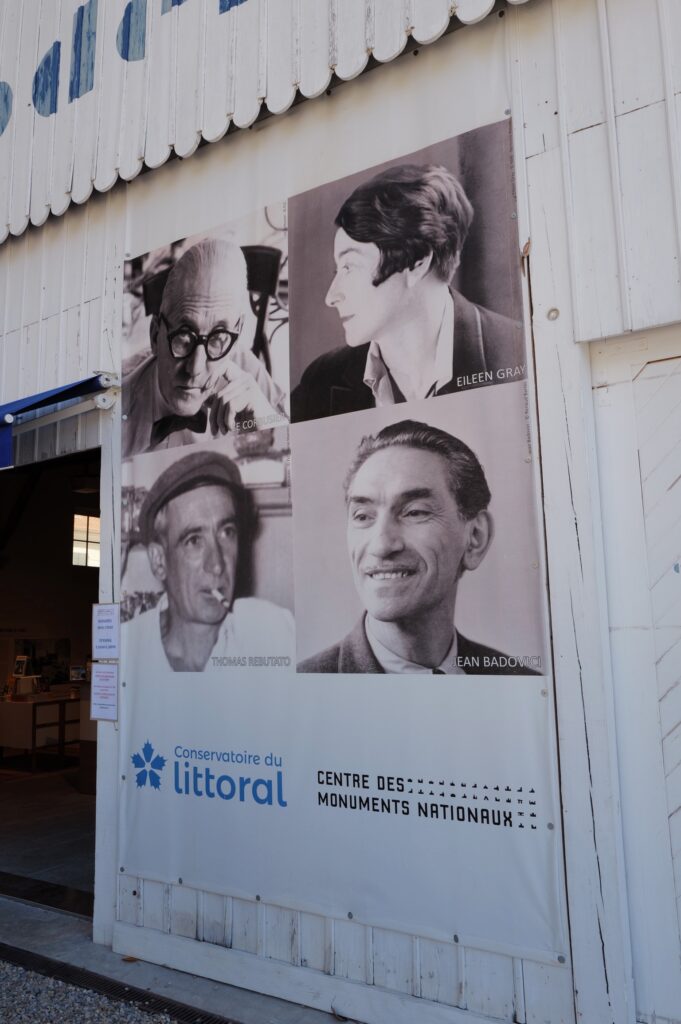
There is Eileen Gray’s E-1027. There is L’Étoile de Mer. There is Le Corbusier’s Cabanon. And there are his Unités de Camping.
What makes the site fascinating is not merely the individual buildings.
It is the conversation between them. Gray’s carefully calibrated house for modern living stands close to Le Corbusier’s experiment in minimum dwelling. Two highly influential approaches to modern architecture occupy the same Mediterranean hillside.
For more information click here.
E-1027 in brief
What is E-1027?
E-1027 is a modernist villa in Roquebrune-Cap-Martin on the Côte d’Azur, created by Eileen Gray with Jean Badovici and built between 1926 and 1929.
The architecture, interior and furniture were conceived as an integrated environment designed around everyday life.
Where is E-1027?
E-1027 stands in Roquebrune-Cap-Martin in the Alpes-Maritimes, on the Mediterranean coast between Monaco and Menton.
Who designed Villa E-1027?
Eileen Gray played the central creative role in the design of E-1027, working with architect and critic Jean Badovici.
French heritage authorities identify both as authors of the villa while describing Gray as its architect and decorator and Badovici’s contribution as more occasional.
Did Le Corbusier design E-1027?
No.
Le Corbusier did not design E-1027. Gray and Badovici created the villa between 1926 and 1929.
Le Corbusier later visited the house and painted murals there beginning in 1938.
What does E-1027 stand for?
The name combines Eileen Gray and Jean Badovici’s names:
E = Eileen
10 = J for Jean
2 = B for Badovici
7 = G for Gray
When was E-1027 built?
E-1027 was built between 1926 and 1929.
Why is E-1027 important?
E-1027 is considered an important example of early modernist architecture because Gray combined modern architectural principles with an unusually detailed concern for comfort, privacy, furniture, storage, sunlight and the daily lives of the people using the house.
What furniture did Eileen Gray design for E-1027?
Gray designed furniture and built-in elements specifically for the villa. Designs associated with E-1027 include her famous adjustable table and Transat chair, as well as chairs, storage, screens, tables and other highly functional objects.
Several original pieces from the villa are now held by the Centre Pompidou.
Why are there Le Corbusier paintings in E-1027?
Le Corbusier was a friend of Jean Badovici and stayed at the villa after Gray had left it. Beginning in 1938, he painted murals on its walls with Badovici’s encouragement.
The murals were not part of Gray’s original design and their presence remains one of the most debated episodes in the history of the house.
Did Eileen Gray like Le Corbusier’s murals?
The murals were not commissioned by Gray. According to accounts cited by Cap Moderne, she did not think highly of them.
Is E-1027 a protected historic building?
Yes. E-1027, its garden and land were classified as a French Monument Historique in 2000.
Has E-1027 been restored?
Yes. A long restoration programme sought to recover Gray’s original architectural conception and the character of the villa as it appeared around 1929. The completed restoration was announced in 2021.
Can you visit E-1027?
Yes. E-1027 can be visited as part of the Cap Moderne site at Roquebrune-Cap-Martin. Access is controlled to protect the buildings, so current visiting times and reservation arrangements should always be checked before travelling.
What else can you see near E-1027?
The Cap Moderne site includes Le Corbusier’s Cabanon, L’Étoile de Mer and the Unités de Camping.
The concentration of Gray’s and Le Corbusier’s work makes this small stretch of coastline one of the most interesting sites for modern architecture on the French Riviera.
Sources & further reading
[1] Ministère de la Culture – DRAC Provence-Alpes-Côte d’Azur
Roquebrune-Cap-Martin – Villa E.1027 – Villa Schelbert.
French official heritage record covering the architects, construction dates, architectural characteristics, Le Corbusier’s paintings and historic-monument protection.
[2] Centre Pompidou
Eileen Gray – La Villa E 1027: un cas unique.
Background on Gray and Badovici’s collaboration, the meaning of the name E-1027, the original programme for the house and its place within Gray’s work.
[3] Centre Pompidou – Collection
Records and research concerning original furniture from Villa E-1027 and the complex question of Gray and Badovici’s respective roles in the project.
[4] Centre Pompidou – Musée national d’art moderne
Collection records for furniture designed by Eileen Gray for E-1027, including original chairs, tables and the coiffeuse-paravent.
[5] Cap Moderne
Villa E-1027 – The affair of Le Corbusier’s paintings.
History of Le Corbusier’s stays at the villa, the murals painted in 1938 and 1939 and their subsequent conservation.
[6] Ministère de la Culture – DRAC Provence-Alpes-Côte d’Azur
Cabanon et site corbuséen du Cap Martin.
Official heritage information on Le Corbusier’s Cabanon and the wider Cap Martin site.
[7] Cap Moderne
Restoration of E-1027.
Documentation concerning the conservation programme and completion of the restoration in 2021.